- DevOps
- July 17, 2026
How a DevOps Services Company in USA Accelerates Digital Transformation
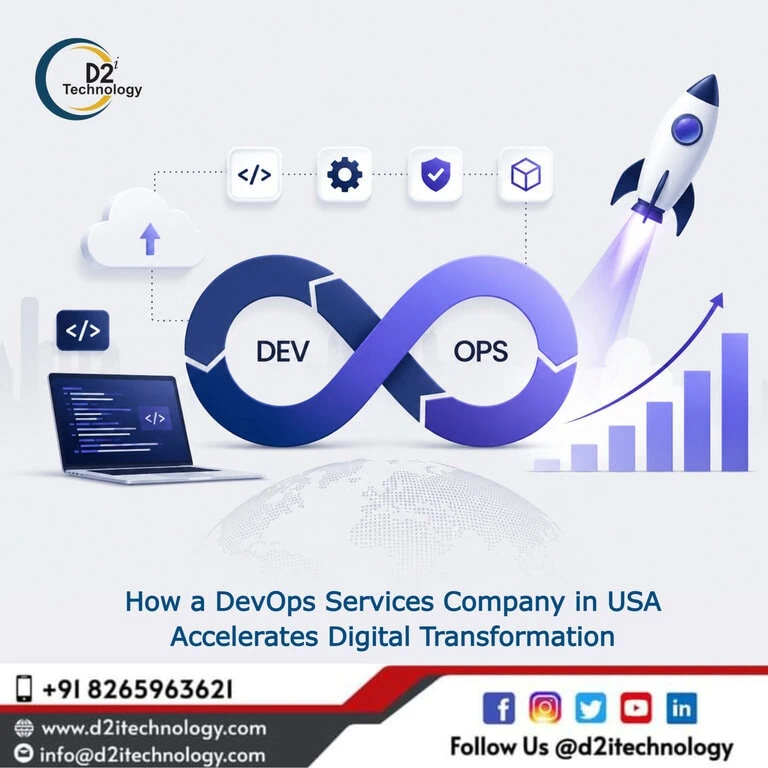
Software teams that ship slowly don’t just frustrate their developers — they lose ground. Releases pile up, bugs accumulate in backlogs, and competitors who’ve invested in better delivery pipelines pull further ahead with every sprint. That’s the practical reality behind why businesses are increasingly turning to a DevOps services company in USA to restructure how their software gets built, tested, and deployed.
DevOps isn’t a single tool or a job title. It’s a way of working — one that collapses the wall between development and operations to create faster feedback loops, more reliable releases, and infrastructure that can actually keep up with business demand. Done right, it changes the rhythm of an entire engineering organization.
What Digital Transformation Actually Requires
The phrase “digital transformation” gets used a lot. What it actually means in practice varies by company — but underneath all the variations, the same technical requirements tend to appear: faster deployment cycles, greater system reliability, tighter security, and the ability to scale without everything breaking.
None of those outcomes happen through good intentions. They require deliberate infrastructure decisions: how code moves from a developer’s machine to production, how environments are provisioned, how incidents are detected and resolved, and how teams collaborate across the development lifecycle.
This is exactly where a professional DevOps services company earns its value. Not by handing you a stack of tools, but by designing a delivery system that fits how your business actually operates.
Core Capabilities That Drive Real Change
CI/CD Pipeline Design and Implementation
Continuous integration and continuous delivery (CI/CD) is the backbone of modern software deployment. When it’s working well, developers merge code frequently, automated tests catch issues early, and deployments happen in minutes rather than days.
Getting there requires more than setting up Jenkins or GitHub Actions. It means thinking through branching strategies, test coverage requirements, environment parity, and rollback procedures. Understanding the business benefits of CI/CD is straightforward — the harder part is implementing it in a way that holds up under real team conditions.
D2i Technology’s DevOps services cover the full pipeline design process, from initial assessment through to production deployment and monitoring setup.
Infrastructure as Code and Cloud Automation
Manual infrastructure provisioning is slow and error-prone. When someone has to click through a cloud console to spin up a new environment, it creates inconsistencies that compound over time — different configurations between staging and production, missing security settings, resources that nobody can account for months later.
Infrastructure as Code (IaC) solves this by treating environment configuration the same way you treat application code: version-controlled, tested, and deployed automatically. Combined with cloud automation, this is what allows teams to scale confidently rather than nervously.
Next-generation DevOps services for cloud automation are helping US businesses move away from fragile manual processes toward infrastructure that provisions itself reliably and repeatably.
Security Integration — DevSecOps
Security that gets bolted on at the end of a development cycle is expensive and incomplete. Vulnerabilities discovered after deployment cost significantly more to fix than those caught during development, and the business risk in between is real.
A mature DevOps services company integrates security into every stage of the pipeline — what the industry calls DevSecOps. This includes automated vulnerability scanning in CI, dependency auditing, secrets management, and access control reviews built into deployment workflows. D2i Technology’s SecOps capabilities extend naturally into the DevOps pipeline, ensuring security isn’t a bottleneck but a built-in quality gate.
Combining this with security testing services and infrastructure-level controls means your releases aren’t just faster — they’re safer.
Monitoring, Observability, and Incident Response
You can’t improve what you can’t see. A significant part of what a DevOps services company does is helping teams gain visibility into how their systems are actually behaving in production.
This means setting up meaningful metrics and dashboards, configuring alerting that signals real problems rather than noise, and establishing runbooks so that when incidents happen, the response is structured rather than chaotic. DORA metrics — deployment frequency, lead time for changes, change failure rate, and time to restore service — give teams a quantitative baseline for measuring how their delivery performance evolves over time.
Containerization and Microservices
Applications that were built as monoliths don’t scale or deploy gracefully. Containerization — typically with Docker and Kubernetes — allows large applications to be broken into independently deployable units, each of which can be scaled, updated, and maintained without touching the rest of the system.
The benefits of combining DevOps with microservices and containerization are well-documented, but the migration path requires careful planning. Moving too fast creates operational complexity; moving too slowly means the benefits stay theoretical.
Why USA-Based DevOps Expertise Matters
Regulatory and Compliance Alignment
US businesses operate under specific compliance requirements — HIPAA, SOC 2, PCI-DSS, and others — that have direct implications for how software is built and deployed. A DevOps services company that understands these frameworks can design pipelines and infrastructure controls that support compliance from the ground up rather than scrambling to retrofit them later.
This is one of the less visible but genuinely important reasons to work with a USA-based DevOps services provider rather than a generic offshore team unfamiliar with the US regulatory landscape.
Communication and Collaboration That Actually Works
DevOps is inherently collaborative. It requires ongoing dialogue between development, operations, product, and often security and business stakeholders. Time zone gaps and language friction slow down that collaboration in ways that compound over time.
DevOps consulting firms in the USA bring the alignment that matters: shared business context, overlapping working hours, and familiarity with the tools and standards US engineering teams already use.
Depth of Toolchain Experience
A capable DevOps services company should be fluent across the major cloud platforms (AWS, Azure, GCP) and the ecosystem of tools that surround them. This includes orchestration platforms, monitoring stacks, secret management systems, artifact registries, and more. If you want to understand the certifications and credentials that signal genuine DevOps expertise, looking for AWS, Azure, and GCP proficiency is a strong starting point.
Common Signs Your Business Needs DevOps Help
Not every organization knows exactly when to bring in a DevOps services partner. Some signals are obvious — frequent production outages, deployment processes that take days, developers spending more time firefighting than building. Others are subtler.
If you’re unsure whether your current setup is holding you back, reviewing the signs that your DevOps approach needs attention is a useful starting point. Similarly, understanding when to consider bringing in a DevOps service can help you time the engagement before problems become crises rather than after.
The future scope of DevOps also points to why this is a long-term investment rather than a one-time fix — platform engineering, AI-assisted operations, and developer experience are all areas where companies that build strong DevOps foundations now will be better positioned over the next several years.
What to Expect When You Engage a DevOps Services Company
A credible DevOps engagement typically starts with an honest assessment. Before recommending anything, a good partner will want to understand your current delivery pipeline, your team structure, your pain points, and your business goals. The output of that assessment becomes the roadmap.
From there, implementation usually happens in phases — high-impact wins first (usually CI/CD improvements and environment stability), followed by deeper automation, observability improvements, and eventually more advanced capabilities like IaC at scale or cloud cost optimization.
If you’re comparing options, exploring what USA-based DevOps services solutions typically include will give you a useful benchmark for evaluating proposals. And if you’re building for the long term, understanding how to gain ongoing value from DevOps investment is worth reading before you sign anything.
Why D2i Technology
D2i Technology brings DevOps practice together with software quality, security, and automation testing services under one roof. That integration matters. DevOps without quality assurance produces fast-failing software. Security without DevOps integration creates compliance bottlenecks. A team that handles all of it cohesively produces something more valuable than the sum of its parts.
With delivery expertise spanning CI/CD pipeline implementation, cloud infrastructure automation, containerization, and integrated security testing, D2i Technology helps businesses in the US build delivery systems that hold up — not just at launch, but as the product and team scale.
Conclusion
Software delivery is a competitive advantage. Organizations that can ship reliably, recover quickly from incidents, and deploy multiple times a day are playing a fundamentally different game than those still managing change requests through manual checklists.
Partnering with a DevOps services company in USA that has the depth, the toolchain fluency, and the business understanding to redesign your delivery system is one of the higher-leverage investments an engineering organization can make. The benefits compound over time — faster teams, more stable systems, and the confidence to move quickly without breaking things.
Frequently Asked Questions
Let's Accelerate Your Delivery Pipeline
D2i Technology helps US businesses design and implement DevOps systems that ship faster, break less, and scale under real-world conditions. Whether you're starting from scratch or modernizing a legacy process, we'll build something that actually works for your team.