- eLearning Accessibility
- November 13, 2026
Top 10 E-learning Software Development Companies: Best EdTech Partners for 2026
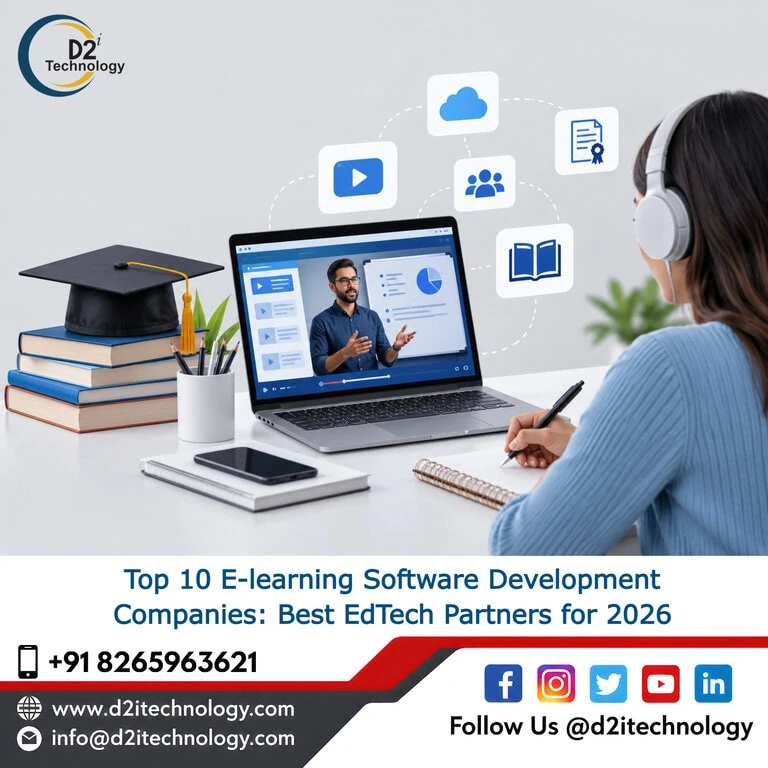
Online learning now sits at the center of how universities teach, how companies train staff and how professionals keep their skills current. Behind every good course or learning platform is a team that understands both technology and how people learn. Choosing between e-learning software development companies means finding a partner that gets both right.
This guide compares ten e-learning software development companies, from custom course specialists to platform builders. We explain who each suits and what to check before you commit, with a particular focus on accessibility, which is often overlooked until it becomes a problem.
A note on transparency: D2i Technology is our own company and appears first. The other nine are well-established names in digital learning, and we have described each one fairly.
What E-learning Software Development Covers
The term covers a wide range of work. Most projects fall into one or more of these areas:
- Learning management systems (LMS): setting up, customizing or building platforms that host courses, track progress and manage users.
- Custom course development: interactive modules, videos, simulations and assessments, often built in tools like Articulate Storyline or Adobe Captivate.
- Mobile learning: apps and responsive courses designed for short sessions on phones.
- Integrations: connecting learning platforms with HR systems, student information systems and single sign-on.
- Learning analytics: dashboards that show completion, performance and engagement.
- Accessibility and remediation: making courses and platforms usable by learners with disabilities.
Standards Every E-learning Partner Should Know
SCORM and xAPI
SCORM packages courses so they run in an LMS and report completion and scores. xAPI goes further, tracking learning activities across apps, simulations and real-world tasks.
LTI
Learning Tools Interoperability lets external tools plug into platforms such as Canvas, Moodle and Blackboard securely, which matters for higher education.
WCAG and Section 508
Accessibility standards apply to learning content just as they do to websites. Public institutions and federal contractors in particular must meet Section 508, and WCAG is the common benchmark. Our guide to Section 508 compliance for e-learning explains what this means in practice.
How We Chose These EdTech Development Companies
We looked at each company’s published work, the types of learning products it builds and the audiences it serves, from corporate training to higher education. We also considered how each one approaches accessibility and learning standards.
Top 10 E-learning Software Development Companies
1. D2i Technology
Services: accessible e-learning development, course remediation, LMS and web app development, accessibility testing
D2i Technology works from Charlottesville, Virginia, and Noida, India. Our accessible e-learning team builds new courses and fixes existing ones, with deep experience in Articulate Storyline accessibility, from focus management to keyboard alternatives for drag-and-drop.
We also build custom learning platforms through our web application development services and test them with screen readers and keyboard-only navigation.
Best for: universities, training providers and companies that need accessible courses and platforms, especially when Section 508 or ADA compliance is required.
2. ELB Learning
Services: custom courses, authoring tools, content libraries, consulting
ELB Learning offers custom course development along with its own authoring tools and asset libraries, giving clients both services and software.
Best for: corporate training teams wanting tools and content from one provider.
3. Allen Interactions
Services: custom learning design, performance-focused training
Allen Interactions is known for its emphasis on meaningful, behavior-changing learning design rather than click-through content.
Best for: organizations that want training tied to measurable performance.
4. SweetRush
Services: custom learning, immersive experiences, learning strategy
San Francisco-based SweetRush creates custom learning programs, including immersive and game-based experiences, for large companies.
Best for: enterprises wanting creative, high-production learning experiences.
5. Infopro Learning
Services: custom content, managed learning services, training outsourcing
Infopro Learning offers content development alongside broader managed learning services for corporate clients.
Best for: companies outsourcing large parts of their training operations.
6. CommLab India
Services: rapid e-learning development, translation, legacy conversion
CommLab India focuses on rapid e-learning, helping organizations produce and update large volumes of courses quickly.
Best for: teams needing fast turnaround on many courses.
7. EI Design
Services: custom e-learning, mobile learning, learning technology consulting
EI Design creates corporate training content and mobile learning solutions for global organizations.
Best for: global companies with mobile-first training needs.
8. Kineo
Services: custom learning, LMS services, off-the-shelf courses
Kineo combines content development with learning platform services and a library of ready-made courses.
Best for: organizations wanting content and platform support together.
9. Raccoon Gang
Services: Open edX development, LMS customization, course creation
Raccoon Gang specializes in Open edX, the open-source platform that originated at Harvard and MIT.
Best for: universities and providers building on Open edX.
10. Learning Pool
Services: learning platforms, content, learning analytics
Learning Pool offers learning platforms, content and analytics for corporate and public sector clients.
Best for: organizations wanting a combined platform and content partner.
Why Accessibility Should Be on Every E-learning Brief
Accessibility problems in e-learning are common because interactive courses rely on drag-and-drop exercises, timed activities, hover effects and video. Each of these can shut out learners who use screen readers, keyboards or captions.
The consequences are real. Under the DOJ’s 2024 ADA Title II rule, public colleges and universities must make web content, including online course materials, meet WCAG 2.1 AA. Federal agencies and contractors face Section 508 requirements. Corporate learners with disabilities may also raise complaints when they cannot complete required training.
Building accessibility in from the storyboard stage is far cheaper than fixing a finished course. When you speak to e-learning software development companies, ask:
- Do you design interactions with keyboard and screen reader users in mind?
- Do you provide captions, transcripts and audio descriptions where needed?
- Do you test courses with real assistive technology before delivery?
- Can you remediate our existing course library?
The accessibility problems we find most often when auditing courses are:
- Drag-and-drop activities with no keyboard alternative.
- A focus order that jumps around the slide or skips content.
- Images and diagrams without meaningful alternative text.
- Videos without captions or transcripts.
- Text and buttons with low color contrast.
- Feedback and timers that screen readers never announce.
Each of these is fixable, and many can be avoided entirely with good storyboarding. Our article on why e-learning accessibility matters goes deeper into the benefits for every learner.
Custom LMS or Existing Platform?
One of the first questions e-learning software development companies will ask is whether you need a custom platform. For most organizations, the answer is no, at least not at first.
Established platforms such as Moodle, Canvas, Open edX and commercial LMS products already handle enrollment, tracking, reporting and standards like SCORM. Customizing and integrating one of them is usually faster and cheaper than building from scratch.
A custom platform makes more sense when:
- Learning is your core product, for example an online academy or certification business.
- You need a learning experience that existing platforms cannot support.
- License costs for a commercial LMS are growing faster than your business.
- You need deep integration with your own product or customer data.
What a Typical E-learning Project Looks Like
Most course development projects follow a similar path:
- Analysis: understanding learners, goals and what they need to do differently after training.
- Design: learning objectives, course structure and storyboards, with accessibility planned in.
- Development: building interactions, media and assessments in the chosen authoring tool or platform.
- Review and testing: content review by subject experts, plus functional, device and accessibility testing.
- Launch: publishing to the LMS and checking that tracking and reporting work.
- Evaluation: measuring completion, assessment results and on-the-job impact.
Measuring Whether Learning Works
Completion rates are easy to measure but say little about impact. Ask e-learning software development companies how they help you measure what matters: improved assessment scores, fewer errors on the job, faster onboarding or better customer feedback. xAPI data and learning analytics dashboards can help connect training to these outcomes.
How to Choose Between EdTech Development Companies
Decide: Platform, Content or Both?
Some partners focus on building and customizing learning platforms, others on creating course content. Be clear about which you need.
Check Standards Experience
Ask about SCORM, xAPI and LTI experience with your specific LMS. Small compatibility issues can cause big reporting problems.
Look at Learning Design Quality
Ask to try sample courses yourself. Are they engaging, clear and focused on real skills, or just slides with a “Next” button?
Ask Which Authoring Tools They Use
Many e-learning software development companies build courses in Articulate Storyline, Rise, Adobe Captivate or similar tools. Each has different strengths for interactivity, mobile support and accessibility. Make sure the tool suits your needs and that your own team can make small edits later if needed.
Plan for Updates
Course content goes out of date. Make sure you receive editable source files and that updates are simple.
Test on Real Devices
Learners use phones, tablets and older laptops. Ask how courses are tested across devices and browsers.
Final Thoughts
The best e-learning software development companies combine sound learning design with reliable technology and a genuine commitment to accessibility. Content specialists bring creativity, platform specialists bring technical depth, and full-service partners can help with both.
If you need accessible courses, course remediation or a custom learning platform, D2i Technology would be glad to help. Our e-learning accessibility audit checklist is a practical place to start reviewing your existing courses.
Frequently Asked Questions
Make Your Learning Platform Work for Every Learner
D2i Technology builds e-learning software and remediates courses so they are engaging, standards-compliant and accessible. Tell us about your platform or course library, and we will help you plan the right approach.