- Web Accessibility
- September 9, 2026
ASDLC vs Traditional SDLC: What’s Different?
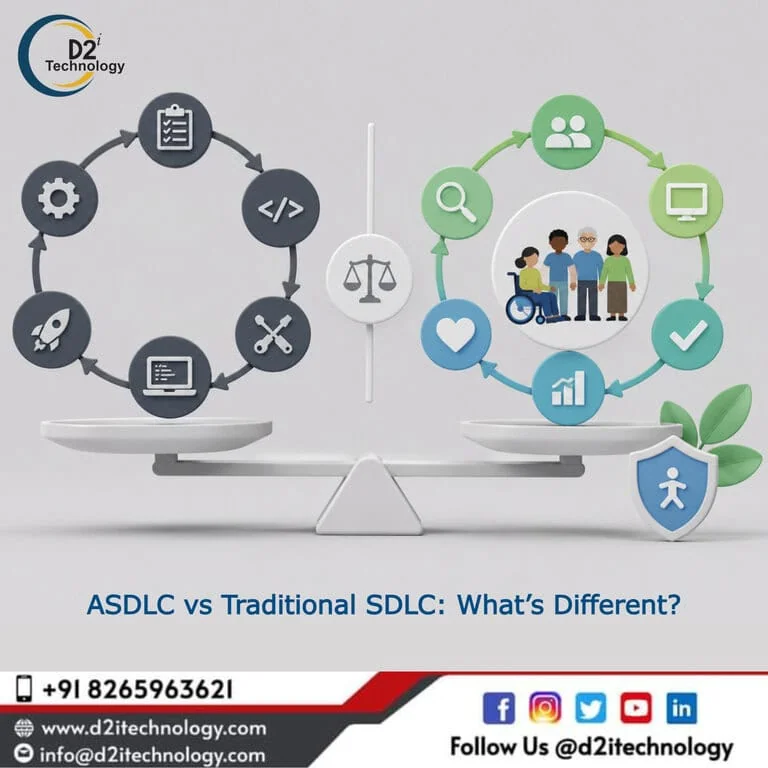
Software development lifecycles aren’t all the same — they differ in what they prioritize, what they verify at each stage, and what quality dimensions are treated as non-negotiable versus optional enhancements. When comparing ASDLC vs Traditional SDLC, the fundamental distinction is straightforward but consequential: a traditional SDLC treats accessibility as a post-development concern, addressed through audits after software ships. An Accessible SDLC (ASDLC) treats accessibility as a quality dimension built into every phase — with the same status as functional correctness, security, and performance. The difference shows up in what gets specified, what gets reviewed, what gets tested, and what gets documented throughout the development process.
This post maps those differences phase by phase: what each approach looks like, what gaps the traditional approach leaves that ASDLC closes, and where the practical benefits of the accessibility-first model actually accrue.
Understanding the Two Models
Traditional SDLC and Accessibility
In the traditional SDLC model, accessibility doesn’t typically appear until late in the development cycle — often as a separate workstream initiated after development is functionally complete. The pattern is familiar: the product is built, a penetration test and performance test run before release, and then, sometimes, an accessibility audit is commissioned. The audit returns a list of violations. Those violations go into the backlog. Some are addressed before the next release; others aren’t, because they’re competing with new feature development. The next audit finds many of the same patterns again.
This isn’t negligence — it’s the outcome of a process that treats accessibility as a quality dimension to be evaluated externally rather than built internally. When accessibility requirements aren’t in the specification, developers don’t implement them. When accessibility isn’t in the definition of done, it doesn’t get verified. When accessibility testing doesn’t run in CI/CD, violations accumulate silently until an audit surfaces them.
Accessible SDLC (ASDLC) and the Accessibility-First Approach
ASDLC restructures where accessibility requirements appear in the development process. Rather than waiting for an audit, accessibility requirements are included in feature specifications, verified at design stage, integrated into the CI/CD pipeline, and checked in QA before any feature is considered complete. The audit that happens periodically in ASDLC finds fewer issues — because the development process has been catching and preventing them throughout.
What a web accessibility checklist should include across the development process and what the best practices for web accessibility audits actually look like provide useful reference frameworks for understanding what ASDLC’s accessibility practices should cover.
Phase-by-Phase Comparison
Planning and Requirements
Traditional SDLC: Business and functional requirements are gathered and documented. Accessibility requirements, if mentioned at all, appear in a separate accessibility policy document that developers are expected to know about and follow. In practice, the policy isn’t referenced during feature specification, and no specific accessibility criteria appear in user stories.
Accessible SDLC: Accessibility acceptance criteria are part of every user-facing feature specification — specific, testable, and attached to the feature they apply to. A feature for a multi-step form includes acceptance criteria for field labeling, error announcement, keyboard operability, and form submission feedback. A feature for an interactive dashboard includes criteria for keyboard navigation, screen reader announcements for dynamic data updates, and focus management when new content loads.
The gap this closes: Requirements that aren’t written don’t get implemented. ASDLC’s planning-phase accessibility requirements ensure that developers have a specific target, not a vague directive to “follow WCAG.”
Design
Traditional SDLC: Designs are created with visual aesthetics and brand consistency as primary constraints. Color choices are made based on palette, not contrast ratios. Interactive component designs show visual states but don’t specify keyboard behavior or screen reader announcements. Handoff to development includes visual specifications; accessibility behavior is assumed to be figured out during implementation.
Accessible SDLC: Color palettes are verified against WCAG contrast thresholds during design system creation — before any design is finalized. Interactive components are specified with keyboard interaction models and screen reader behaviors alongside visual states. Design system documentation includes accessible component patterns that developers implement rather than invent.
The gap this closes: Accessibility issues that originate in design decisions — color contrast, touch target size, interaction patterns without keyboard equivalents — can only be prevented at the design stage. Catching them during a post-launch audit requires changing deployed code, updated designs, and coordinated testing across every affected instance.
D2i Technology’s free Color Contrast Analyzer supports the design-stage color verification that ASDLC requires, providing real-time contrast ratio feedback during color palette decisions.
Development (Implementation)
Traditional SDLC: Developers implement functional requirements. Accessibility is not explicitly in the specification, so implementations reflect whatever the developer knows about accessibility — which varies widely and typically isn’t comprehensive. Code is committed without accessibility verification. PR reviews check functional correctness and code quality; accessibility isn’t a review criterion.
Accessible SDLC: Developers implement functional and accessibility requirements together, because both are in the specification. Accessibility linting tools flag structural violations as code is written. PR reviews include accessibility acceptance criteria in the review checklist. The CI/CD pipeline runs automated WCAG scanning and fails contributions that introduce high-severity accessibility violations before they can merge.
The gap this closes: Accessibility violations that enter the codebase during development accumulate silently without ASDLC’s development-phase checks. With write-time linting and CI/CD gating, the majority of detectable violations are caught before they merge. The best accessibility testing toolkit available in 2026 covers the specific tools that implement these development-phase checks. D2i Technology’s automation testing services support CI/CD accessibility integration for teams implementing ASDLC.
Testing and Quality Assurance
Traditional SDLC: QA validates functional correctness, performance, and often security. Accessibility testing is either not included or treated as a separate, external process. Screen reader testing and keyboard navigation testing are rarely part of the standard QA cycle unless the team has specific accessibility expertise.
Accessible SDLC: QA includes accessibility verification as a standard part of the release testing cycle: keyboard navigation testing for key user flows, screen reader testing for interactive features and dynamic content, and regression testing for accessibility when shared components change. A feature isn’t cleared for release until its accessibility acceptance criteria are verified, not just assumed to have been addressed during development.
The gap this closes: Automated pipeline checks catch approximately 30–40% of WCAG violations — the ones detectable by scanning code and rendered DOM. The remaining violations — behavioral issues, cognitive accessibility problems, incorrect ARIA announcements — require human testing with real assistive technologies. The difference between manual and automated accessibility evaluation and why both are necessary explains this gap clearly. What the three types of accessibility testing each cover maps the full testing picture.
D2i Technology’s accessibility testing services provide the manual evaluation layer that completes what the automated QA phase begins.
Release and Post-Deployment
Traditional SDLC: Accessibility audits, if they happen at all, occur periodically and typically find substantial numbers of violations that have accumulated since the last audit. Findings require significant remediation effort. The same categories of violations often recur across audit cycles because the development process that created them hasn’t changed. Compliance documentation is either absent or assembled retroactively.
Accessible SDLC: Periodic formal audits happen on a defined schedule, but they find fewer violations because the development process has been catching and preventing them throughout. The audit focus shifts toward complex behavioral issues and the judgment-dependent WCAG criteria that automated tools and standard QA miss — rather than basic structural violations that ASDLC’s earlier checkpoints should have caught. Compliance documentation is maintained throughout development rather than assembled retroactively before an audit.
The gap this closes: Audit findings in ASDLC represent genuine knowledge gaps rather than accumulated negligence. Remediation programs following ASDLC audits address genuinely complex issues rather than basic, preventable violations. What accessibility remediation importance means for organizations and what professional accessibility audit companies provide cover the audit and remediation side of this phase.
The Documentation Difference
One difference between traditional and Accessible SDLC that deserves specific attention is documentation. Compliance with ADA, Section 508, EAA, and SEBI accessibility requirements doesn’t just require conformant software — it requires documented evidence of how conformance was achieved and maintained.
Traditional SDLC produces almost no contemporaneous accessibility documentation. When an audit is commissioned, its findings and any subsequent remediation represent the only accessible record of the accessibility program’s activity.
ASDLC produces documentation throughout:
- Feature specifications that include accessibility acceptance criteria (the record of what was required)
- CI/CD pipeline reports that log automated scan results for every PR (the record of what was checked)
- Sprint review records that include accessibility acceptance criteria verification (the record of what was validated before release)
- Formal audit reports and remediation records at defined intervals (the record of comprehensive evaluation)
This documentation picture is significantly stronger in regulatory contexts where an organization needs to demonstrate good-faith, systematic accessibility effort. How accessibility testing services for ADA Title II and WCAG 2.2 compliance work covers what compliance documentation requires.
The Team Capability Difference
Traditional SDLC creates accessibility expertise bottlenecks. If one team member (or an external consultant) owns all accessibility knowledge, accessibility quality depends entirely on that person’s availability and influence. When that person is unavailable during a critical sprint, accessibility regresses.
ASDLC distributes accessibility capability:
- Developers know enough accessibility fundamentals to implement accessible code and interpret linting tool output
- Designers know the accessibility constraints that apply to design decisions
- QA engineers can perform keyboard navigation and basic screen reader testing
- The team collectively can verify accessibility acceptance criteria in sprint review
This distribution doesn’t eliminate the need for specialized accessibility expertise — it means that expertise is applied to the genuinely complex issues rather than to questions any trained developer should be able to answer. The web accessibility guide written specifically for developers is the kind of resource that supports this distributed capability development.
Why the Accessible SDLC Model Produces Better Outcomes
The outcomes difference between ASDLC and traditional SDLC shows up in three measurable dimensions:
Remediation cost: Violations caught during development cost a fraction of what violations caught in post-launch audits cost to fix. ASDLC’s development-phase accessibility checks shift violations to the cheapest point in the cost scale.
Compliance posture: Organizations with documented, systematic accessibility programs have a stronger regulatory and legal position than those that address accessibility reactively. The documentation trail ASDLC generates is a genuine asset in compliance contexts.
User experience quality: Accessible software is better software. The design constraints that WCAG imposes — sufficient contrast, clear labeling, logical structure, keyboard operability — produce interfaces that are more usable for everyone, not just users who require assistive technology. How web accessibility improvement benefits all visitors and the relationship between web accessibility testing and overall user experience make this case directly.
Conclusion
The comparison of ASDLC vs Traditional SDLC ultimately comes down to when accessibility is treated as a quality dimension that matters. In traditional SDLC, accessibility matters after the product is built — at audit time, under compliance pressure, or after a user complaint. In Accessible SDLC, accessibility matters throughout — in requirements, design, code, CI/CD, QA, and documentation. The quality of the output, the cost of maintaining it, and the strength of the organization’s compliance position all reflect which approach the development team has taken.
D2i Technology supports organizations transitioning from traditional to Accessible SDLC — providing the tooling guidance, accessibility training, testing infrastructure, and formal audit capability that makes the transition real rather than aspirational.
Frequently Asked Questions
Ready to Transition From Traditional SDLC to an Accessibility-First Approach?
D2i Technology helps development teams implement Accessible SDLC practices — from specification templates and CI/CD accessibility integration through certified WCAG audits that validate what automated processes deliver.