- Accessibility Testing
- May 25, 2026
Accessibility Testing Services USA for ADA Title II & WCAG 2.2 Compliance
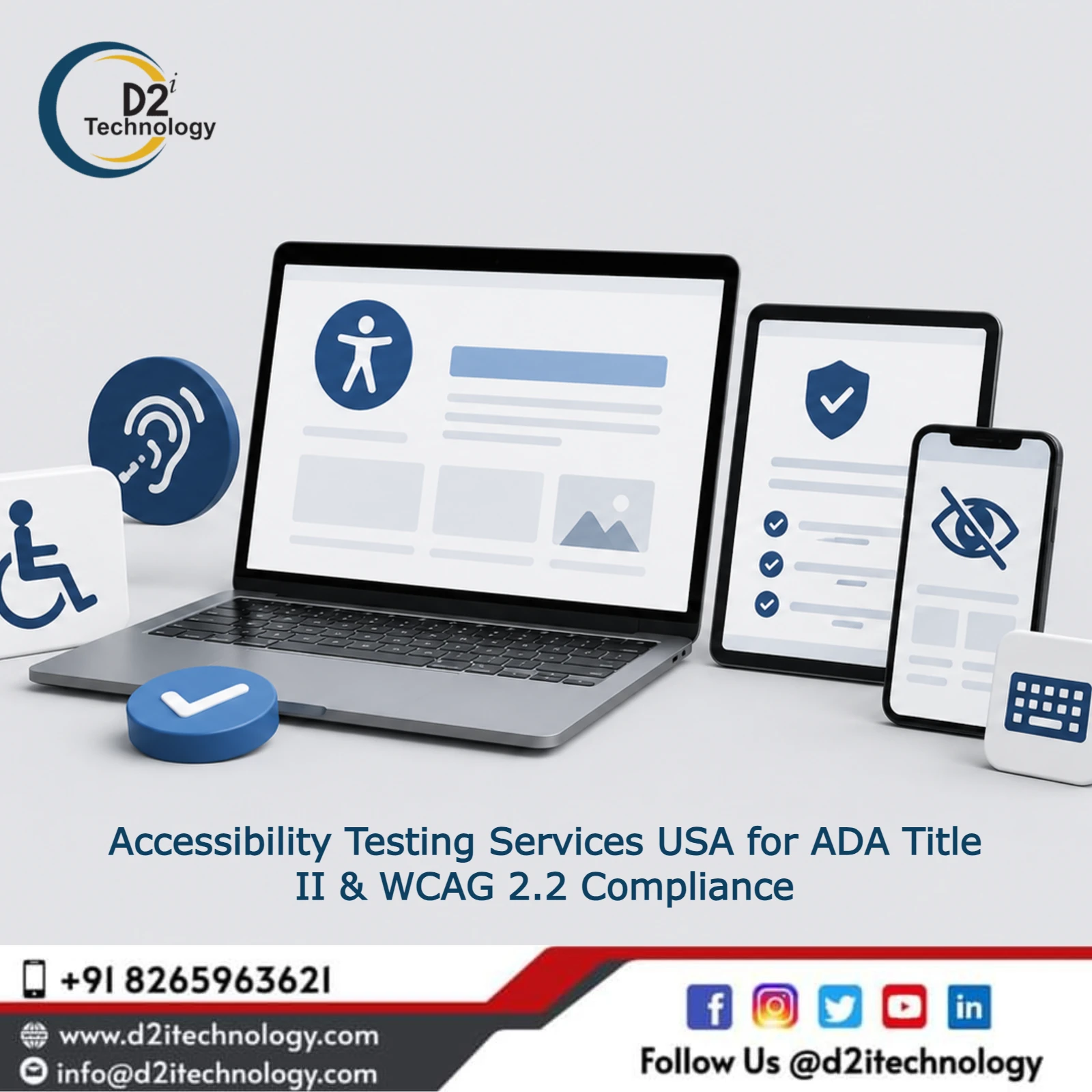
If your organization operates a government website, educational portal, or any digital service covered under federal law, you already know that ADA Title II compliance is no longer optional—it is a legal obligation. Getting professional accessibility testing services in the USA is the most reliable way to confirm that your digital properties meet WCAG 2.2 standards and satisfy the requirements set out under the ADA Title II accessibility rule. The compliance window has already closed for many entities, and for others, the deadlines are arriving fast. Waiting is no longer a strategy.
This guide breaks down what ADA Title II requires, how it connects to WCAG 2.2, and how D2i Technology helps organizations across the United States build and maintain genuinely accessible digital experiences.
What Is ADA Title II and Why Does It Apply to Your Website?
The Americans with Disabilities Act (ADA) has been federal law since 1990, but its application to digital content remained a grey area for decades. In April 2024, the Department of Justice (DOJ) issued a final rule under ADA Title II that explicitly requires state and local government entities to ensure their web content and mobile applications conform to WCAG 2.1 Level AA as a minimum standard—with WCAG 2.2 now being the recommended benchmark.
Read More: ADA Title II Digital Accessibility Checklist for Government Websites
This final rule closes the interpretive gap that previously allowed many public entities to argue that the ADA did not specifically mandate web accessibility. That argument no longer holds. If you are a state agency, public university, county government, public library, public school district, or any other entity covered under Title II, your website and apps must be accessible.
Who Does ADA Title II Cover?
ADA Title II applies to:
- State and local government agencies
- Public schools, colleges, and universities
- Public transit authorities
- Courts, public libraries, and public health departments
- Any entity receiving federal financial assistance
Private organizations that contract with covered entities to deliver digital services on their behalf may also carry similar obligations. This is a wider net than most assume, and it is worth confirming where your organization stands before a complaint forces the question.
The ADA Title II Compliance Deadline You Cannot Miss
The DOJ final rule introduced staggered compliance deadlines based on jurisdiction population size:
- Entities serving populations of 50,000 or more — Compliance deadline: April 24, 2026
- Entities serving populations under 50,000 and special districts — Compliance deadline: April 26, 2027
If your entity falls into the first group, you are already inside the compliance window right now. Failure to comply exposes organizations to federal investigations, DOJ complaints, and civil litigation. The reputational and financial consequences of non-compliance are significant—and increasingly public.
To understand the full scope of this regulation and what it means for your digital infrastructure, read our detailed breakdown of the ADA Title II rule and website accessibility deadline compliance.
What Is WCAG 2.2 and How Does It Relate to ADA Title II?
The Web Content Accessibility Guidelines (WCAG) are published by the World Wide Web Consortium (W3C) and define the technical standards that make web content accessible to people with disabilities. The ADA Title II final rule references WCAG 2.1 Level AA as the required standard. However, WCAG 2.2—released in October 2023—is the current version and adds nine new success criteria on top of WCAG 2.1.
Because WCAG 2.2 is fully backward compatible with 2.1, conforming to WCAG 2.2 Level AA automatically satisfies the 2.1 requirements in the DOJ rule. Most accessibility professionals—including the team at D2i Technology—recommend targeting WCAG 2.2 from the outset rather than aiming for an older standard.
Key WCAG 2.2 Success Criteria to Know
Several WCAG 2.2 additions directly affect common website components:
- 2.4.11 – Focus Not Obscured: Focused UI components must not be entirely hidden by sticky headers or overlays.
- 2.5.3 – Label in Name: Interactive elements with visible text labels must have accessible names that contain that visible text.
- 2.5.7 – Dragging Movements: Any functionality that requires dragging must offer a single-pointer alternative.
- 2.5.8 – Target Size (Minimum): Clickable targets must be at least 24×24 CSS pixels.
- 3.2.6 – Consistent Help: Help mechanisms, if present, must appear in a consistent location across pages.
- 3.3.7 – Redundant Entry: Information a user has already submitted must not be requested again unnecessarily.
These criteria directly affect forms, navigation menus, interactive components, and authentication flows—areas that appear in almost every professional accessibility audit. You can also review the ADA Title II digital accessibility checklist for government websites as a practical starting point for your own review.
Why Professional Accessibility Testing Services Matter in 2026
Automated scanning tools can catch roughly 30–40% of accessibility issues. The rest require human judgment—evaluating context, testing with real assistive technologies, and understanding the user experience from the perspective of someone who relies on a screen reader or keyboard-only navigation. This is why professional accessibility testing services exist.
Organizations that rely solely on accessibility overlays or quick-fix plugins are exposed. These tools do not fix underlying code issues; they apply surface-level workarounds that assistive technology users can still encounter as barriers. DOJ complaints and lawsuits have increasingly named organizations that used these tools as their primary compliance strategy.
A structured, audit-led approach—combining automated scanning with manual accessibility auditing—is the only method that reliably identifies, documents, and supports remediation of real compliance gaps. For a broader view of what this means for your organization, read more on why businesses need accessibility testing services in 2026.
How D2i Technology’s Accessibility Testing Services Work
D2i Technology is a web accessibility and digital solutions company with offices in Noida, India and Charlottesville, Virginia, USA. The team combines IAAP-certified expertise with deep technical knowledge across government, education, healthcare, and financial services sectors. Here is what the accessibility testing process looks like in practice:
Manual Accessibility Auditing
D2i Technology’s auditors review web content page by page, component by component, against WCAG 2.2 Level AA criteria. Each issue is documented with its location, associated WCAG criterion, severity rating, and a clear remediation recommendation. This is the foundation of any credible compliance effort.
Automated Accessibility Testing
Automated tools are used to efficiently surface high-frequency, detectable issues—missing alt text, incorrect heading hierarchies, unlabeled form controls, and color contrast failures. These scans are always paired with manual review; they are never used as a standalone compliance measure.
Screen Reader and Assistive Technology Testing
Real testing with NVDA, JAWS, VoiceOver, and TalkBack validates how your digital content behaves for users who depend on assistive technologies. This step catches interaction-level issues that no automated tool can detect—incorrect focus management, misleading ARIA labels, and inaccessible dynamic content updates.
Remediation Support
An audit report without follow-through is incomplete. D2i Technology provides accessibility remediation services alongside auditing, ensuring that identified issues are resolved at the code level—not just listed in a spreadsheet. Learn more about why web accessibility remediation is essential for long-term compliance and user trust.
Who Should Work With an Accessibility Testing Partner?
Any entity covered under ADA Title II should be engaged with a dedicated accessibility testing partner right now. But the need extends beyond government. Consider these sectors where accessibility testing is increasingly non-negotiable:
- Higher education institutions managing student portals, LMS platforms, and admissions sites
- Healthcare providers accepting federal funding through Medicaid or Medicare programs
- SaaS platforms contracted to serve government agencies
- Financial institutions subject to regulatory compliance obligations
- E-commerce and service platforms with growing exposure under state-level accessibility laws
Among the top accessibility testing services in the USA, what differentiates a reliable partner is the combination of regulatory knowledge, certified expertise, and genuine remediation capacity—not just a scan-and-report workflow.
Common Accessibility Issues Found During Testing
Across the accessibility audits conducted by D2i Technology, certain issues appear consistently across websites of all sizes:
- Missing or incorrect alt text on images, icons, and functional buttons
- Insufficient color contrast ratios failing WCAG 1.4.3 thresholds
- Form fields without programmatic labels, making them unreadable by screen readers
- Keyboard traps inside modals, date pickers, and dropdown menus
- Absent skip navigation links that force keyboard users to tab through the entire menu on every page load
- Auto-playing media without accessible pause or mute controls
- PDFs that are untagged and therefore completely inaccessible to assistive technologies
- Dynamic content that updates without notifying screen readers via ARIA live regions
Each of these issues has a clear fix when addressed at the code level. The challenge lies in finding them consistently and systematically—which is precisely what a professional accessibility testing service delivers. For a forward-looking perspective on where the industry is heading, see our coverage of accessibility testing trends for 2026.
Conclusion
ADA Title II has transformed web accessibility from a recommended practice into a legal mandate for government and government-adjacent digital services across the United States. With WCAG 2.2 as the recommended technical standard and compliance deadlines already in effect for large jurisdictions, there is no room to delay.
D2i Technology’s accessibility testing services in the USA provide the structured, expert-led approach that organizations need to achieve genuine, documented compliance. From the initial audit through to full remediation, the team partners with you at every stage—making your digital experience inclusive, legally defensible, and better for every user.
Frequently Asked Questions
Ready to Make Your Website ADA Title II Compliant?
Whether your compliance deadline has already passed or is approaching, D2i Technology's certified accessibility experts are ready to help. Get a comprehensive WCAG 2.2 audit, assistive technology testing, and hands-on remediation support—designed specifically for your organization's needs and legal obligations.