- Web Accessibility
- October 7, 2026
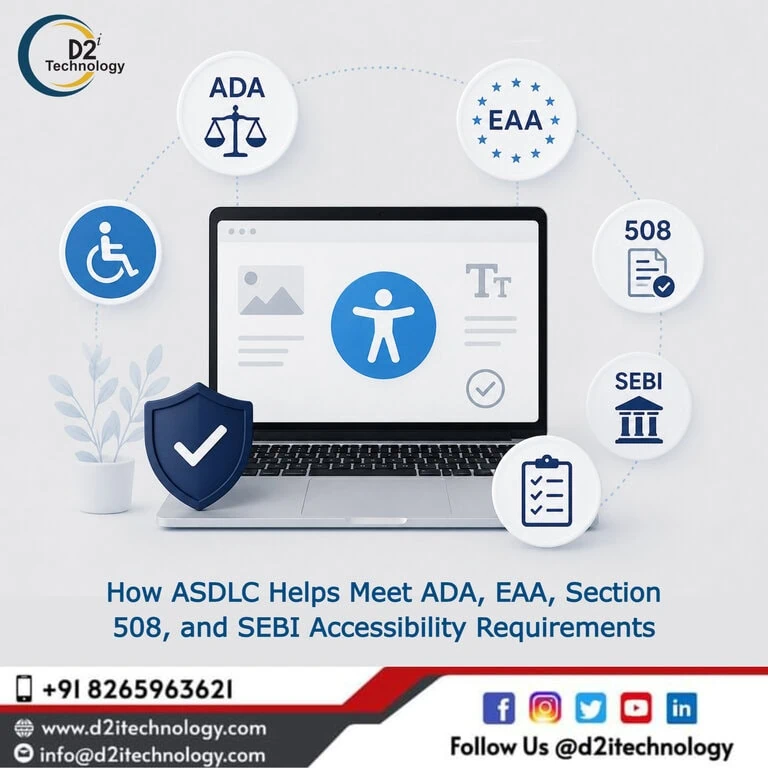
How ASDLC Helps Meet ADA, EAA, Section 508, and SEBI Accessibility Requirements
Here’s a tension that most software development teams haven’t fully resolved: accessibility compliance is a legal requirement that applies to the output of software development, but software development practices rarely treat accessibility as a built-in quality gate. The result is the same pattern repeating everywhere — a site or application gets audited for accessibility after it’s built, a list of violations comes back, remediation begins, and a few months later a new version ships with the same violations because the development process that created them hasn’t changed. ADA compliance software development done properly doesn’t just fix accessibility violations — it changes how software gets built so that violations are prevented from accumulating in the first place.
The Agentic Software Development Lifecycle (ASDLC) creates a specific opportunity to do this right: AI agents that participate throughout the development process can incorporate accessibility checking, accessible coding patterns, and WCAG validation into the workflow itself rather than treating accessibility as a post-launch audit task. This post examines how ASDLC intersects with ADA, Section 508, the European Accessibility Act (EAA), and SEBI’s accessibility requirements — what it genuinely helps with and where human expertise remains irreplaceable.
The Accessibility Compliance Landscape in 2026
Before examining ASDLC’s role, it’s worth being precise about what these regulations require.
ADA (Americans with Disabilities Act) — United States
The ADA prohibits discrimination against people with disabilities in places of public accommodation, and courts and regulators have increasingly applied this to digital properties — websites, mobile applications, and software platforms. The technical standard most consistently applied in ADA enforcement is WCAG 2.1 Level AA. ADA Title II’s 2024 final rule made WCAG 2.1 Level AA the explicit technical standard for state and local government digital content, with enforcement deadlines now active.
The ADA Title II rule, website accessibility deadlines, and what compliance actually requires in practice and how ADA Title II digital accessibility requirements are applied to US and Indian websites cover the current US compliance landscape in detail.
Section 508 — US Federal Sector
Section 508 of the Rehabilitation Act requires federal agencies, federal contractors, and federally funded organizations to ensure their electronic and information technology is accessible. The technical standard references WCAG 2.1 Level AA, making compliance with Section 508 effectively WCAG 2.1 AA conformance for all digital products produced for or used by the federal government.
European Accessibility Act (EAA)
The EAA requires that a broad range of products and services offered in the EU — including computers, smartphones, e-commerce platforms, banking services, and transport services — meet accessibility requirements aligned with WCAG 2.1 Level AA. With enforcement deadlines in 2025 and 2026, this regulation has significant implications for any organization doing business in European markets.
SEBI (Securities and Exchange Board of India) Accessibility Requirements
SEBI has established accessibility requirements for regulated entities in India’s securities market — listed companies, stock brokers, depositories, and mutual fund platforms are increasingly expected to ensure their digital properties meet WCAG 2.1 Level AA standards. How to conduct a WCAG compliance audit for SEBI-regulated entities and a step-by-step guide to SEBI compliance with accessibility auditors cover the India-specific regulatory picture.
The common thread across all four frameworks: WCAG 2.1 Level AA is the underlying technical standard. This means organizations using ASDLC to build WCAG-conformant software are simultaneously addressing the technical requirements of all four regulatory frameworks, regardless of which markets they operate in.
The Core Problem ASDLC Can Help Solve
The reason accessibility violations accumulate in software development isn’t that developers are careless — it’s structural. Accessibility requirements are typically evaluated after code is written, by a separate team or external auditor, on a schedule that doesn’t align with the development cadence. By the time a violation is found, the code that introduced it is often already in production, integrated into multiple features, and expensive to change.
ASDLC creates an opportunity to move accessibility checking earlier in the development process — embedded into the code generation, review, and CI/CD stages rather than deferred to a post-launch audit. This is the same principle that makes security scanning in CI/CD more effective than security audits after deployment: catching issues when they’re introduced costs a fraction of what remediation costs after the fact.
Why proactive accessibility consistently produces better outcomes than reactive remediation captures this principle directly — and ASDLC is the development methodology that makes proactive accessibility structurally possible at every stage of the build.
How ASDLC Specifically Supports Accessibility Compliance
Agents That Generate Accessible Code Patterns
Code generation agents can be instructed to follow accessible coding conventions by default — semantic HTML structure, proper ARIA attribute usage, meaningful link text, labeled form inputs, and alternative text requirements for images. When these conventions are part of the agent’s instruction set and verified by the CI/CD pipeline, every code contribution the agent makes follows accessible patterns automatically rather than requiring a separate accessibility pass.
This doesn’t mean agents produce perfectly accessible code without oversight. It means the baseline is better than code generated without any accessibility consideration — and problems that do appear are caught early rather than discovered in post-launch audits.
Automated Accessibility Checking in CI/CD
ASDLC’s CI/CD pipeline is the natural place to integrate automated WCAG checking — tools like axe-core that can scan rendered HTML against WCAG 2.1 Level AA criteria and fail agent-generated (and human-generated) contributions that introduce accessibility violations. The 2026 accessibility testing landscape and how WCAG 3 is changing the picture for ADA and AI compliance covers the evolving tooling environment that supports this kind of pipeline-integrated checking.
Accessibility testing services for US ADA Title II and WCAG 2.2 compliance and the best accessibility testing toolkit available in 2026 inform which tools are most appropriate for different stages of the development pipeline.
Documentation of Accessibility Decisions
Compliance with ADA, Section 508, EAA, and SEBI requirements requires more than technical conformance — it requires documentation. VPATs (Voluntary Product Accessibility Templates) for Section 508, accessibility statements for EAA, and audit-ready compliance documentation for SEBI all require systematic records of how accessibility requirements were addressed.
Agents in ASDLC can generate and maintain accessibility documentation as part of the development workflow — creating audit trails of which WCAG criteria were tested, which passed, which failed and were addressed, and the timeline of remediation. This documentation infrastructure is built in rather than assembled retroactively before an audit.
Consistency Across Large Codebases
Large development teams working on enterprise codebases consistently produce uneven accessibility quality — some developers apply accessibility practices carefully, others don’t, and the inconsistency compounds as the codebase grows. Agents applying consistent accessible coding patterns across every contribution — regardless of which human developer is directing a specific task — raise the accessibility floor across the entire codebase. This consistency is one of the underappreciated accessibility benefits of ASDLC.
What ASDLC Cannot Solve on Its Own
This is critical: ASDLC addresses the development-side contribution to accessibility compliance. It does not replace the manual accessibility evaluation that regulatory compliance requires.
Automated Checking Catches 30–40% of WCAG Failures
The automated accessibility scanning embedded in an ASDLC pipeline reliably catches structural issues — missing alt attributes, color contrast failures, form labeling problems. It cannot evaluate whether alt text is meaningfully descriptive (only that it exists), whether keyboard navigation works correctly through complex custom interactions, or whether screen reader announcements are contextually appropriate. The difference between manual and automated accessibility auditing and where each is necessary makes this limitation explicit and quantifiable.
Compliance Documentation Requires Human Certification
Section 508 VPATs and EAA conformance statements carry legal weight — they’re documents that attest to compliance, not just automated scan summaries. A human accessibility evaluator with IAAP certification needs to sign off on these documents based on thorough manual evaluation. What certified WCAG compliance auditors do and why certification matters is relevant context for understanding why human expert evaluation can’t be replaced by automated tools regardless of how good those tools become.
SEBI and ADA Compliance Audits Require External Verification
Regulatory compliance audits for SEBI-regulated entities and ADA compliance assessments aren’t self-certified. Organizations need external accessibility audit reports from credible, qualified evaluators to demonstrate compliance in regulatory contexts. The WCAG compliance audit process for SEBI entities and the accessibility compliance audit checklist for 2026 cover what these external audits need to cover.
D2i Technology’s comprehensive accessibility testing services and accessibility remediation services provide the expert-led evaluation and remediation that turns ASDLC’s accessibility baseline into a defensible compliance posture.
Building Compliance Into the ASDLC Workflow
For organizations subject to ADA, Section 508, EAA, or SEBI accessibility requirements, building compliance into ASDLC requires a few specific design choices:
Accessibility requirements in agent specifications: Every feature specification that produces user-facing output should explicitly state WCAG requirements as acceptance criteria — not as a general reminder that accessibility matters, but as specific, testable criteria that the agent’s output is evaluated against.
Axe-core or equivalent in CI/CD as a required gate: Automated WCAG scanning should fail builds that introduce accessibility violations, treating accessibility failures with the same pipeline weight as failing tests. This makes accessibility non-negotiable rather than aspirational.
Scheduled manual evaluation cycles: ASDLC’s automated baseline doesn’t replace periodic manual accessibility audits. Organizations with compliance obligations should schedule manual WCAG evaluations quarterly or annually at minimum, using certified accessibility professionals, to verify conformance at the level that regulatory compliance requires.
Accessibility remediation as part of the sprint cycle: When manual audits surface violations that automated scanning missed, those violations should be addressed within the same development sprint cycle that discovered them — using the same ASDLC workflow to implement and verify fixes — rather than deferred to a separate remediation project.
Why proactive accessibility consistently outperforms reactive remediation as an organizational strategy reflects exactly this integrated approach — accessibility as an ongoing quality standard rather than a periodic compliance exercise.
D2i Technology at the Intersection of ASDLC and Accessibility
D2i Technology is positioned uniquely at the intersection of AI-driven software development and accessibility compliance. Our AI development services help engineering teams implement ASDLC with accessibility built into the workflow from the start. Our accessibility testing services and accessibility remediation services provide the certified human evaluation and technical remediation that turns an ASDLC accessibility baseline into compliance documentation that holds up to regulatory scrutiny.
Conclusion
ADA compliance software development doesn’t happen by accident, and it doesn’t happen solely because you’re using AI agents to build software. What ASDLC does is create the structural opportunity to build accessibility in at every development stage — through accessible code generation patterns, automated WCAG checking in CI/CD, and consistent application of accessibility standards across large codebases. What it doesn’t replace is the human evaluation, certified compliance documentation, and external audit verification that ADA, Section 508, EAA, and SEBI requirements demand.
Organizations that combine ASDLC’s accessibility automation with D2i Technology’s certified accessibility testing and remediation expertise get the full picture: a development process that prevents accessibility debt from accumulating, paired with the human expertise to verify and document conformance at the level regulatory compliance actually requires.
Frequently Asked Questions
Build Software That's Accessible by Design — and Compliant by Evidence
D2i Technology combines agentic development expertise with certified WCAG accessibility testing and remediation services, helping organizations meet ADA, Section 508, EAA, and SEBI requirements through both better development practices and rigorous compliance documentation.