- Web Accessibility
- April 29, 2026
ADA Title II Web Accessibility 2026: Why USA & Indian Websites Must Act Now
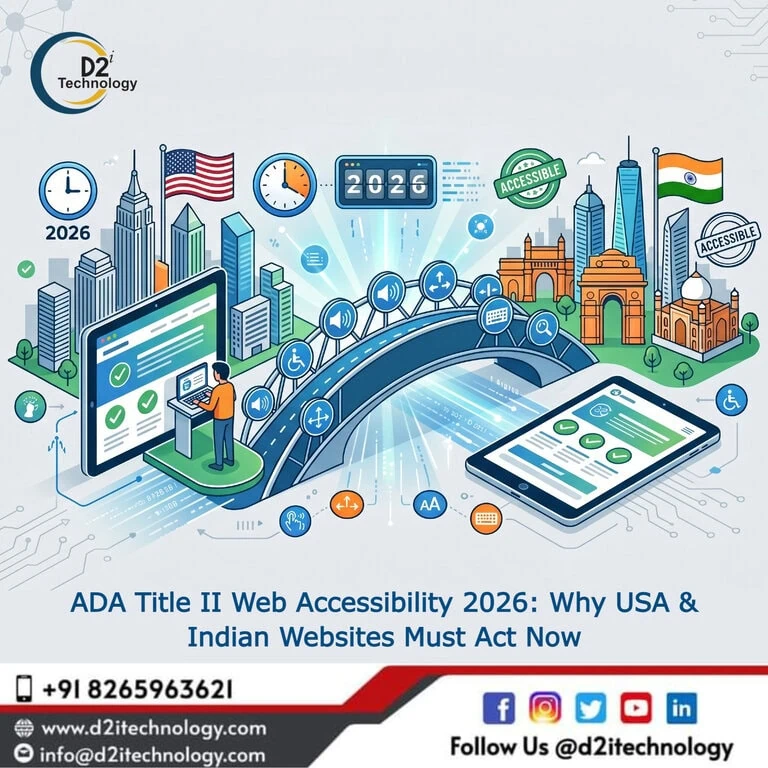
The digital world is no longer optional — it is infrastructure. And with the ADA Title II web accessibility rule now enforcing phased compliance deadlines through 2026, both US public entities and globally operating organizations — including Indian companies serving American clients or audiences — are facing a legal and ethical obligation they can no longer defer.
If your website is not accessible, it is not just a UX problem. It is a liability.
What Is ADA Title II Web Accessibility?
The Americans with Disabilities Act (ADA) is a landmark US civil rights law enacted in 1990. Title II of the ADA specifically covers state and local government entities, prohibiting discrimination against people with disabilities in all programs, services, and activities — including digital ones.
For decades, Title II’s application to websites existed in legal gray zones. Courts ruled inconsistently, and many public entities assumed good faith effort was sufficient. That changed in April 2024, when the US Department of Justice (DOJ) published a final rule under the ADA Title II accessibility rule, officially mandating that state and local governments bring their web content and mobile apps into conformance with WCAG 2.1 Level AA standards.
This rule closes the ambiguity. Web accessibility is now the law for covered entities — not a suggestion.
ADA Title II Web Accessibility Updates in 2026
The ADA Title II digital accessibility rule takes a tiered compliance approach based on population size:
| Entity Type | Population | Compliance Deadline |
|---|---|---|
| Larger public entities | 50,000+ | April 24, 2026 |
| Smaller public entities | Under 50,000 | April 26, 2027 |
| Special district governments | Any size | April 26, 2027 |
For larger jurisdictions, the ADA Title II compliance deadline is April 24, 2026 — and that is not a soft target. Courts and the DOJ have consistently signaled they will take enforcement seriously.
Beyond government websites, the ripple effect is significant. Organizations that contract with or serve government entities, educational institutions, healthcare portals, public transit authorities, and publicly funded services all fall under scrutiny.
The ADA Title II regulations require conformance with WCAG 2.1 AA, covering critical areas such as:
- Perceivable – Alt text for images, captions for video, adaptable content layouts
- Operable – Full keyboard navigation, no seizure-triggering animations, sufficient time limits
- Understandable – Clear language, consistent navigation, error identification
- Robust – Compatible with assistive technologies like screen readers and refreshable Braille displays
For a deeper breakdown of compliance requirements specific to 2026, refer to our guide on ADA Website Accessibility Compliance 2026: WCAG Guide.
Why USA Websites Must Act Now
Many public entity websites in the United States have been operating under voluntarily adopted guidelines or older standards. The ADA Title II rule eliminates that option for covered organizations.
Here is why acting immediately matters:
1. Legal Exposure Is Real
Failure to comply with the ADA Title II accessibility rule opens entities to DOJ investigations, federal lawsuits, and mandatory corrective action plans. Settlements in accessibility cases routinely require organizations to commit to multi-year remediation programs under court supervision — far more costly than proactive compliance.
2. Remediation Takes Time
Accessibility remediation is not a one-day project. A medium-complexity website with hundreds of pages, PDFs, video content, and third-party integrations can take months to audit, fix, test, and verify. Organizations that start the week before the deadline will not finish on time.
3. Automated Tools Are Not Enough
Many organizations assume a plugin or automated scanner resolves their obligations. It does not. Automated tools catch roughly 30–40% of WCAG violations. The rest require manual expert review. Read more about this in our post on Manual Accessibility Audit vs Automated Testing.
4. Third-Party Content Is Your Responsibility
If your website embeds forms, maps, videos, or widgets from third-party vendors, you are still responsible for ensuring those elements meet WCAG 2.1 AA. Many government portals rely on vendor-managed calendars, registration systems, and payment portals — all of which must be evaluated.
Why Indian Websites Should Care About ADA Title II
This is a question many Indian digital agencies and businesses are beginning to ask — and rightfully so.
Indian companies operating in the following contexts have direct exposure to ADA Title II regulations:
- IT and digital service vendors contracted by US state and local governments
- EdTech platforms serving US school districts or public universities
- Healthcare technology companies supporting publicly funded US health programs
- SaaS and software firms whose products are used by US government agencies
Beyond direct legal exposure, the ADA Title II web accessibility 2026 deadline has set a global standard benchmark. Regulatory momentum across geographies — including India’s own SEBI accessibility mandates and the Rights of Persons with Disabilities Act — is moving in the same direction.
Indian companies that invest in accessibility compliance now gain a significant competitive advantage when bidding for US government contracts, onboarding enterprise US clients, and building scalable, inclusive products. Learn how Indian companies are approaching this in our post on Digital Accessibility for Indian Companies.
For Indian businesses already navigating SEBI-driven accessibility requirements, the overlap with WCAG standards makes dual compliance more achievable than it might seem.
Common Web Accessibility Issues That Cause Non-Compliance
Whether you are a US government agency or an Indian company serving US clients, the violations that trigger ADA Title II non-compliance tend to follow predictable patterns:
- Missing or poor alt text on images, charts, and infographics
- Low color contrast between text and background (fails WCAG 1.4.3) — check your site with our Color Contrast Analyzer Tool
- Keyboard navigation failures — interactive elements unreachable without a mouse
- Videos without captions or transcripts
- Forms without proper labels and error identification
- PDFs that are not tagged or structured for screen reader access
- Inaccessible modal dialogs and pop-ups that trap keyboard focus
For a complete list of violations commonly found during audits, see our resource on Common Accessibility Issues and 10 Common Accessibility Mistakes to Fix on Your Website.
How to Make Your Website ADA Title II Compliant
Here is a practical framework for achieving compliance before the ADA Title II compliance deadline:
Step 1: Conduct a Full Accessibility Audit
Begin with a comprehensive audit combining automated scanning and manual expert review. This surfaces all WCAG 2.1 AA violations across your web content, PDFs, videos, and mobile interfaces.
Step 2: Prioritize Critical Barriers
Not all violations carry equal weight. Focus first on barriers that completely block access — missing form labels, skip navigation failures, keyboard traps, and lack of captions on key video content.
Step 3: Remediate Systematically
Fix violations in development, not just in a surface overlay. Overlays do not achieve genuine compliance and have been challenged in US courts. Remediation must reach the source code.
Step 4: Test With Real Assistive Technologies
Use screen readers (NVDA, JAWS, VoiceOver), keyboard-only navigation, and other assistive tools to verify the user experience for people with disabilities.
Step 5: Document Everything
The DOJ places value on documented good faith effort. Maintain an accessibility policy, a remediation log, and a feedback mechanism on your website.
Step 6: Monitor and Maintain
Accessibility is not a one-time certification. Every new page, feature, or third-party integration is a potential new violation. Build accessibility into your content and development workflows.
For professional support on this process, explore our Website Accessibility Remediation Services and Accessibility Testing Services.
Benefits of Accessibility Beyond Compliance
Meeting the ADA Title II digital accessibility standard delivers outcomes well beyond legal safety:
Broader Audience Reach — Over 1.3 billion people worldwide live with some form of disability. Accessible websites serve this audience directly and retain them as long-term users.
Stronger SEO Performance — WCAG-compliant practices (semantic HTML, alt text, structured headings, descriptive links) align closely with how search engines index and rank content. Read more in our post on Accessibility and SEO.
Lower Legal Risk — Beyond ADA Title II, accessibility compliance reduces exposure to Section 508, the Rehabilitation Act, and international equivalents.
Improved User Experience for Everyone — Captions help users in noisy environments. High contrast helps users in sunlight. Keyboard navigation helps power users. Accessible design is universal design.
Brand Trust and Reputation — Organizations that prioritize inclusion communicate that they value all users — a message that resonates with both customers and enterprise clients.
Why Choose D2i Technology for ADA Title II Accessibility Compliance
D2i Technology is a specialized digital accessibility and web development firm with IAAP-certified professionals who understand the ADA Title II accessibility rule from both a legal and technical standpoint.
Here is what sets D2i Technology apart:
- IAAP WAS Certified experts conducting audits — not just automated tools
- WCAG 2.1 AA compliant remediation across HTML, CSS, JavaScript, PDFs, and multimedia
- Experience with US government-facing projects and Indian companies serving US clients
- Transparent reporting with clear issue logs, severity ratings, and recommended fixes
- Ongoing monitoring partnerships so your compliance holds after remediation
- eLearning accessibility remediation for Articulate Storyline and LMS platforms
Whether you are a public entity facing the April 2026 deadline or an Indian SaaS company seeking to strengthen your US market position, D2i Technology delivers compliance you can stand behind.
Explore our Accessibility Services and Accessibility Remediation offerings to understand how we can support your compliance journey.
Also see: Why Businesses Need Accessibility Testing Services in 2026 and Web Accessibility Audit & Remediation Services for Enterprises 2026.
Frequently Asked Questions
Your ADA Title II Deadline Is Closer Than You Think
Whether you're a US public entity racing against the April 2026 deadline or an Indian company looking to strengthen your accessibility posture for US clients, D2i Technology's IAAP-certified experts are ready to audit, remediate, and validate your website — end to end.