
- Web Accessibility
- April 24, 2026
Accessibility Testing in 2026: WCAG 3.0, ADA Deadlines & the Rise of AI-Driven Compliance
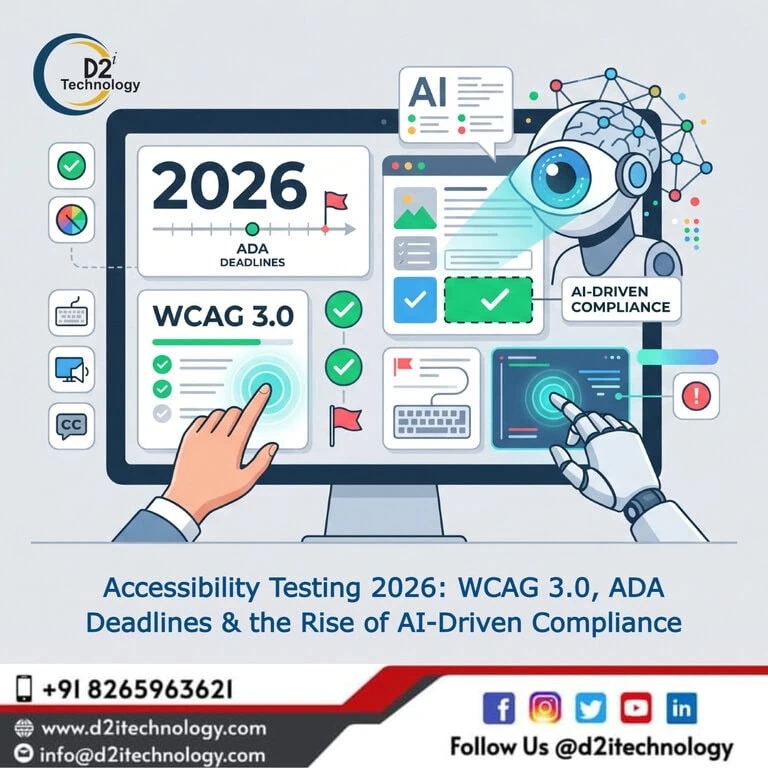
Accessibility testing 2026 is no longer a back-burner item on a product roadmap — it is a legal obligation, a business imperative, and increasingly, a reflection of how seriously an organisation takes digital inclusion. With landmark regulatory deadlines approaching, a new generation of AI-powered testing tools emerging, and the W3C actively shaping the future through WCAG 3.0, the accessibility landscape is more dynamic than it has ever been. Whether you are a developer, a compliance officer, or a business owner, understanding where the standards stand today is essential to staying ahead.
Where Things Stand: The Standards Landscape in April 2026
The accessibility standards ecosystem has undergone significant consolidation over the past year. WCAG 2.2 has firmly established itself as the working standard, expanding on WCAG 2.1 with nine additional success criteria covering stricter keyboard focus indicators, minimum target sizes for interactive elements, and consistent help mechanisms. For most compliance purposes — including ADA, Section 508, and SEBI in India — WCAG 2.1 Level AA remains the benchmark, but organisations that are building new digital products are increasingly designing to WCAG 2.2 from the outset.
Meanwhile, the W3C published a new working draft of WCAG 3.0 in March 2026, offering a preview of the direction accessibility guidelines are heading. WCAG 3.0 moves away from the binary pass/fail model and introduces a scoring-based approach, broader technology coverage, and new outcome categories. It is not yet a recommendation standard — meaning it should not be used as a compliance target — but it signals a more nuanced and comprehensive framework for the future.
For a practical comparison of how manual and automated approaches fit into this evolving landscape, D2i Technology’s post on manual accessibility audit vs. automated testing is worth reading alongside the current updates.
ADA Title II: The Compliance Clock Is Ticking
One of the most consequential regulatory developments in 2026 is the enforcement timeline under the ADA Title II final rule issued by the US Department of Justice. The rule mandates that state and local government entities comply with WCAG 2.1 Level AA for their web content and mobile applications.
The deadlines are clear:
- April 26, 2027 — Public entities serving populations of 50,000 or more
- April 26, 2028 — Smaller public entities
For public sector organisations and their technology vendors, this means the window for remediation is not as wide as it might appear. Accessibility audits, gap analyses, developer training, and remediation all take time — and the complexity of government websites often means that full conformance requires months of sustained effort.
D2i Technology has covered the specifics of this rule in detail in our post on ADA Title II website accessibility deadlines and compliance. If your organisation serves a US government entity or supplies digital products to one, that article is a critical read.
For a broader compliance overview including WCAG guidance, see our ADA website accessibility compliance guide for 2026.
Section 508 Gets a Refresh: Trusted Tester 5.1.3
The Department of Homeland Security updated its Trusted Tester program to version 5.1.3 in 2025-2026 to align testing methodology with current Section 508 requirements. Trusted Tester is widely used by federal agencies and their contractors as the approved manual testing protocol. Version 5.1.3 refines the process for evaluating interactive elements, PDF accessibility, and keyboard operability — areas where many digital products continue to fall short.
If your organisation is in the federal supply chain or building tools used by US government agencies, Trusted Tester conformance is not optional — and it goes well beyond what automated scanners can catch.
The WebAIM Million Report 2026: Errors Are Still Everywhere
The annual WebAIM Million accessibility analysis continues to serve as a sobering benchmark for the industry. The 2026 findings show that accessibility errors remain present across 3.9% of all page elements — a figure that, when multiplied across millions of web pages, represents an enormous barrier to access for people with disabilities.
More striking is the finding that average page complexity has grown by 22.5% over the past year alone. More components, more dynamic content, more third-party integrations — all of which create new accessibility failure points that standard automated scans may not catch.
The most common error categories remain familiar: missing alternative text, low colour contrast, absent form labels, and empty link text. These are issues that have been flagged consistently for years. The persistence of these errors points to a systemic gap in development workflows, not just individual oversights. Our article on common accessibility issues breaks these down with remediation guidance.
AI in Accessibility Testing: Capability and Caution
The integration of artificial intelligence into accessibility testing tools has accelerated considerably. Tools like Axe Dev Tools Mobile now extend automated coverage to complex, non-source-code testing scenarios — including native mobile applications, rendered UI states, and dynamically generated content that was previously difficult to evaluate programmatically.
AI-powered tools can now flag potential issues in images, infer context from surrounding elements, and even suggest remediation code. This is a meaningful leap beyond the rule-based scanning that characterised earlier generations of automated tools.
However, the accessibility community has been consistent on one point: AI does not replace human judgement. Automated tools — even sophisticated AI-assisted ones — typically catch between 30% and 40% of WCAG failures. Screen reader behaviour, cognitive load, language clarity, and interaction patterns in complex UI components require experienced human evaluators. The right approach combines automated scanning with structured manual testing.
Key Testing Priorities for 2026
Organisations approaching accessibility testing this year should focus on the following:
- Audit to WCAG 2.1 Level AA first. This is the legal benchmark for ADA Title II, Section 508, and most international standards. Don’t wait for WCAG 3.0 to arrive before starting.
- Include mobile in your testing scope. ADA Title II explicitly covers mobile applications. Automated testing tools now have stronger mobile coverage, but manual testing on actual devices with real assistive technologies is still necessary.
- Shift testing left. Catching accessibility issues during design and development is significantly less costly than remediating them post-launch. Build automated checks into your CI/CD pipeline and include accessibility criteria in definition-of-done checklists.
- Address increasing page complexity. As JavaScript-heavy frameworks and third-party integrations become standard, accessibility testing must cover dynamic states, modal interactions, single-page application routing, and live regions.
- Don’t overlook colour contrast. It remains one of the most common failures. Use tools that evaluate contrast in context, not just at the element level. Our colour contrast tools for accessibility guide can help.
For a comprehensive developer-focused overview, see our web accessibility guide for developers.
Why Continuous Testing Matters More Than a One-Time Audit
A single accessibility audit captures a snapshot. Websites evolve — content is added, components are updated, plugins are changed, and third-party scripts are integrated. Each of these changes is a potential accessibility regression. Organisations that treat accessibility as an ongoing programme rather than a one-time compliance exercise maintain conformance more reliably and avoid the legal and reputational risks that come with documented failures.
D2i Technology’s post on why businesses need accessibility testing services in 2026 makes this case in more detail.
Our web accessibility audit and remediation services guide for enterprises in 2026 is also a strong reference for organisations building or refining their accessibility programmes.
How D2i Technology Supports Accessibility Compliance
D2i Technology provides accessibility testing services and accessibility remediation delivered by IAAP WAS-certified professionals. Our team combines automated scanning with structured manual testing, assistive technology evaluation, and developer-level remediation support. We work with clients across the US, UK, India, and beyond — covering web applications, mobile apps, PDFs, and e-learning content.
Whether you need a one-time conformance audit, ongoing monitoring, or end-to-end remediation, our accessibility services are built to meet organisations where they are and help them reach where they need to be.
Frequently Asked Questions
Not sure where your digital products stand against WCAG 2.1, WCAG 2.2, or the ADA Title II deadline?
Our IAAP-certified accessibility specialists can assess your current state, identify compliance gaps, and recommend a remediation roadmap tailored to your organisation.