- AI Development
- July 9, 2026
Why Enterprises Are Adopting Agentic Software Development
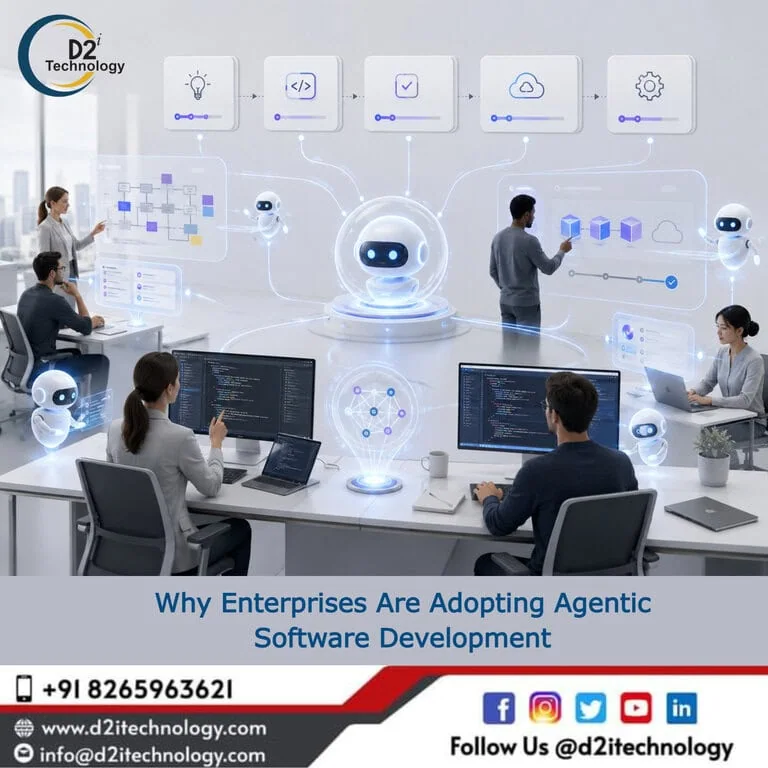
There’s a meaningful difference between enterprises experimenting with AI-assisted development and enterprises building agentic AI into how software gets made. Enterprise AI software development in its current, more advanced form isn’t primarily about code autocomplete in a developer’s IDE — it’s about AI agents that participate in the development process autonomously, taking sequences of actions across the full software lifecycle: research, planning, implementation, testing, review, and deployment. The shift from tool to participant changes the economics, the risk profile, and the potential upside substantially.
This post looks at the business drivers pulling enterprises toward this model, what they’re actually gaining, and where the genuine complexity lies in making it work at scale.
The Business Pressures Driving Enterprise Adoption
The Productivity Expectation Gap
Software delivery backlogs at enterprise scale are a chronic problem. Business stakeholders request capabilities. Product roadmaps fill up. Engineering teams are already operating near capacity. The backlog grows. Timelines slip. This isn’t a new problem, but the expectation that software can now be delivered faster — driven partly by observing what smaller, AI-native companies can ship with smaller teams — has made the backlog problem more visible and more politically uncomfortable for many enterprise engineering leaders.
Agentic AI development doesn’t eliminate this gap overnight, but it compresses the cost of producing working code for well-defined requirements significantly. When AI agents can draft implementations, write tests, and create pull requests for features that previously consumed multiple developer-days, the throughput math for certain categories of development work changes substantially.
The Developer Shortage and Talent Cost Reality
Experienced software engineers are expensive and scarce, particularly in specialized domains. Enterprises competing for the same pool of senior engineers face both cost pressure and the reality that there simply aren’t enough available to staff every team that needs them. Agentic AI development allows existing engineering teams to operate with greater leverage — handling more work per engineer, with agents taking on the more routine implementation tasks that don’t require the judgment and architectural experience that distinguishes senior engineers from their peers.
This isn’t about replacing engineers. Why manual expertise remains essential even when AI is doing more of the routine work captures the dynamic accurately: AI makes experienced engineers more productive, not redundant, by redirecting their attention toward the decisions that actually require human judgment.
Competitive Pressure From AI-Native Organizations
Enterprises in most sectors now compete directly with companies that were built AI-native — organizations where AI assistance in product development is baked in from the ground up rather than grafted onto established processes. The velocity advantage these organizations can achieve puts pressure on incumbent enterprises to close the gap, or risk losing ground on product iteration speed that translates directly into market position.
What Enterprises Are Actually Gaining
Faster Cycle Times for Well-Defined Work
The productivity gains from agentic development are most pronounced in work categories where requirements are clear and testable: implementing specified features from detailed user stories, writing tests for existing code, generating boilerplate, updating documentation to reflect code changes, and handling the mechanical parts of code review. These categories represent a meaningful share of total engineering effort, and compressing them has real downstream effects on cycle time.
How AI innovation and intelligent automation are changing how software solutions get built reflects this pattern across multiple domains — automation that targets well-defined, repeatable tasks consistently delivers faster outcomes than automation aimed at ambiguous, judgment-heavy work.
Improved Test Coverage Without Proportional Cost
One of the persistent quality trade-offs in enterprise software development is that thorough testing costs time, and time is always in short supply. Test coverage often gets trimmed when delivery pressure peaks, which predictably leads to defect rates that rise as codebases grow. AI agents that write tests alongside implementation code can raise coverage baselines without consuming the engineering cycles that comprehensive human-written testing requires. The caveat — and it’s an important one — is that AI-generated tests need the same review and quality oversight applied to AI-generated implementation code. Volume of tests isn’t the same as quality of tests.
More Consistent Code Review Throughput
Code review is a bottleneck in most enterprise development processes. Reviewers are busy, reviews pile up, and the quality of review degrades as fatigue sets in or time pressure accumulates. How code review automation affects development efficiency at scale covers the specific categories of review work where AI performs well — catching style inconsistencies, flagging obvious patterns of concern, verifying documentation completeness — and where human judgment remains irreplaceable: understanding architectural intent, evaluating security implications in novel contexts, and making judgment calls about technical debt trade-offs.
Institutional Knowledge Preserved and Accessible
Enterprise codebases accumulate implicit knowledge: conventions documented only in comments, architectural decisions recorded in Slack threads, patterns that made sense in 2019 but whose rationale has been forgotten. AI agents that can query codebases at scale and surface this embedded context give development teams a kind of institutional memory that’s genuinely difficult to maintain through other means. When a new developer asks why a particular pattern exists, an AI agent that can trace its history through commits and related code is more useful than an outdated wiki page.
Where Enterprise Adoption Gets Complex
The Governance Overhead Is Real
Deploying AI agents in an enterprise development environment isn’t a drop-in change. It requires rethinking access controls (what can agents read and write?), audit infrastructure (what are agents actually doing?), review workflows (who approves what agent-generated changes?), and incident response processes (how do you handle an agent making an unintended change at 2 AM?). How AI agent governance and monitoring need to be structured for production-grade systems covers the monitoring and audit side of this in detail — getting governance right is the part of agentic adoption that most organizations underinvest in relative to the technical deployment itself.
Enterprise Security and Compliance Add Specific Requirements
For enterprises in regulated industries — finance, healthcare, insurance, government contracting — agentic AI development doesn’t just need to produce correct software. It needs to produce auditable software through processes that satisfy regulatory scrutiny. The security and reliability risks specific to agentic AI operating in real applications outlines some of these concerns at the application level — concerns that apply with equal force to the development process itself, where agents with access to production credentials or sensitive codebases introduce risk vectors that conventional development processes don’t.
What the EU AI Act’s compliance requirements actually mean for enterprises building and using AI systems is essential context for any European enterprise or organization with European operations evaluating how AI systems — including development agents — fall within emerging regulatory classifications. Getting this analysis wrong at the adoption stage is significantly more expensive than building compliance considerations into the architecture from the start.
Integration With Existing Enterprise Architecture
Enterprises don’t have clean, greenfield environments. They have legacy systems, complex dependency trees, proprietary internal APIs, custom toolchains, and compliance-mandated processes that any new capability — AI or otherwise — has to work within. Agentic AI systems that work well in isolation sometimes don’t translate cleanly into enterprise environments where they need to integrate with existing CI/CD pipelines, ticketing systems, access management, and deployment controls.
How enterprise-scale application development actually works and what it requires is useful framing for understanding the complexity that enterprise development environments represent — the agentic systems that succeed in enterprise contexts are those designed with this complexity in mind, not those designed to demonstrate capabilities in simplified conditions.
Quality and Testing Remain Human Responsibilities
The organizations experiencing the most productive outcomes from agentic AI development are those that have maintained — or increased — their investment in quality assurance alongside their investment in agent capabilities. The irreplaceable role of testing expertise in software quality, even as AI handles more of the implementation work reflects a pattern consistent across high-performing implementations: agents that generate code are paired with rigorous testing disciplines that verify what agents produce, including adversarial testing of AI agent behavior itself.
D2i Technology’s automation testing services and security testing capabilities are designed with exactly this integration in mind — providing the quality and security infrastructure that makes agentic development trustworthy rather than merely fast.
What Distinguishes Successful Enterprise AI Adoption
The enterprises seeing the most sustained benefit from agentic software development share a few consistent characteristics: they started with governance and security architecture before scaling capabilities; they maintained strong human review practices rather than assuming AI output quality; they treated agentic development as an ongoing capability to evolve rather than a deployment to complete; and they measured outcomes against actual development metrics (cycle time, defect rates, review throughput) rather than against impressive demos.
D2i Technology’s approach to building AI that solves real business problems rather than generating novelty reflects the same outcome orientation that separates durable AI adoption from the kind that produces an initial surge of enthusiasm followed by a quiet retreat to established workflows.
The Trajectory From Here
Agentic software development isn’t a trend that enterprise organizations can observe from a distance indefinitely. The velocity gap between AI-assisted and conventional development processes is already measurable in production environments, and it’s widening as agent capabilities improve and organizations that adopted early accumulate experience.
For enterprises evaluating this shift, the question isn’t whether agentic AI will become standard in software development — it’s how to adopt it in a way that captures the productivity benefits without creating the governance and security problems that poorly governed AI systems reliably introduce.
D2i Technology’s AI development services are built around helping organizations navigate exactly this adoption challenge: getting the governance, security, and quality infrastructure right alongside the capability deployment, so that enterprise AI software development produces sustainable results rather than impressive initial metrics and compounding technical debt.
Conclusion
Enterprise AI software development through agentic approaches is gaining adoption because the business case is real: faster delivery for well-defined work, higher test coverage without proportional cost, improved code review throughput, and better access to institutional codebase knowledge. The complexity is equally real — governance overhead, compliance requirements, enterprise integration challenges, and the irreducible need for strong human QA alongside AI-generated outputs.
Enterprises that get this transition right treat agentic development as an organizational capability to build systematically, not a technology to deploy opportunistically. D2i Technology is positioned to support that systematic approach — from AI system development through the security testing and quality assurance infrastructure that makes autonomous AI trustworthy in production.
Frequently Asked Questions
Ready to Adopt Enterprise AI Software Development the Right Way?
D2i Technology helps enterprises implement agentic AI development with the governance, security, and quality infrastructure needed to deliver real outcomes — not just impressive demos. Let's talk about what your organization needs.