- AI Development
- April 27, 2026
AI Agent Testing: Complete Guide to Testing AI Agents for Reliability, Security & Performance
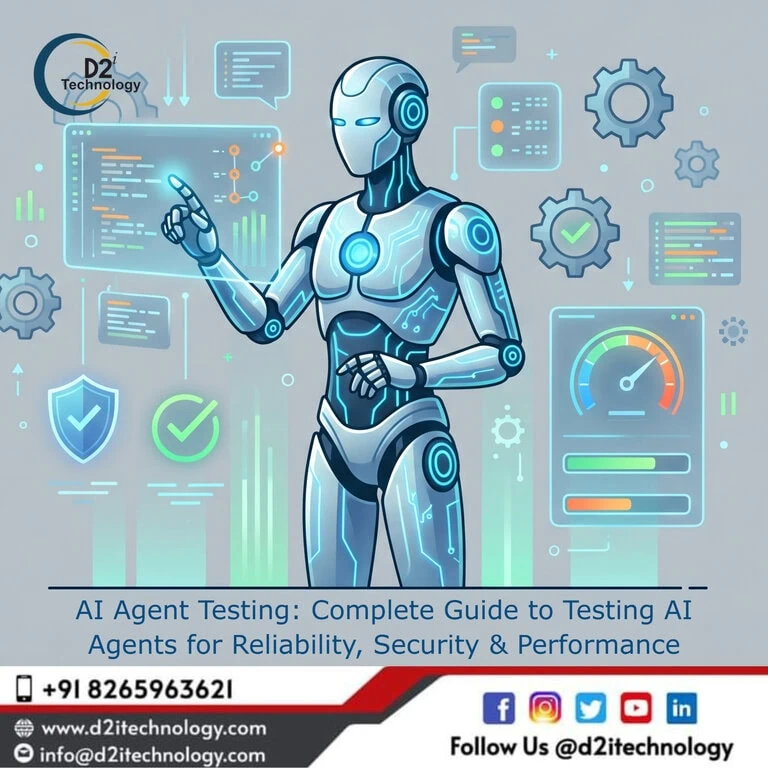
Artificial intelligence is evolving rapidly, and one of the most powerful advancements is the rise of AI agents. Unlike traditional AI models, AI agents can think, plan, take actions, and interact with multiple systems to complete tasks autonomously.
However, with this intelligence comes complexity—and that’s where AI agent testing becomes critical.
If you are building or using AI-powered systems, understanding how to test AI agents effectively is no longer optional—it’s essential for ensuring reliability, safety, and performance.
In this guide, we’ll break down everything you need to know about AI agent testing, along with practical strategies to help you build robust and trustworthy AI systems.
What is AI Agent Testing?
AI agent testing refers to the process of validating the behavior, decision-making, and performance of AI agents across real-world scenarios.
Unlike traditional AI model testing, where outputs are evaluated for accuracy, testing AI agents involves:
- Multi-step workflows
- Decision logic validation
- Tool and API interactions
- Memory and context handling
In simple terms, you are not just testing answers—you are testing how the AI thinks and acts.
Read Also: Agentic AI Testing – Ensuring Security, Accuracy, and Reliability in Autonomous Systems
Why AI Agent Testing is Important
1. Unpredictable Outputs
AI agents are non-deterministic. This means: Same input can produce different results
Without proper AI testing strategy, this can lead to:
- Inconsistent behavior
- Incorrect decisions
2. Real Business Impact
AI agents can:
- Trigger workflows
- Send emails
- Access databases
A small bug can cause:
- Financial loss
- Data issues
- Customer dissatisfaction
3. Security & Data Risks
Modern AI systems interact with APIs and sensitive data.
Without strong AI automation testing, risks include:
- Data leakage
- Prompt injection attacks
- Unauthorized actions
4. Brand Trust
Poorly tested AI agents can:
- Give wrong answers
- Misbehave with users
- Damage brand credibility
Key Challenges in Testing AI Agents
1. Non-Deterministic Nature
Traditional test cases don’t work well because:
- Output is probabilistic
- Results vary
2. Multi-Step Execution
AI agents operate in loops: Plan → Act → Observe → Repeat
You must test:
- Each step
- Final outcome
3. External Dependencies
Agents depend on:
- APIs
- Databases
- Third-party tools
Failures may not be internal.
4. Context & Memory Handling
Agents remember past interactions:
- Bugs may appear after multiple steps
- Context misuse can occur
Types of AI Agent Testing
1. Functional Testing
Ensures the agent completes tasks correctly.
Example: Booking a meeting using calendar API
2. Scenario-Based Testing
Simulates real workflows.
Example:
- Refund request
- Order validation
- Payment processing
3. Integration Testing
Validates:
- API calls
- Tool usage
- Data flow
4. Security Testing
A critical part of AI model testing:
- Prompt injection
- Data leaks
- Unauthorized actions
5. Performance Testing
Measures:
- Response time
- Latency
- Cost efficiency
6. Regression Testing
Ensures updates don’t break existing functionality.
AI Testing Strategy for AI Agents
A strong AI testing strategy should include:
1. Define Clear Objectives
- What should the agent do?
- What should it avoid?
2. Build Real-World Scenarios
Test:
- Normal use cases
- Edge cases
- Malicious inputs
3. Use Evaluation Metrics
Measure:
- Task success rate
- Accuracy
- Safety compliance
4. Combine Manual + Automated Testing
- Human validation for quality
- Automation for scale
5. Continuous Testing
AI systems evolve:
- Testing must be ongoing
Best Practices for Testing AI Agents
1. Log Everything
Track:
- Inputs
- Outputs
- API calls
- Errors
2. Version Control Prompts
Treat prompts like code:
- Track changes
- Run regression tests
3. Test Edge Cases
Include:
- Ambiguous queries
- Invalid inputs
- Attack scenarios
4. Prioritize Security
Always validate:
- Data privacy
- Access control
5. Start with MVP Testing
Don’t over complicate:
- Test core workflows first
Real-World Example of AI Agent Testing
Imagine a customer support AI agent.
User Request:
“I want to cancel my order”
Expected Workflow:
- Identify order
- Check eligibility
- Call API
- Confirm cancellation
What to Test:
- Invalid order ID
- Already shipped orders
- API failure handling
- Incorrect user input
This is where AI automation testing ensures reliability at scale.
Future of AI Agent Testing
The future of AI agent testing includes:
- AI testing AI (auto-evaluation systems)
- Advanced simulation environments
- Better benchmarking tools
- Stronger compliance frameworks
Organizations investing in testing AI agents today will:
- Build more reliable systems
- Gain competitive advantage
- Reduce long-term risks
Conclusion
AI agents are transforming how businesses operate—but without proper testing, they can introduce significant risks.
A strong AI testing strategy ensures:
- Reliable performance
- Secure operations
- Consistent user experience
Whether you’re building automation tools, AI assistants, or enterprise solutions, investing in AI agent testing is the key to long-term success.
About D2i Technology
At D2i Technology, we specialize in AI testing, automation, and accessibility testing, helping businesses build reliable and scalable digital solutions.
Looking to test your AI systems? Let’s connect.
Frequently Asked Questions
Ready to Build Reliable AI Agents?
At D2i Technology, we specialize in AI testing, automation, and accessibility testing — helping businesses build reliable, secure, and scalable AI-powered digital solutions. Let's evaluate your AI agent testing strategy together.