- Manual Testing
- July 8, 2026
Manual Test Engineers Can Review Pull Requests Too—AI Just Makes It Easier
Introduction
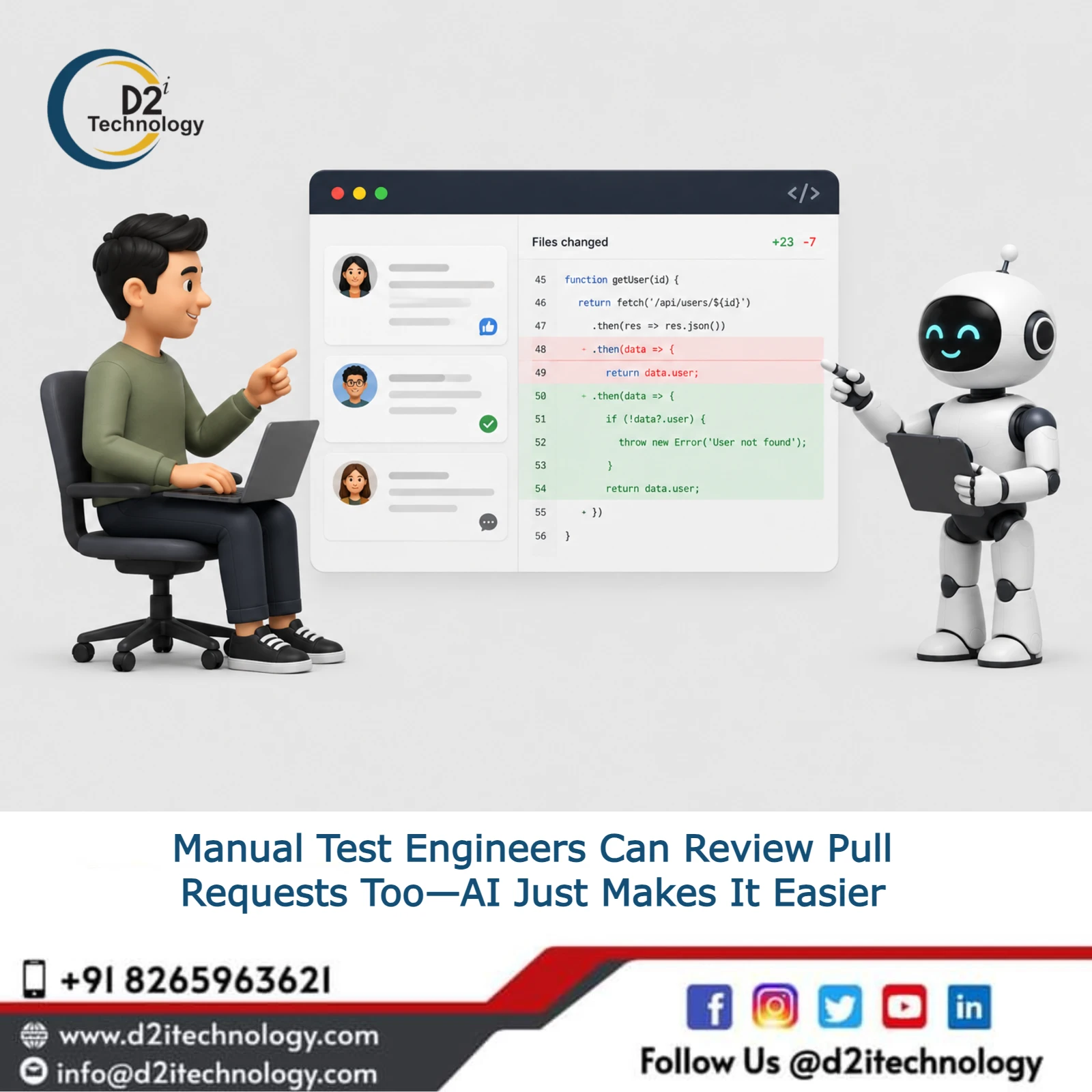
Like many other manual test engineers, I used to think that reviewing pull requests simply wasn’t part of my job. My work started the moment a build landed in the QA environment, not before. Reviewing the code itself belonged to developers, and testers waited their turn once something was ready to click through. That’s how a Manual Testing Service operated for years, and honestly, it worked well enough that nobody questioned it.
AI changed that assumption for me. Once I started using it alongside my regular testing work, I realized I no longer needed deep coding expertise to understand what a pull request actually changed, why it changed, or what it might break. I could ask AI to walk me through it in plain language, test the described behavior against sample data, and start shaping a test strategy before the code ever reached the QA environment. That shift didn’t devalue what testers do — if anything, it gave us an earlier seat at the table, at the exact stage where catching a problem is cheapest.
At D2i Technology, this is now part of how our Manual Testing Service USA engagements run day to day, and it’s changed how early we catch issues that used to slip through until much later in the cycle.
Why Manual Testers Should Care About PR Reviews
Picture the usual scenario: a developer finishes a feature and opens a pull request to merge it into the main branch. Historically, testers stay out of that conversation entirely — code isn’t our responsibility, and it’s on the developer and their reviewer to decide when it’s production-ready. Meanwhile, a huge chunk of testing time gets spent later, after the build reaches QA, just figuring out what actually changed.
But what if a tester could understand the change before it’s even deployed?
Say a PR updates login functionality. Instead of waiting for a build to land in QA to learn what was touched, I can ask AI questions like:
- What business functionality has changed?
- Which areas or modules does this affect?
- Are there obvious edge cases here?
- What high-risk scenarios deserve special attention?
- Are there regression scenarios worth exploring?
By the time the build actually reaches me, I already have a working idea of what needs testing. That makes the whole QA process noticeably more efficient compared to the old approach of learning the code cold once it’s deployed. To be clear, this doesn’t make testers responsible for reviewing code quality — it just lets us engage with it earlier, with a better sense of what’s coming.
Where This Fits Into a Manual Testing Service
This kind of early engagement is exactly what separates a reactive testing setup from a genuinely proactive manual testing service. Testers who understand a change before it merges can flag missing validations, unclear requirements, or accessibility gaps while the developer still has the context fresh — instead of filing a bug report days later that sends everyone back to the same code.
AI Doesn’t Replace Testing Experience
The more I worked this way, the clearer it became that AI can explain what changed in the code, but it has no real sense of the business context behind it. It can tell me a function was modified, but not how actual users interact with that part of the product. It can list plausible regression scenarios, but it doesn’t know what issues real users have already reported in production.
In other words, AI offers ideas — the judgment about which ones matter still comes from the person using it. That, to me, is where the value of a manual tester really shows up. AI can suggest, summarize, and highlight risk areas, but choosing the test scenarios that actually matter for the business still depends on a tester’s experience and intuition. AI makes testers more productive; it doesn’t replace the skill of knowing what to prioritize.
Practical Ways I Use AI During a PR Review
Rather than reading every line of a complex diff line by line, I treat AI as a learning partner during review. Some of the prompts I rely on most:
Understanding the Change Itself
- What is this PR about, in plain terms?
- What functions or areas of the program does it touch?
- What does this specific function or class actually do?
Assessing Risk and Coverage
- What are the potential risks here, and how would I go about validating them?
- What positive, negative, and boundary test scenarios should I be considering?
- What validations might not have been accounted for?
These prompts don’t replace the code review a developer does — they simply help me understand the change faster, so I can start building test coverage around it sooner rather than later.
AI Also Speeds Up the Testing Work Itself
Beyond helping me understand a PR, AI has practical uses across daily testing activities too — generating sample API request bodies, drafting SQL queries for test data setup, writing first-pass bug descriptions, or outlining test plan documents. None of this replaces judgment, but it does clear away a lot of repetitive groundwork.
That matters because it frees up time for the parts of testing that genuinely need a human: exploratory testing, edge-case hunting, and building out realistic user scenarios that no AI summary would think to suggest on its own.
Accessibility Still Needs a Human Eye
This is where D2i Technology’s background adds something specific to the process. Any UI-facing pull request still needs a manual check against WCAG expectations — keyboard operability, correct ARIA labeling, focus behavior in modals and dropdowns. AI can point out that a component changed; it won’t reliably tell you that a screen reader will now announce the wrong label, or that a focus trap silently broke. That’s still a job for a tester who knows what to look for.
The Bigger Picture for Manual Testers
I think the role of a manual test engineer is genuinely evolving in the AI-assisted era. We’re no longer confined to testing only after code is written — we can engage with requirements and code changes early, flag risks, and collaborate with developers well before a build ever reaches QA.
That doesn’t make testers obsolete. If anything, it raises the value of the role, because now there’s a real need for people who know when to lean on AI to move faster and when to rely on their own testing instincts to catch what AI can’t see. Software quality, in the end, is still decided by people. AI is just a tool that helps us get there with less wasted time.
What This Means for Businesses Choosing a Testing Partner
If you’re evaluating a Manual Testing Service USA provider, this is worth asking about directly: does their QA team engage with pull requests, or do they only show up once a build is “done”? A partner who waits until the end is finding problems at the most expensive point to fix them. A partner who reviews changes early, understands the codebase’s history, and uses AI as a genuine aid rather than a substitute for judgment tends to deliver fewer regressions and faster releases.
At D2i Technology, this is how our testing engineers approach accessibility audits, functional QA, and full-cycle manual testing engagements — treating early involvement as a standard part of the process, not an optional extra.
Final Thoughts
AI has made it considerably easier for manual testers to understand code changes without needing to be developers themselves. It summarizes, it suggests, it accelerates — but the judgment about what actually matters for real users still comes from experience. The testers getting the most out of this shift aren’t handing PR understanding over to AI entirely; they’re using it to get to the same careful, user-focused testing work faster than before.
If your team still treats manual testing as something that starts only after code merges, PR-stage involvement is one of the simplest places to change that.
Frequently Asked Questions
Ready to Strengthen Your QA Process?
Let D2i Technology's manual testing experts work alongside your development team from the pull request stage onward, catching issues earlier and shipping with more confidence.