- AI Development
- June 4, 2026
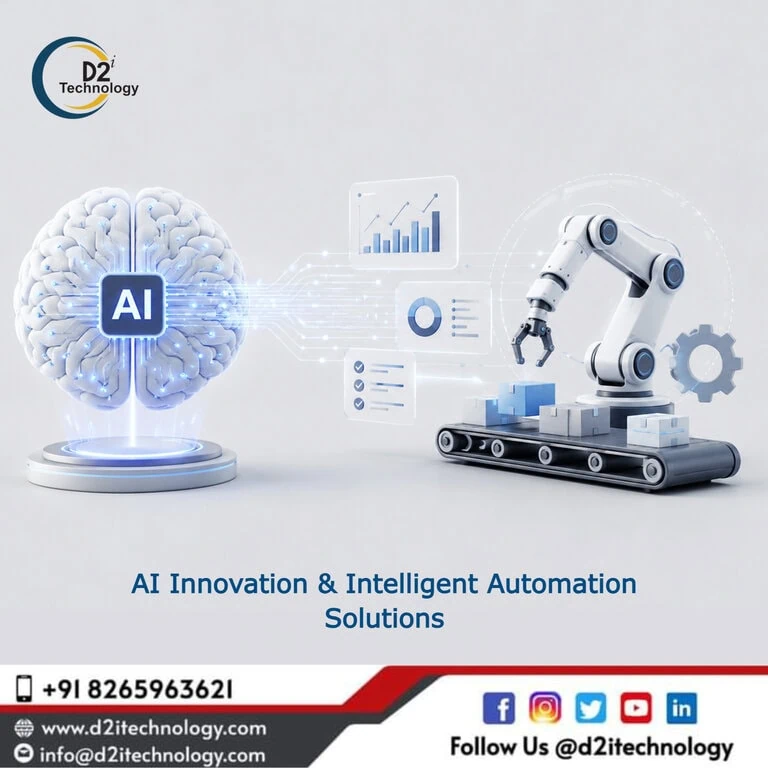
AI Innovation & Intelligent Automation Solutions
For years, artificial intelligence was positioned as a technology of the future — something that would eventually arrive, reshape industries, and change how businesses operate. That future is already here. Intelligent automation solutions are no longer experimental. They are live, operational, and quietly transforming how organisations manage workflows, serve customers, and use their data. The question most business leaders are asking now isn’t whether AI can help — it’s where to start, and who to trust to build it properly.
At D2i Technology, we’ve spent considerable time working with businesses that are past the curiosity stage. They understand the opportunity. What they need is a development partner who can translate that opportunity into a working system — one that integrates cleanly with existing processes, delivers measurable results, and continues to perform reliably after launch.
This post covers what intelligent automation genuinely looks like in practice: the use cases worth prioritising, the technology that powers it, and the implementation approach that separates high-value deployments from expensive disappointments.
Why Intelligent Automation Is a Business Priority Right Now
The economics of intelligent automation have shifted significantly. The barriers that once reserved AI for well-funded enterprise technology departments — specialist talent, expensive infrastructure, long implementation timelines — have dropped substantially. The same capabilities that once required millions in R&D investment are now accessible through modern APIs, cloud platforms, and development frameworks that a focused engineering team can deploy in weeks rather than years.
This shift creates a genuine window of opportunity for businesses willing to act before their competitors do.
But it also creates noise. Every software vendor now claims to offer AI capabilities. Every project management tool has an “AI assistant.” Distinguishing between genuine automation that transforms operations and surface-level features dressed up in AI language requires a clear-eyed view of what the technology can and can’t do in real business environments.
Our work on agentic AI and security risk in web applications addresses exactly that clarity gap — because understanding the limits of the technology is as important as understanding its potential.
What Intelligent Automation Actually Covers
The term “intelligent automation” is broad by design. It describes systems that go beyond rule-based scripts to handle variability, context, and complexity — the characteristics of real business workflows rather than idealised ones.
In practice, it spans four main capability areas.
AI Agents That Work Autonomously
AI agents are systems capable of receiving a goal, breaking it into steps, accessing tools and data sources, and completing tasks with minimal human oversight. This is a meaningful leap beyond basic chatbots or keyword-matching systems.
A well-built AI agent for business can:
- Handle customer enquiries that span multiple intents within a single conversation
- Access internal databases or CRM systems to retrieve real-time information
- Draft, format, and route documents based on content and context
- Monitor systems and trigger alerts or workflows when specific conditions are met
- Conduct structured research across multiple sources and return summarised findings
The operational impact is significant. An agent handling tier-one customer support around the clock doesn’t get tired, doesn’t need breaks, and maintains consistent quality across thousands of interactions. For businesses where support volume is high relative to team size, the efficiency gain is immediate and measurable.
Our detailed breakdown of AI agent testing for reliability, security, and performance explains how we validate these systems before they go live — because an agent that behaves unpredictably in production is worse than no agent at all.
Business Process Automation
Most businesses have a layer of repetitive, predictable work that consumes a disproportionate share of staff time. Document processing, data entry, invoice handling, compliance reporting, appointment scheduling — these are activities where human effort adds cost without adding creativity or strategic value.
Business process automation targets this layer directly. By combining workflow orchestration with AI-powered decision logic, it’s possible to automate entire end-to-end processes rather than isolated individual steps.
The distinction matters. Automating one step in a five-step process reduces friction but doesn’t eliminate the bottleneck. Automating the full workflow — including exception handling, escalation logic, and integration with downstream systems — is what produces a genuine productivity shift.
For e-commerce businesses specifically, this means order processing, inventory updates, and customer communication can run without manual intervention. For financial services organisations, it means compliance documentation and reporting workflows that previously consumed analyst hours can be handled systematically and consistently. For healthcare, it means administrative coordination — scheduling, referrals, documentation — can keep pace with clinical demand.
Conversational AI at Scale
Customer expectations have moved. The tolerance for slow response times, long hold queues, or email threads that span days has shrunk. Businesses that can deliver fast, accurate, contextually appropriate responses at scale have a measurable advantage in retention and acquisition.
Conversational AI — built properly — delivers this. Not as a deflection mechanism that frustrates users who can’t find the answer they need, but as a genuinely helpful first point of contact that resolves the majority of enquiries without escalation.
The quality of a conversational system depends heavily on the quality of its underlying design: the intent mapping, the knowledge base architecture, the escalation pathways, and the feedback loops that allow it to improve over time. These are engineering decisions, not just configuration choices — which is why the development partner matters as much as the platform.
Data Intelligence and Operational Insight
Data accumulates faster than most organisations can analyse it manually. Sales data, support ticket data, operational logs, customer behaviour data — all of it contains signal that could inform better decisions, but only if there’s a system capable of processing it at volume and surfacing what’s meaningful.
AI-powered analytics and reporting tools bridge this gap. Rather than waiting for a quarterly report prepared by an analyst, operational leaders can access live dashboards that highlight trends, flag anomalies, and surface the questions worth asking — in time to act on them.
This connects directly to D2i Technology’s broader work in custom web application development, where data visibility and intelligent reporting are recurring requirements across client engagements.
Industries Where Intelligent Automation Creates the Clearest Value
Intelligent automation is broadly applicable, but some industries have particularly acute pain points where the impact is especially significant.
Healthcare Administration
Healthcare organisations carry an enormous administrative burden alongside their clinical responsibilities. Appointment scheduling, patient communication, referral coordination, documentation, and compliance reporting all consume time that clinical staff would rather spend on patient care.
Automation in this context doesn’t compromise clinical quality — it protects it, by freeing staff from administrative overhead and reducing the risk of errors in routine processes.
Financial Services and Compliance
Financial institutions operate under strict regulatory requirements, manage large volumes of sensitive data, and must maintain detailed audit trails across all operations. These characteristics make them ideal candidates for intelligent automation — particularly for document verification, fraud monitoring, customer onboarding, and automated compliance reporting.
Our accessibility and compliance work for financial institutions reflects how deeply we understand regulated-environment requirements, which directly informs how we approach security and auditability in AI systems for this sector.
E-Commerce Operations
Online retail generates enormous operational volume relative to team size. Product catalogue management, customer support, returns processing, inventory forecasting, and marketing personalisation are all areas where automation multiplies capacity without proportionally increasing cost.
Recommendation engines and personalisation systems also belong here — AI that improves conversion by surfacing relevant products to specific customers based on behaviour, not just category browsing.
Education and Learning Platforms
From student support and content personalisation to administrative workflows and performance reporting, educational institutions and EdTech platforms are finding significant value in AI-driven systems. Our experience with e-learning accessibility and Articulate Storyline 360 has given D2i Technology a particularly strong understanding of the nuances involved in building AI systems for learner-facing environments.
Startups Building AI-Native Products
Many of the most interesting AI deployments aren’t internal automation projects — they’re startups building AI capabilities directly into the products they sell. For these teams, the development partner relationship is especially important: the code being written is the product, not infrastructure supporting it.
How D2i Technology Approaches AI Development
Our process starts with discovery, not development. Before any code is written, we invest time in understanding the business context:
- What processes are consuming the most time relative to the value they produce?
- Where do errors or inconsistencies most frequently occur, and what’s their downstream impact?
- What does the user experience need to feel like — for customers, for internal staff, or both?
- What existing systems need to be integrated, and what are their constraints?
This phase shapes everything that follows. A solution designed around accurate problem understanding will always outperform one built from a generic template, regardless of how sophisticated the underlying technology is.
From discovery, we move to strategy and architecture — defining the technical approach, the data requirements, the integration points, and the performance criteria the system needs to meet. Only then does development begin.
Our commitment to long-term software quality means that AI systems we build are designed with maintainability and extensibility in mind from day one. Automation infrastructure that’s difficult to update, audit, or extend quickly becomes a liability rather than an asset.
Security and reliability are not afterthoughts. Every system we build incorporates secure architecture design, access controls, data protection practices, and monitoring capabilities aligned to the environment it operates in. For a deeper look at how we approach AI governance specifically, our piece on agent governance and AI monitoring outlines the framework we apply.
The Real Value Proposition of Intelligent Automation
Every business case for intelligent automation ultimately rests on three levers: time saved, errors reduced, and capacity unlocked.
Time saved is the most immediate. When a process that previously required two hours of manual effort runs automatically in minutes, the staff hours reclaimed can be redirected toward work that genuinely requires human judgement, creativity, or relationship-building.
Errors reduced matters particularly in compliance-sensitive environments, where a single processing mistake can trigger regulatory scrutiny or customer-facing consequences. Consistent, rule-governed automation removes the variability that leads to errors in high-volume manual workflows.
Capacity unlocked is the long-term multiplier. A team that was previously operating at capacity because of administrative load can take on more clients, more projects, or more strategic initiatives without proportionally increasing headcount.
That combination — efficiency, accuracy, and scalable capacity — is what makes intelligent automation one of the highest-return technology investments a business can make in 2026.
Frequently Asked Questions
Let's Build an Intelligent Automation System for Your Business
Whether you're exploring your first AI deployment or looking to expand existing automation capabilities, D2i Technology has the engineering expertise and business focus to help you build something that genuinely works. Tell us about the problem you're trying to solve — the conversation is free, and the clarity it provides is valuable.