- AI Development
- May 1, 2026
We Build AI That Solves Real Problems
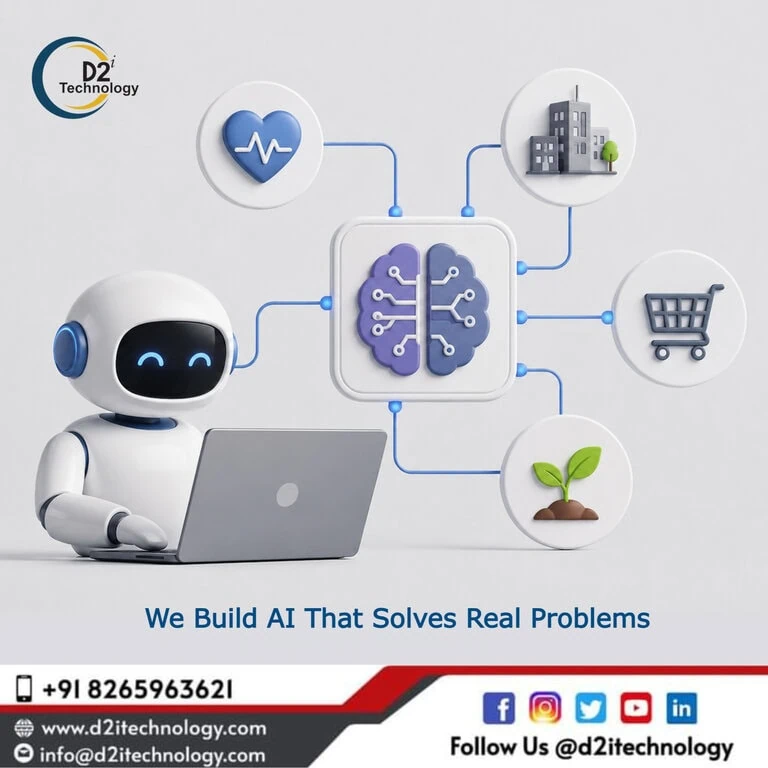
Every business leader has heard the pitch: AI will transform your operations, eliminate inefficiencies, and unlock unprecedented growth. But when business owners actually reach out to an AI development company, they rarely open with a request for machine learning models or neural networks. They come with something far more specific — and far more human.
They want to stop answering the same customer questions manually. They want to stop copying data between systems at the end of every workday. They want systems that work quietly and reliably in the background while their team focuses on what actually matters.
At D2i Technology, that’s exactly the kind of problem we build for.
What “AI Development” Actually Means in Practice
The term “AI development” gets stretched in a lot of different directions. For some companies, it means research labs and experimental prototypes. For others, it means slapping a chatbot on a website and calling it a day.
For us, it means building practical, production-ready technology that a business can actually use.
That includes intelligent AI agents, business automation systems, and fully custom tools designed around specific workflows. The common thread isn’t any particular technology — it’s a deliberate focus on outcomes over architecture.
If you’re looking at what this looks like in practice, our AI development services cover the full journey from problem discovery to deployment.
Why Businesses Actually Need AI Right Now
There’s a gap between businesses that are struggling with repetitive, manual work and the sophisticated AI technology that now exists to address it. That gap isn’t technical — it’s practical. Most business owners know they have inefficiencies. The challenge is finding a reliable partner who can bridge that gap without overcomplicating things.
Consider how much time is lost to tasks like:
- Responding to routine customer inquiries that follow the same patterns every day
- Pulling reports manually that could be generated on demand by an intelligent system
- Moving information between platforms that don’t communicate natively
- Following up on leads that haven’t been qualified yet
None of these problems require bleeding-edge research. They require thoughtful implementation of tools that already exist — applied by engineers who understand both the technology and the business context.
Our custom web application development work gave us that dual perspective early on, and it informs how we approach every AI engagement.
Intelligent AI Agents: A Digital Team Member, Not a Gimmick
The phrase “AI agent” gets overused, so let’s be specific about what it means when it’s done well.
An intelligent AI agent is a system that can receive instructions, retrieve information, make decisions within defined parameters, and take action — repeatedly, consistently, and without fatigue.
What That Looks Like in the Real World
Customer support agents handle common questions around the clock, routing complex issues to human agents only when genuinely necessary. This isn’t about replacing your support team — it’s about giving them back the hours they currently spend on repetitive, low-value queries.
Internal knowledge assistants help employees find policy documents, process guidelines, or historical project data in seconds instead of digging through folders or pinging colleagues.
Lead qualification agents engage with potential customers at the point of first contact, gathering key information and scoring intent before a salesperson’s time is involved.
Research assistants pull from multiple data sources, synthesize findings, and deliver structured summaries — tasks that previously consumed hours of analyst time.
These aren’t theoretical. They’re systems that teams are using right now to reclaim meaningful portions of their workday.
For a sense of how agentic AI is being tested and governed, our piece on agentic AI testing for security, accuracy, and reliability covers the quality side of this work in detail.
Business Automation Systems: The Quiet Multiplier
Automation isn’t glamorous. It doesn’t make for exciting boardroom presentations. But the compounding effect of automating repetitive processes across an organisation is one of the highest-value investments a business can make.
We build automation systems for:
- Email and communication management — routing, categorising, and drafting responses based on intent and content
- Document processing — extracting, classifying, and routing information from invoices, forms, and contracts
- Cross-platform data synchronisation — keeping CRM, project management, and reporting systems in sync without manual intervention
- Scheduled reporting and monitoring — delivering dashboards and alerts based on live data rather than waiting for someone to run a report
The key is reliability. An automation that breaks silently is worse than no automation at all. Everything we build is designed to fail gracefully, log clearly, and notify the right people when human review is needed.
Our approach to building web applications that scale globally applies directly here — automation infrastructure needs the same long-term architectural thinking as any production application.
Custom AI Tools: When Off-the-Shelf Doesn’t Fit
Not every business problem maps neatly to an existing product. Sometimes the workflow is unusual. Sometimes the data is sensitive and can’t leave a private environment. Sometimes the user base has specific accessibility or usability requirements that generic tools ignore.
That’s where custom AI tool development earns its place.
We’ve worked on systems spanning:
- Knowledge management platforms that let teams query internal documentation using natural language
- AI-powered dashboards that surface anomalies and trends from operational data in real time
- Workflow automation tools built into existing business applications via API integration
- Customer support systems with full conversation history, escalation logic, and CRM integration
- Data processing pipelines that transform raw inputs into structured, actionable outputs
The starting point is never “what technology should we use?” It’s always “what problem are we solving, and what does success look like?”
Our Process: Listen First, Build Second
A lot of development engagements go wrong because the discovery phase is rushed. A vendor hears a rough description of the problem, proposes a solution, and starts building — only to discover three months later that they solved the wrong version of the problem.
We do things differently.
Before any code is written, we spend dedicated time understanding the business context:
- What processes are currently slowing the team down?
- Where do errors most commonly occur, and what’s their downstream impact?
- What would a genuinely successful outcome look like six months after launch?
- Who are the end users, and what does their daily workflow actually look like?
Only once we have honest, specific answers to those questions do we design a solution. Then we build, test, refine, and deploy — with clear communication at every stage.
No bloated project teams. No lengthy consulting decks. Just practical engineering focused on delivery.
Industries Where This Work Creates Real Impact
Intelligent automation and AI tooling aren’t sector-specific. The underlying problems — repetitive work, fragmented data, slow communication — exist in almost every industry.
Small and Medium Businesses
Every hour saved from administrative work is an hour redirected toward growth. For smaller teams, the leverage from automation is disproportionately large.
E-Commerce
Customer support, order processing, inventory updates, and product recommendations all benefit from intelligent automation, often reducing response times and operational overhead simultaneously.
Healthcare
Administrative workflows, documentation support, appointment scheduling, and patient communication are areas where AI can reduce staff burden without compromising care quality.
Financial Services
Repetitive data processing, compliance documentation, reporting, and customer onboarding workflows are excellent candidates for automation in regulated environments.
Education and E-Learning
AI can support content delivery, student queries, administrative tasks, and learning pathway personalisation — areas that our e-learning accessibility work has consistently highlighted as high-value for improvement.
Building for the Long Term, Not Just Launch Day
One of the most common mistakes in software development — and AI development is no exception — is optimising entirely for the initial deployment. Systems get built to solve today’s problem but aren’t designed to handle more users, more data, or new requirements six months from now.
At D2i Technology, every system we build is designed with scalability in mind. That means modular architecture, clean API integrations, clear documentation, and deployment patterns that allow for growth without requiring a full rebuild.
The future of code review automation gives a clear picture of how automation-first thinking is reshaping the development process itself — and why long-term maintainability matters as much as launch quality.
Practical AI Is About Trust as Much as Technology
Working with an AI development company means sharing your processes, your data, and sometimes your competitive edge. That requires a relationship built on honest communication — not sales pressure.
We tell clients what’s achievable and what isn’t. We push back when a proposed solution is more complex than the problem warrants. And we don’t disappear after launch.
Long-term partnerships are built on consistent delivery and transparent communication. That’s the standard we hold ourselves to.
Frequently Asked Questions
Ready to Build AI That Actually Works for Your Business?
Whether you have a detailed brief or simply a business problem worth solving, D2i Technology can help you design and build an intelligent solution that delivers measurable results. Let's have a practical conversation about what's possible.