- Web Accessibility
- August 14, 2026
Complete Web Accessibility Toolkit for Developers and Businesses
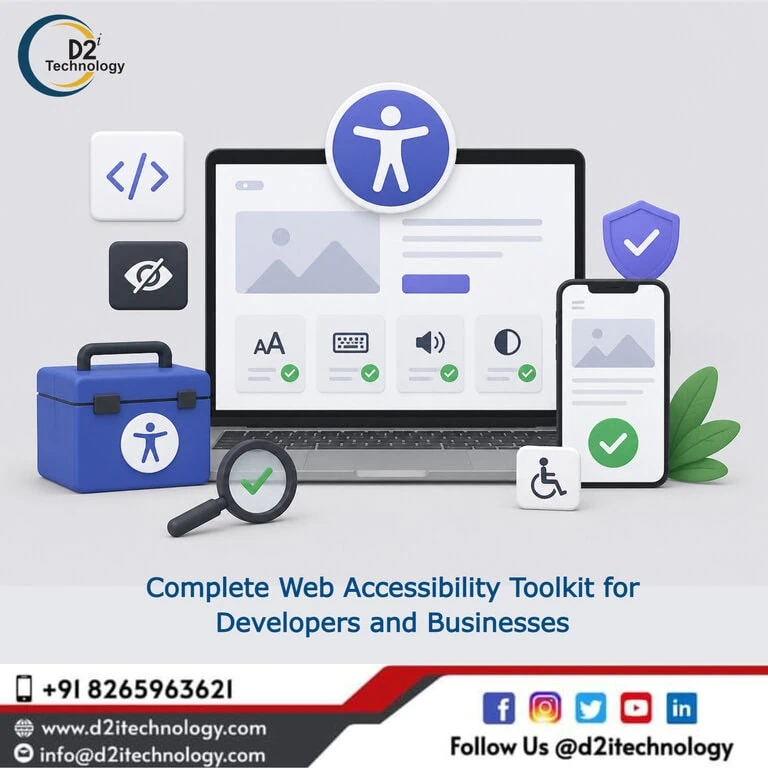
Accessibility doesn’t happen by accident. It’s the result of deliberate choices made at every stage of a website’s lifecycle — from the color palette chosen during design to the ARIA attributes written by a developer to the alt text added by a content editor three months after launch. Each of these people needs different tools to do their part of the work well. A web accessibility toolkit — understood in its broadest sense — is the collection of tools, testing resources, guidelines, and organizational practices that makes accessibility something a team can consistently deliver rather than occasionally remember.
This post maps out what a complete web accessibility toolkit looks like across its different layers: automated testing tools, manual evaluation tools, developer-specific resources, content authoring tools, and the organizational frameworks that make all of it stick.
Why a Toolkit Approach Matters
Accessibility testing and implementation are often treated as a single step — run a check, fix what it finds, done. That framing breaks down quickly in practice.
Automated checkers catch roughly 30–40% of WCAG failures. Manual evaluation with screen readers and keyboard navigation catches more. Color contrast tools address one specific family of issues. Developer linting tools catch problems at code time. Content author guidelines prevent new issues from appearing after launch. Organizational policies govern what gets procured and deployed.
None of these alone is sufficient. Together, they form a toolkit that makes accessibility a continuous quality standard rather than a periodic cleanup exercise. What a complete web accessibility testing toolkit contains covers the tooling side of this in practical depth — and is worth reading alongside this broader organizational framing.
The misconception that accessibility is only relevant for users with severe disabilities also affects how toolkit investment is prioritized. Accessibility serves far more people than those with permanent disabilities — it benefits aging users, people in temporary situational limitations, users on low-quality devices, and anyone navigating your site in suboptimal conditions. A toolkit built with that broader population in mind tends to be more comprehensive than one built for narrow compliance.
Layer 1: Automated Scanning Tools
Every accessibility toolkit starts here. Automated scanners run against your URL and return structured results mapped to WCAG success criteria. They’re fast, scalable, and well-suited to catching the structural and code-level issues that appear consistently across large sites.
Automated Website Scanners
D2i Technology’s D2i AccessScan provides WCAG-mapped automated scanning with structured results organized by severity and WCAG criterion. It’s built for the use case most teams actually need: not just a single-page check, but assessment across multiple pages with findings organized for both technical and compliance use.
For teams that want a broader comparison of available tools before committing to a workflow, the top 10 WCAG accessibility compliance checkers in 2026 evaluates the major options across coverage, accuracy, and output format.
Color Contrast Analysis
Color contrast failures are among the most frequently occurring — and most easily preventable — accessibility violations. A dedicated contrast tool belongs in every designer and developer’s daily workflow, not just in post-launch audits.
D2i Technology’s free Color Contrast Analyzer provides real-time ratio calculation against WCAG 2.1 thresholds — with pass/fail results for Level AA and AAA, for both normal and large text. Using it during design system decisions, rather than after brand colors are locked, produces significantly better outcomes. Tips for getting maximum value from an online color contrast checker covers practical workflow integration for design and development teams.
Browser Extension Tools
Browser extensions like axe DevTools and WAVE run directly in the browser context, testing the live rendered page rather than a static snapshot. This makes them particularly useful for testing pages that require authentication, dynamic content triggered by user interaction, or any state that can’t be reached by a URL-based scanner. These belong in every front-end developer’s browser, running on every page before it’s considered complete.
Layer 2: Manual Evaluation Tools
The 60–70% of WCAG failures that automated tools miss require human judgment and real assistive technology testing. The manual evaluation layer of any complete accessibility toolkit includes:
Screen Readers
NVDA (free, Windows), JAWS (Windows, commercial), and VoiceOver (built into macOS and iOS) are the primary screen readers used for accessibility testing. Testing with real screen readers reveals interaction failures that no automated tool can detect: whether a modal dialog correctly announces its purpose when opened, whether error messages are announced in context, whether a carousel’s navigation controls are described meaningfully, and whether focus management works correctly through multi-step processes.
Each screen reader behaves slightly differently, and test results sometimes vary between them. Testing with at least NVDA and VoiceOver covers the most commonly used combinations.
Keyboard Navigation Testing
Keyboard-only navigation testing doesn’t require any special tool beyond the keyboard itself. Tab through every interactive element on a page and verify: that focus is visible at all times, that no keyboard traps exist, that all functionality reachable by mouse is also reachable by keyboard, and that logical focus order is maintained. A guide to keyboard navigation accessibility requirements and testing provides the specific patterns and failure modes to test for.
Accessibility Bookmarklets and Browser Tools
Tools like the Accessibility Insights browser extension (from Microsoft) provide both automated scanning and guided manual test workflows — stepping evaluators through WCAG criteria that require human judgment with clear pass/fail questions. These bridge the gap between purely automated tools and full expert evaluation.
Layer 3: Developer-Specific Tools
Developers need accessibility tools that fit into code-writing workflows, not just post-build evaluation. The developer layer of an accessibility toolkit addresses this specifically.
Linting and IDE Integration
ESLint plugins for JSX accessibility (eslint-plugin-jsx-a11y for React projects) catch common accessibility violations at write time — before code is committed or reviewed. Missing button labels, incorrect ARIA role usage, images without alt attributes — these get flagged inline in the code editor rather than discovered after deployment.
A practical web accessibility guide written specifically for developers covers the implementation patterns that commonly get missed and how to address them in code — a useful reference for developers building accessibility awareness alongside their technical skills.
CI/CD Pipeline Integration
Running automated accessibility checks as part of the continuous integration pipeline means accessibility regressions are caught before they reach staging or production. The axe-core library can be integrated directly into testing suites used by most major frameworks. Every pull request that changes UI components can be automatically scanned, with failures blocking merges until resolved.
This approach fundamentally changes how accessibility is managed — from periodic audits that find accumulated issues to continuous testing that prevents accumulation in the first place.
The D2i Accessibility Toolkit for WordPress
For teams working in WordPress — which powers a significant portion of business and government websites — D2i Technology has developed the D2i Accessibility Toolkit plugin. It brings accessibility checking and improvement capabilities directly into the WordPress CMS environment, allowing content editors and site managers to evaluate accessibility at the point of content creation rather than discovering issues during a formal audit.
This is especially valuable for WordPress sites maintained by non-technical content teams, where accessibility failures often come from content decisions (missing image alt text, incorrect heading usage, inaccessible tables) rather than code-level problems. WordPress accessibility improvements that make a real difference for visitors covers the most impactful changes WordPress sites can make — many of which the toolkit helps implement.
Layer 4: Content and Design Resources
Developers can’t carry accessibility alone. The content and design layers introduce their own accessibility requirements, and a complete web accessibility toolkit equips those teams as well.
Content Author Guidelines
A one-page content author accessibility guide — covering image alt text, heading structure, link text, table formatting, and file accessibility — gives non-technical content teams actionable rules they can apply without deep WCAG knowledge. This prevents the most common content-level accessibility failures from entering the site in the first place.
Common accessibility issues and how to fix them identifies the patterns that recur most frequently across websites, many of which are content decisions rather than code problems. Making this a reference for content teams closes a gap that development-focused toolkits often leave open.
Design System Accessibility Standards
An accessible design system is the highest-leverage investment in accessibility that a digital team can make. When color tokens, typography scales, spacing standards, interactive component patterns, and focus styles are built with accessibility requirements baked in, every page built on that design system inherits accessibility by default rather than by effort.
Enhancing your site with color contrast tools integrated into the design process covers the specific point at which contrast decisions should happen — during design system specification, not after brand colors are locked.
Layer 5: Organizational Resources and Frameworks
Tools and technical guidelines only work within an organization that has committed to using them. The organizational layer of a web accessibility toolkit addresses policies, governance, and the structures that make accessibility a durable practice.
Accessibility Policy and Statement
An accessibility policy commits the organization to WCAG standards and establishes accountability. A public accessibility statement communicates the organization’s commitment to users and provides a feedback mechanism for reporting barriers. Both are required elements of a credible compliance posture, and both signal internal accountability in a way that informal commitments don’t.
Why accessibility should be integral to a company’s digital strategy makes the organizational case for treating accessibility as a core practice rather than a compliance add-on — relevant reading for leaders building the internal case for toolkit investment.
Accessibility in Procurement
The most effective time to address a vendor’s accessibility is before signing a contract. Procurement requirements that ask vendors for VPATs (Voluntary Product Accessibility Templates) or direct WCAG conformance evidence build accessibility standards into the tools and platforms your organization relies on.
An accessibility strategy for procurement provides a framework for building these requirements into vendor evaluation — particularly relevant for organizations adding new CMSs, authentication systems, payment processors, or customer-facing portals.
Regular Audit Cycles
No toolkit is complete without a plan for how often the site gets evaluated. Accessibility erodes with normal development activity. A regular audit cycle — combined with automated regression testing in CI/CD — keeps the gap between current state and required conformance manageable.
The organizational policies on web accessibility that sustain long-term compliance covers governance structures that keep accessibility on the agenda between formal audits.
D2i Technology’s Accessibility Tools and Services
D2i Technology provides both the tools and the professional services that constitute a complete web accessibility toolkit in practice. The free tools — D2i AccessScan, the Color Contrast Analyzer, and the D2i Accessibility Toolkit for WordPress — give development and content teams immediate capabilities at no cost.
Where organizations need to go further — with formal WCAG audits, assistive technology testing, remediation support, and compliance documentation — D2i Technology’s accessibility testing services and accessibility remediation services cover the full scope of professional engagement. The complete accessibility services overview maps out how these services connect and how organizations at different stages of their accessibility journey can engage.
For organizations curious about the business case beyond compliance, how accessibility affects e-commerce and online shopping experiences demonstrates the direct revenue implications of making digital products work for more people.
Conclusion
A web accessibility toolkit isn’t a single product — it’s a layered system of tools, testing resources, guidelines, and organizational practices that make accessibility achievable across the full development and content lifecycle. Automated scanners, color contrast checkers, screen readers, developer linting tools, design system standards, content author guidelines, procurement requirements, and regular audit cycles all play roles that the others can’t fill.
D2i Technology provides the tools and expertise to build this system for your organization — whether you’re starting with a free scan to understand where you stand, or building a complete compliance program with professional audit, remediation, and ongoing governance support.
Frequently Asked Questions
Build Your Web Accessibility Toolkit the Right Way
D2i Technology offers free accessibility tools, certified WCAG audits, professional remediation services, and the organizational guidance to build an accessibility practice that lasts. Whether you're just starting out or ready to close your compliance gap, we're here to help.