- AI Development
- November 2, 2026
Top 10 AI-Native Software Development Companies: Future-Ready Partners for 2026
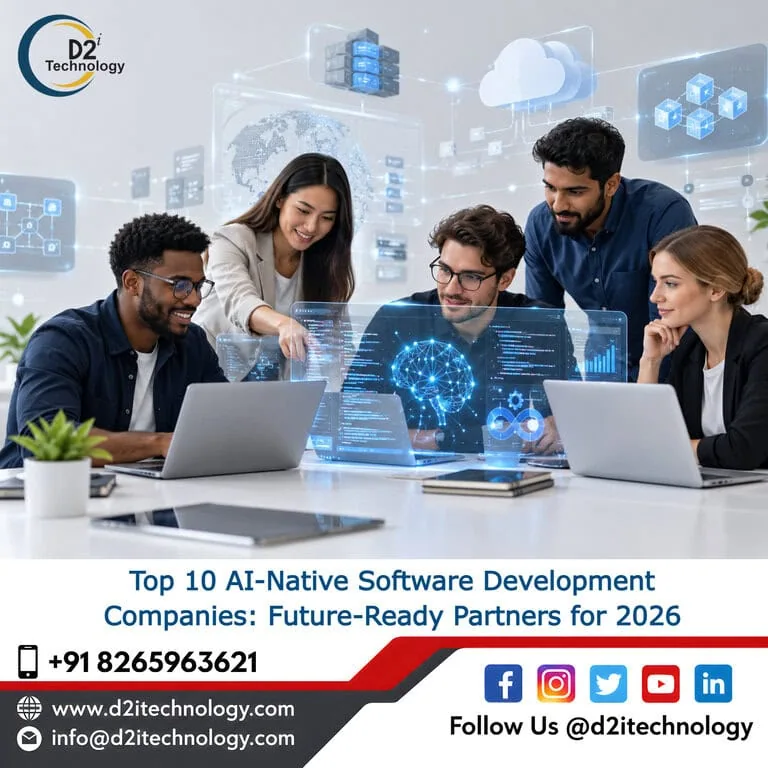
“AI-native” has become one of the most used phrases in software services, and it does not always mean the same thing. For some firms it means developers use coding assistants. For others it means AI agents handle large parts of the delivery process, or that every product they build has AI at its core. If you are comparing AI-native software development companies, it pays to understand what each one actually means by the term.
This guide explains what AI-native development really involves, compares ten AI-native software development companies and offers practical questions to separate genuine capability from marketing.
In the interest of transparency, D2i Technology is our own company and appears first. The other nine are included because of their public work and investment in AI-driven engineering, and we have described them fairly.
What Makes a Software Company AI-Native?
We think a genuinely AI-native company shows three traits.
AI Throughout the Delivery Process
AI supports every stage of the software lifecycle: turning requirements into user stories, drafting code, writing tests, reviewing pull requests, generating documentation and triaging bugs. We describe this in detail in our article on the agentic software development lifecycle.
AI at the Core of the Product
Products are designed around AI capabilities from the start, such as natural-language interfaces, intelligent automation or agents, rather than adding a chatbot at the end.
Strong Human Oversight
This is the part that marketing often skips. AI makes mistakes, sometimes confidently. Genuine AI-native development firms pair AI speed with experienced engineers who review, test and take responsibility for what ships.
Why AI-Native Development Matters
When done well, AI-native software development can:
- Shorten delivery time for routine features, integrations and tests.
- Improve test coverage, because writing tests becomes much cheaper.
- Keep documentation current as code changes.
- Free senior engineers to focus on architecture, security and difficult problems.
- Make AI features better, because the team understands AI’s strengths and failure modes from daily use.
When done badly, it produces large amounts of code nobody fully understands. The difference is discipline.
How We Chose These AI-Native Software Development Companies
We looked for firms that publicly describe how AI is built into their delivery approach, that build AI-powered products for clients and that show a serious approach to quality, security and governance. We included specialist firms, global engineering companies and consultancies.
Top 10 AI-Native Software Development Companies
1. D2i Technology
Services: AI-assisted software development, generative AI, AI agents, LLM and RAG development, testing, accessibility
D2i Technology works from Charlottesville, Virginia, and Noida, India. We use AI across our delivery process and have written extensively about it, including best practices for implementing agentic SDLC and how to build applications with agentic software development.
We also build AI-first products through our AI development services, including AI agents and generative AI applications. Every AI-assisted change is reviewed by engineers and checked by our QA, security and accessibility specialists before release.
Best for: businesses that want AI-driven speed without giving up testing, security or accessibility.
2. Turing
Focus: AI model development support, AI-powered engineering services
Palo Alto-based Turing works with leading AI labs on improving model capabilities and offers AI-focused engineering services to enterprises.
Best for: enterprises wanting engineers closely connected to frontier AI work.
3. Thoughtworks
Focus: AI-assisted engineering, platforms, software delivery
Thoughtworks has researched and written widely about AI-assisted software delivery, including through its Technology Radar, and brings strong engineering discipline.
Best for: enterprises that want a thoughtful, evidence-based approach.
4. Globant
Focus: AI-powered digital products, AI-driven delivery models
Globant has made AI central to its delivery approach and offers subscription-based AI Pods that combine AI agents with human experts.
Best for: organizations exploring new AI-driven service models.
5. EPAM Systems
Focus: AI engineering, AI-enabled delivery, platforms
EPAM Systems has invested heavily in AI-enabled engineering and builds AI capabilities into large enterprise platforms.
Best for: large organizations modernizing complex systems.
6. LeewayHertz
Focus: generative AI, AI agents, AI-first products
San Francisco-based LeewayHertz focuses on building products with generative AI and agents at their core.
Best for: companies building AI-first products.
7. Markovate
Focus: AI product development, agents, automation
Markovate builds AI-powered products for startups and growing businesses with a hands-on approach.
Best for: startups launching AI-native products.
8. BairesDev
Focus: nearshore engineering, AI development
BairesDev provides nearshore engineers with AI and machine learning skills, working in US-friendly time zones.
Best for: companies scaling AI-capable engineering teams.
9. Slalom
Focus: AI strategy and delivery, data, cloud
Slalom combines AI delivery with change management, helping organizations adopt AI-driven ways of working.
Best for: organizations changing how their own teams build software.
10. Accenture
Focus: enterprise AI, AI-enabled software engineering
Accenture has made large investments in AI and applies AI across its software engineering and operations services.
Best for: global enterprises running large AI transformations.
How AI Changes Each Stage of Development
Here is how AI-native software development companies typically use AI across the lifecycle, and where people still need to lead:
- Requirements: AI turns meeting notes and documents into draft user stories and acceptance criteria. Product owners check them for accuracy and priorities.
- Design: AI helps produce wireframes, component code and design variations. Designers make the decisions about experience, brand and accessibility.
- Coding: assistants and agents draft features, refactor code and write boilerplate. Engineers review every change and own the architecture.
- Testing: AI generates unit tests, test data and test cases from requirements. Testers decide what matters, explore edge cases and test with real assistive technology.
- Code review: AI flags likely bugs, security issues and style problems. Human reviewers approve merges.
- Documentation: AI keeps technical docs and release notes current. Engineers check that they are accurate.
- Operations: AI helps summarize incidents, analyze logs and suggest fixes. On-call engineers make the final call.
Our post on how AI agents improve SDLC stages goes deeper into each step.
Start With a Pilot
The best way to judge AI-native development firms is to see them work. A good pilot is a real feature or small product with a clear scope, delivered over four to eight weeks. During the pilot, look at:
- How quickly working software appears.
- The quality of the code, tests and documentation your own engineers review.
- How many defects reach staging and production.
- How openly the team explains where AI was used and what it got wrong.
Speed is easy to show in a demo. Quality over several weeks tells you much more.
Questions to Ask AI-Native Development Firms
How Do You Use AI at Each Stage?
Ask for specifics: which tools, at which stages, for which tasks. Vague answers like “we use AI everywhere” are a warning sign.
How Do You Review AI-Generated Code?
Every change should be reviewed by an experienced engineer who understands it. Ask how reviews work and who is accountable. Our post on code review automation covers how AI and human reviewers can work together.
How Do You Test?
AI-native software development companies should have strong automated test suites and experienced manual testers. AI can write tests, but humans need to decide what is worth testing. Our manual testing team is a key part of how we keep quality high.
How Do You Handle Security?
Ask about dependency scanning, secret detection, secure coding checks and penetration testing. The OWASP GenAI Security Project is a useful reference for AI-specific risks.
How Is Our Data Protected?
Find out which AI tools will see your code and data, where they run and whether anything is used to train third-party models. Make sure your contract covers this.
How Do You Measure the Benefit?
Ask how the firm measures speed and quality, such as cycle time, defect rates and change failure rates. Claims of huge productivity gains should come with evidence.
Is AI-Native Development Right for Every Project?
Not always. AI-native software development companies tend to deliver the biggest gains on well-understood work: CRUD applications, integrations, internal tools, test automation and modernizing legacy code with good test coverage.
The gains are smaller, and the risks higher, for highly regulated systems, safety-critical software, novel algorithms or code with little documentation and few tests. In those cases, AI can still help, but the share of human design, review and testing needs to be higher.
A trustworthy partner will tell you honestly where AI will help on your project and where it will not.
Risks of Getting AI-Native Development Wrong
- Hidden technical debt: code that works today but is hard to understand and change tomorrow.
- Security gaps: insecure patterns copied at scale.
- Accessibility regressions: AI tools often generate interfaces that look fine but fail screen reader and keyboard users. Testing against WCAG remains essential.
- Over-reliance: teams losing the skills to work without AI assistance.
Final Thoughts
The best AI-native software development companies use AI to move faster while keeping experienced people firmly in charge of quality, security and accessibility. Specialist firms bring focus on AI-first products, global engineering companies bring scale, and consultancies help change how your own teams work.
If you want AI-driven speed backed by thorough review and testing, D2i Technology would be glad to show you how we work. Our article on the future of software engineering with agentic AI shares more of our thinking.
Frequently Asked Questions
Build Faster With AI, Without Cutting Corners
D2i Technology combines AI-assisted engineering with experienced reviewers, testers and accessibility specialists, so you get speed and quality together. Tell us what you want to build, and we will show you how we would approach it.