- Web Accessibility
- August 12, 2026
Top WCAG Compliance Checker Tool for Website Accessibility Testing
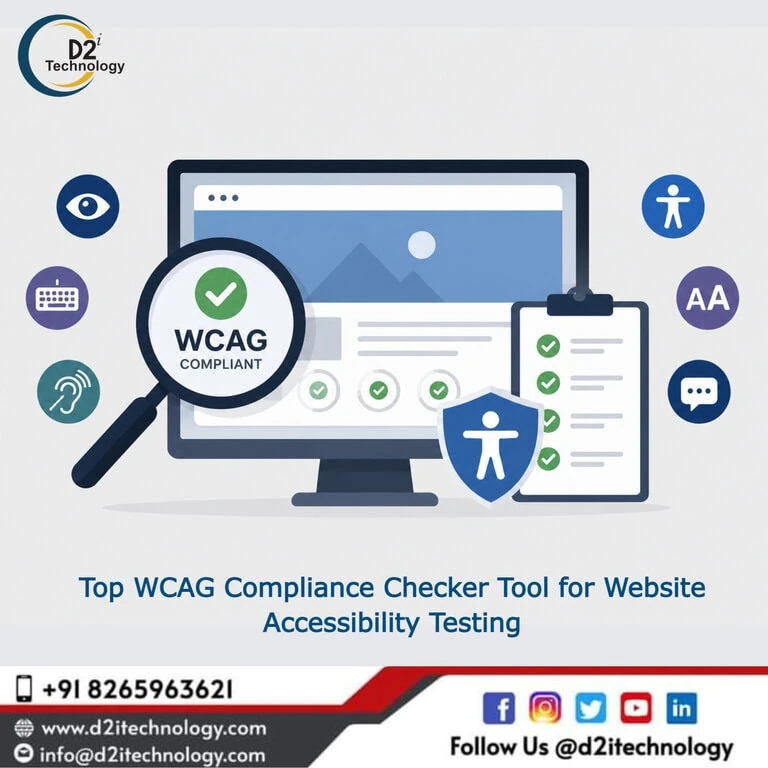
Choosing the right WCAG compliance checker tool isn’t a decision most people think about carefully — they grab whatever appears first in a search, run a scan, and treat the output as authoritative. That approach works until you’re facing a formal accessibility complaint, a compliance audit, or a legal deadline, at which point the difference between a thorough checker and a superficial one becomes very clear, very quickly. This post is for the teams and organizations who want to make that choice deliberately: understanding what a WCAG compliance checker actually tests, what separates better tools from worse ones, how to read results usefully, and how the best checkers fit within a complete accessibility testing program.
What WCAG Compliance Actually Means
Before evaluating any checker, it’s worth being precise about what “WCAG compliance” means, because the phrase gets used loosely in ways that create confusion.
WCAG — the Web Content Accessibility Guidelines — is a technical standard published by the W3C. Conformance with WCAG means a website or application meets a defined set of success criteria at a specified level (A, AA, or AAA). WCAG 2.1 Level AA is the level required by most current legal frameworks: ADA Title II for US government entities, Section 508 for federal contractors, and accessibility regulations in the EU, Canada, and Australia.
The four principles underlying all WCAG success criteria are Perceivable, Operable, Understandable, and Robust — the POUR framework. Every accessibility requirement flows from these four properties: content must be perceivable by users who can’t see, hear, or both; operable by users who can’t use a mouse; understandable by users who process information differently; and robust enough to work with current and future assistive technologies.
The four WCAG principles and what they mean in practice is a useful foundation before working with any compliance checker, because it frames why individual violations matter — not just which boxes they check.
A WCAG compliance checker tests the subset of these criteria that can be evaluated automatically. It does not — and cannot — verify full WCAG conformance. Understanding that distinction upfront prevents the most common mistake organizations make with these tools.
What a WCAG Compliance Checker Tests
Perceivable: The Criteria Checkers Handle Well
Most compliance checkers have strong coverage of Perceivable criteria that are code-detectable:
Text alternatives (1.1.1): Whether images have alt attributes, whether decorative images are properly marked as such, and whether complex images have extended descriptions.
Color contrast (1.4.3 and 1.4.11): Whether text meets the 4.5:1 minimum ratio for normal text and 3:1 for large text and UI components. This is one of the most reliably detected violations across all WCAG checkers.
Adaptable content: Whether the page has a declared language (3.1.1), whether reading order is meaningful in the DOM, and whether orientation is not restricted (1.3.4).
Where Perceivable criteria get harder for checkers is in areas requiring judgment: whether audio descriptions adequately describe video content, whether a text alternative is meaningfully descriptive rather than just syntactically present, and whether time-based media is captioned correctly.
Operable: Mixed Coverage
Operable criteria present a split picture for automated checkers. Some are reliably detected:
Focus visibility (2.4.7): Whether focusable elements have a visible focus indicator — though checkers can only confirm CSS focus styles exist, not whether they’re actually visible at the required contrast.
Skip navigation (2.4.1): Whether a mechanism exists to bypass repeated blocks of content — typically a skip link.
Page titled (2.4.2): Whether each page has a unique, descriptive title.
Link purpose (2.4.4): Whether link text is descriptive — though checkers are conservative here, since “read more” is technically detectable as vague while “learn more about our accessibility services” typically passes.
Where checkers struggle with Operable criteria: whether keyboard navigation works through complex interactive components, whether there are keyboard traps, and whether timing can be adjusted in time-limited content. These require behavioral testing, not code analysis.
Understandable and Robust: Mostly Manual Territory
Understandable criteria — error identification, labels and instructions, consistent navigation — have partial automated coverage. Robust criteria, which concern whether content is reliably interpreted by assistive technologies, also have partial coverage: duplicate IDs, missing ARIA roles, invalid attribute values. But verifying that ARIA is implemented correctly — not just that attributes are present — requires screen reader testing.
The 2026 accessibility testing landscape and what WCAG 3 changes brings context to how checker technology is evolving alongside the standards themselves, including what the next generation of compliance verification looks like.
Evaluating a WCAG Compliance Checker: The Criteria That Matter
Rule Set Currency
The tool needs to test against the current applicable WCAG version. WCAG 2.1 added criteria that WCAG 2.0-only tools miss. WCAG 2.2 added additional criteria around focus appearance (2.4.11, 2.4.12) and accessible authentication (3.3.7, 3.3.8). A checker that claims WCAG 2.2 coverage but only implements WCAG 2.0 rules is misrepresenting itself — and its results will create false confidence.
D2i Technology’s D2i AccessScan implements current WCAG 2.1 Level AA rules, returning structured results that map directly to WCAG success criteria so you can trace every finding to its compliance context. Alongside AccessScan, the D2i Color Contrast Analyzer addresses WCAG 1.4.3 and 1.4.11 specifically, with real-time pass/fail feedback against both AA and AAA thresholds.
For a comparative view of how major available WCAG checkers stack up, the top 10 WCAG accessibility compliance checkers in 2026 covers the field in detail, including rule coverage, accuracy, and output quality for each tool.
Output Format and Traceability
A WCAG compliance checker’s output needs to be actionable. Each finding should identify the WCAG success criterion violated, the specific element and its location in the page, the nature of the failure (what’s wrong with it), the severity of its impact on users, and a remediation direction.
Outputs that list violation counts without element-level specificity aren’t usable by development teams without a second round of investigation to locate the actual problem. When evaluating tools, generate a test run on a known page and assess whether the output gives a developer everything they need to find and fix the issue without additional research.
JavaScript and Dynamic Content Handling
Static HTML checkers miss the majority of accessibility issues on modern web applications built with React, Angular, or Vue, because the accessibility-relevant content doesn’t exist until JavaScript executes. A compliance checker that tests only the page source as-served will produce results that don’t reflect what real users — and real assistive technologies — encounter.
Look for tools that operate on the rendered DOM after JavaScript execution. This is especially important for single-page applications and any page that loads content dynamically.
Scalability Beyond Single Pages
Compliance programs don’t run one-page checks. They need to assess hundreds of pages across a domain, identify which violations are systemic (template-level) versus isolated (page-specific), and track progress as remediation work proceeds. Tools that can crawl a domain and aggregate results across pages are structurally more useful for compliance programs than those limited to single-URL evaluation.
Where WCAG Compliance Checkers Fit in a Testing Program
A WCAG compliance checker belongs at the automated layer of a broader accessibility testing program — not as the whole program. Why businesses need comprehensive accessibility testing services in 2026 makes this case clearly: the stakes in 2026 are high enough that relying solely on automated checking is an organizational risk, not a technical shortcut.
For organizations preparing for or managing against compliance obligations, the testing program should include:
Automated scanning with a WCAG compliance checker — covering the 30–40% of violations that are machine-detectable, providing broad coverage across many pages quickly.
Manual evaluation — covering interactive behavior, screen reader compatibility, cognitive accessibility, and all the criteria that require human judgment. How IAAP-certified accessibility auditors approach website evaluation explains what certified expertise adds to this layer.
Assistive technology testing — actual keyboard navigation, NVDA/JAWS/VoiceOver testing, voice control verification. These reveal behavioral failures that neither automated nor manual code review catches.
Regular re-scanning — because compliance erodes as content and code evolves. A website that passes today will accumulate new violations through normal development activity. Integrating checker scans into deployment workflows catches regressions before they reach production.
For Compliance-Focused Organizations
Organizations preparing formal WCAG conformance documentation for ADA, Section 508, or other regulatory requirements should understand that a checker tool scan — even a comprehensive one — doesn’t constitute a VPAT (Voluntary Product Accessibility Template) or a conformance claim. Formal conformance reporting requires evaluation against the complete set of applicable WCAG criteria by qualified evaluators.
Accessibility testing services structured for US ADA Title II and WCAG 2.2 compliance describes what a compliance-grade testing program looks like — and how it incorporates checker tools as one component rather than the whole.
For organizations that want to understand how WCAG checker results translate into a remediation program, the importance of web accessibility remediation covers the gap between a findings report and actual compliance — and why that gap requires structured work rather than a list of tickets.
Using Checker Results to Communicate Across Teams
One underappreciated function of a good WCAG compliance checker is its role as a communication tool across teams with different levels of technical knowledge.
Developers need element-level specificity and WCAG criterion references. Designers need to understand what specific contrast ratios mean visually and how they affect design decisions. Legal and compliance teams need summary views that connect findings to regulatory risk. Leadership needs enough context to make resourcing decisions.
The best checker outputs can be reformatted or filtered for different audiences. When evaluating a tool, consider whether its output can serve these different communication needs — or whether everything has to be manually reformatted for non-technical stakeholders.
The top 10 accessibility testing companies in the USA typically build this kind of cross-functional reporting into their professional service offerings — worth understanding if your compliance program involves stakeholders beyond the development team.
D2i Technology’s Accessibility Testing Toolkit
D2i Technology offers both the free AccessScan tool and comprehensive accessibility testing services for organizations that need more than automated checking can provide. The testing services cover full WCAG 2.1 and 2.2 evaluation, assistive technology testing, formal conformance documentation, and the accessibility remediation services that turn findings into actual compliance.
For certified compliance work, D2i Technology’s IAAP-certified auditors bring the credentials and evaluation depth that organizations need when formal conformance claims or regulatory defensibility is required. And for certified WCAG compliance auditing in 2026 specifically, certification signals the level of expertise that matters when accessibility findings will be scrutinized.
Conclusion
A WCAG compliance checker tool is a powerful entry point into accessibility testing — one that every development and compliance team should be using consistently. Chosen well, it surfaces real failures quickly, gives developers actionable information, and creates a baseline against which progress can be measured.
Chosen poorly — or treated as the entirety of a compliance program — it creates the illusion of coverage while leaving significant accessibility barriers unaddressed. The best use of a compliance checker is as the automated foundation of a testing program that also includes manual evaluation, assistive technology testing, and structured remediation. D2i Technology builds exactly that kind of program for organizations that need to move beyond tool-based checking to genuine, documented WCAG conformance.
Frequently Asked Questions
Ready to Test Your Website Against WCAG Standards?
Start with D2i Technology's free AccessScan tool for instant automated results — and when you need to go further, our IAAP-certified accessibility team delivers the full manual audit, remediation, and compliance documentation your organization needs.