- AI Development
- September 21, 2026
How to Build Applications Using Agentic Software Development
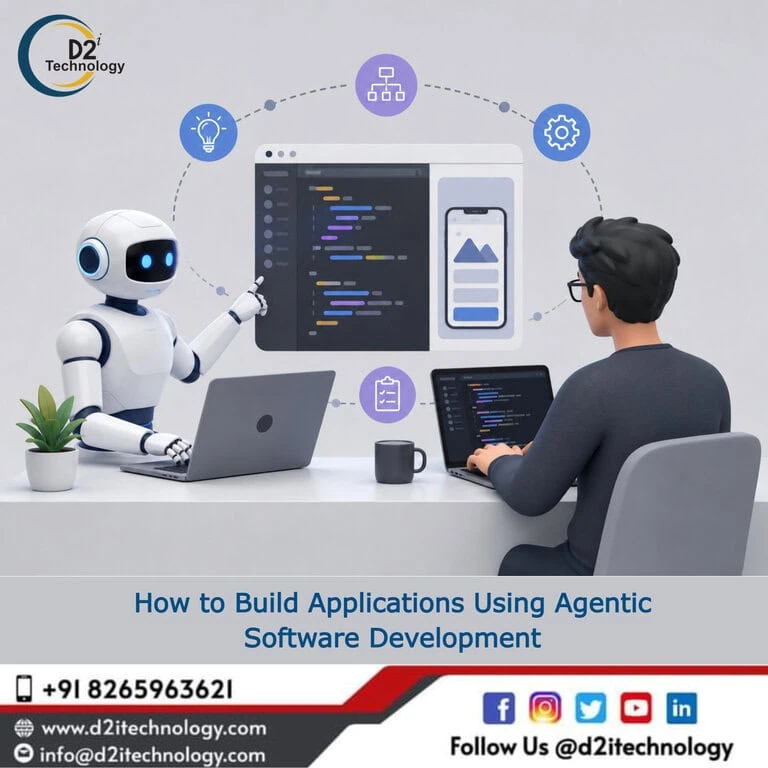
Building an application using agentic software development isn’t the same as building one with traditional AI assistance. With a code completion tool, developers still own every line of code — the AI accelerates writing, but a human decides what to write and why. With an agentic approach, AI agents take goal-directed actions across multiple development steps: analyzing requirements, drafting implementations across files, generating tests, executing them, and opening pull requests for human review. The development team shifts from writing code to directing, reviewing, and governing an agent-assisted process that produces code as its output.
That shift sounds appealing in the abstract. In practice, it requires a different set of decisions upfront — about how to structure requirements, how to set up the agent environment, how to define human review responsibilities, and how to maintain the kind of code ownership that keeps software maintainable over time. This post walks through those decisions in the practical order a development team faces them.
Step 1: Choose the Application Type That Fits Agentic Development Well
Not every application is equally suited to agentic development in 2026. Agent-assisted development produces the best results for applications where:
Requirements can be specified precisely. Agentic development is fundamentally a requirements-to-code translation process. If requirements are clear, testable, and well-bounded, agent implementations tend to be accurate and useful. If requirements are vague or depend heavily on implicit domain knowledge, agents produce implementations that technically compile but miss the point.
The codebase uses well-understood patterns. Agents trained on large corpora of code produce better results for popular frameworks (React, Node.js, Django, Spring Boot) than for proprietary or highly idiosyncratic codebases. Applications built on conventional, well-documented technology stacks get more value from agentic development than those requiring highly specialized domain knowledge.
The development team can maintain ownership of the output. Agentic development works best when human engineers understand the code that agents produce — not because they wrote every line, but because they reviewed it carefully enough to know what it does and why. Applications where the codebase will need to be maintained, extended, and debugged over years need engineers who can engage with it at depth, regardless of how it was initially produced.
What enterprise-scale application development actually involves and why architecture decisions matter beyond the initial build is relevant grounding here — the application types that work best for agentic development are those with clear structure, established patterns, and engineering teams prepared to govern the output.
Step 2: Set Up the Agent Environment
Before writing any specifications, the agent environment needs to be configured correctly. Doing this after development has started creates rework.
Define the Codebase Context
Agents produce better implementations when they have access to the existing codebase — its structure, conventions, and patterns. For a new application, this means creating enough scaffolding (directory structure, configuration files, base patterns, style guides) before engaging agents on feature implementation. For an existing codebase, it means ensuring agents have the right access scope — enough to understand context, but bounded by access controls that limit what they can modify without review.
Establish Access Controls and Authority Limits
Decide upfront what agents are authorized to do without human review: read operations, creating branches, opening pull requests — and what requires explicit approval: merging, database schema changes, environment variable modifications, any write to production systems. These boundaries need to be enforced technically (branch protection rules, CI gate requirements, API scope restrictions) rather than stated as policy and relied upon as convention.
How to structure governance and monitoring for AI agents to keep consequential actions within defined boundaries covers this in depth — the governance configuration done at setup time shapes every subsequent agent interaction in the project.
Configure the CI/CD Pipeline as a Quality Gate
The CI/CD pipeline is the enforcement layer for quality on agent-generated code. Before agents start producing pull requests, the pipeline needs to be running — with automated tests, static analysis, security scanning, and accessibility checks all configured to fail on violations. Agent-generated contributions should go through exactly the same pipeline as human-written contributions. Why well-structured CI/CD pipelines are the foundation that makes agent output reliable rather than merely fast captures this dependency precisely.
D2i Technology’s DevOps services cover the pipeline design and infrastructure that makes this quality gate work in practice.
Step 3: Write Specifications That Agents Can Execute
This is the step most teams underestimate. The quality of agent output is directly bounded by the quality of the specification it receives. Requirements that work for human developers — who fill in gaps from domain knowledge, ask clarifying questions, and make reasonable interpretive assumptions — often don’t give agents enough to work from.
What Agent-Ready Specifications Look Like
Good agent specifications are:
- Self-contained: They don’t require external context to understand. All relevant constraints, requirements, and conventions are stated explicitly rather than implied.
- Testable: They specify acceptance criteria in terms that can be checked programmatically — not “the feature should be intuitive” but “submitting the form with field X empty should return a validation error with text Y.”
- Scoped to one coherent unit of work: Agents produce better results on bounded tasks. A specification for “implement the user authentication flow” is likely too large; “implement the password reset email generation function with parameters [specified]” is appropriately scoped.
- Convention-explicit: Style conventions, error handling patterns, logging standards, and naming conventions should be stated in the specification or referenced from a style guide the agent has access to, rather than expected to be inferred from the existing codebase.
This level of specification quality is higher than most teams apply to human development tasks — and it tends to be valuable regardless of whether agents or humans are implementing, because it reduces ambiguity that produces rework either way.
Step 4: Run the Agent-to-Review Loop
With environment configured and specifications written, the core agentic development loop looks like this:
- Task dispatch: A specification is passed to the agent (via whatever interface the team’s chosen tooling uses — Claude Code in the terminal, Cursor’s agent mode, or a custom orchestration layer).
- Agent execution: The agent researches the existing codebase, drafts the implementation across relevant files, generates corresponding tests, and opens a pull request.
- Automated pipeline review: The CI/CD pipeline runs — tests, linting, security scanning, accessibility checks. If the pipeline passes, the PR moves to human review; if it fails, the agent may be directed to address the failures.
- Human code review: An engineer reviews the implementation for correctness, security implications, and architectural fit. This review should be substantive — not a rubber stamp of the passing pipeline. The code review is where engineers maintain understanding of what’s been built.
- Iteration or merge: If the review surfaces issues, they’re addressed (either by the agent based on review feedback or by the human reviewer directly, depending on the nature of the issue) and the pipeline runs again. If the review passes, the PR merges.
How code review in AI-assisted development differs from traditional review and what makes it effective covers what engineers should actually be looking for when reviewing agent-generated code — it’s a different cognitive mode than reviewing code written by a colleague whose reasoning you can infer from the changes.
Step 5: Maintain Testing Discipline Alongside Agent Output
Agents can generate tests, and those generated tests have real value. They also have a consistent limitation: they test what the specification says, not what the system should do under conditions the specification didn’t anticipate. Building applications with agentic development requires intentional testing practice alongside agent-generated coverage.
Test Agent Outputs at the Unit and Integration Level
Agent-generated unit tests catch the obvious cases — the happy path and the documented error cases. Supplement these with integration tests that verify component interactions and edge cases that emerge from component combinations. How automated testing frameworks like Playwright integrate with AI-assisted test generation covers the practical side of this for browser-side testing scenarios.
Test the Application’s Security Properties Explicitly
Applications built with AI-generated code need the same security validation as applications built with human-written code — and the agent infrastructure itself needs to be evaluated for the security risks it introduces. Security risks specific to agentic AI operating in web application environments covers the agent-specific security dimension; D2i Technology’s security testing services and penetration testing capabilities cover the application-level validation.
Include Accessibility in the CI Pipeline From Day One
Applications need to meet accessibility standards, and AI-generated UI code isn’t reliably accessible by default. Building automated accessibility checks into the CI pipeline — so they fail agent-generated contributions that introduce accessibility violations — catches problems before they accumulate. D2i Technology’s accessibility testing services cover the manual evaluation layer that automated checks miss.
Step 6: Maintain Code Ownership and Architectural Understanding
This is the discipline that separates agentic development engagements that remain sustainable over time from those that produce fast initial delivery and mounting technical debt.
When agents generate code that engineers review but don’t deeply understand, the engineering team gradually loses the ability to reason about their own system. Debugging becomes harder. New feature implementations conflict with patterns the team doesn’t remember introducing. Architectural problems become invisible until they cause incidents.
Maintaining code ownership in agentic development requires deliberate practice:
- Substantive code review — not just checking that tests pass, but understanding what the implementation does and why
- Architecture documentation updated to reflect agent-generated additions, not left as an artifact of the initial design
- Periodic human-written implementation of some features, particularly in critical or complex code paths, to maintain hands-on understanding of the codebase
D2i Technology’s approach to building AI that solves real engineering problems sustainably reflects this philosophy — agentic development that produces a codebase engineering teams can maintain and extend is valuable; agentic development that produces a codebase nobody fully understands is a liability with a delayed cost.
D2i Technology and Agentic Application Development
D2i Technology helps engineering teams implement agentic development workflows with the governance, security, quality assurance, and DevOps infrastructure needed to make agent-assisted development sustainable rather than just fast. Our AI development services cover both the agent implementation side and the engineering infrastructure side — because getting the governance and quality layers right is what determines whether agentic development delivers lasting value.
Conclusion
Agentic software development done well isn’t a shortcut to building applications — it’s a restructured development process that requires more careful upfront specification, more deliberate governance configuration, and more intentional code ownership practice than conventional development. The payoff is real: faster delivery on well-defined work, higher baseline test coverage, and the ability for engineering teams to focus more of their attention on the decisions that genuinely require human judgment. Getting there requires treating the agent environment setup, specification quality, and review discipline as seriously as any other part of the development process.
Frequently Asked Questions
Build Your Next Application With Agentic Development Done Right
D2i Technology helps engineering teams implement agentic software development workflows with the governance, security, testing, and DevOps infrastructure that makes AI-assisted development reliable — not just fast. Let's talk about your next build.