- AI Development
- September 30, 2026
How AI Agents Improve Every Stage of the SDLC
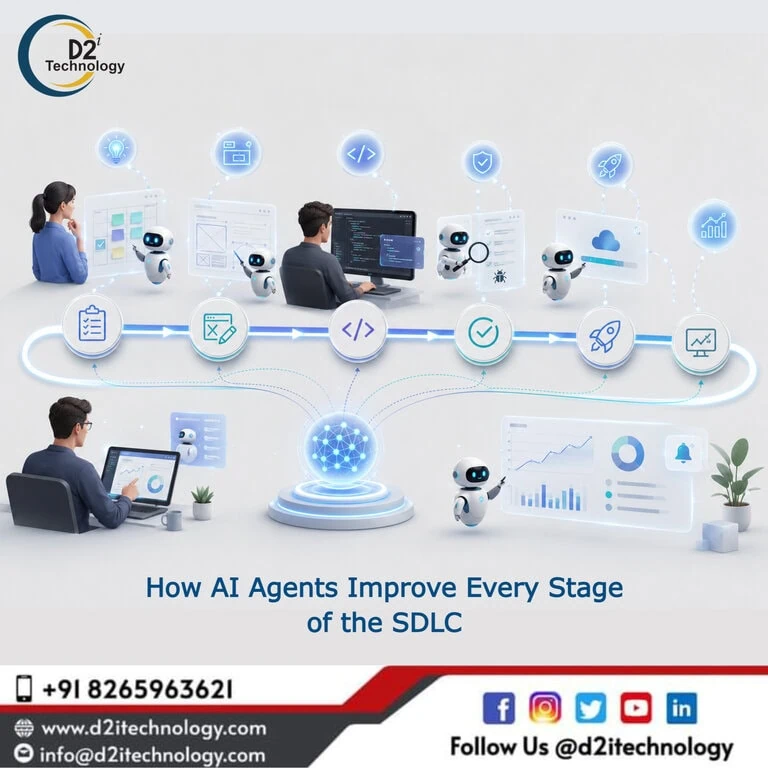
Software development has never lacked for tools that promised to speed things up. Most of them improved one part of the process while leaving the rest unchanged — a faster IDE, a smarter linter, a better test framework. What makes AI agents in SDLC different is that they operate across the full lifecycle, not just within a single tool or phase. The improvement isn’t confined to “developers write code faster.” It’s a more distributed change: agents that contribute to requirements analysis, generate implementation code, write and execute tests, review pull requests, manage deployments, and monitor production behavior — each improving its stage in specific, measurable ways.
This post maps those improvements stage by stage: what AI agents actually change, what the before-and-after looks like in practice, and where the limits of those improvements sit.
Requirements and Planning: From Synthesis Bottleneck to Structured Clarity
The problem before agents: Requirements gathering is slow and lossy. Stakeholders communicate in different vocabularies. Business analysts translate, interpret, and inevitably miss nuances. The gap between “what was said in the kickoff meeting” and “what the engineering team understood” is where a significant percentage of project rework originates.
What AI agents change: Research and synthesis agents can process large volumes of input — meeting transcripts, existing tickets, email threads, product specifications — and produce structured, queryable summaries. They identify where different stakeholders are using the same term to mean different things, flag requirements that conflict with existing system behavior, and generate first-draft user stories that product owners can review and refine rather than write from scratch.
The improvement isn’t eliminating the requirements phase — it’s compressing the time from “raw stakeholder input” to “engineering-ready specification” and reducing the amount of ambiguity that survives into implementation.
What agents don’t change: The judgment calls remain human. What to build, how to balance competing priorities, which trade-offs reflect actual business value — agents surface these tensions but don’t resolve them. How AI agent governance needs to be structured to keep human judgment in control of consequential decisions is directly relevant here: the governance framework sets the boundary between what agents recommend and what humans decide.
Architecture and Design: Pattern Matching at Scale
The problem before agents: Architecture decisions are made by a small number of experienced engineers, under time pressure, drawing on pattern libraries that exist mostly in their heads. Junior engineers contribute less than they could because they lack the pattern recognition that comes from years of architectural decision-making.
What AI agents change: Design-stage agents can query large bodies of architectural documentation, compare proposed designs against documented patterns and known anti-patterns, and flag structural concerns early. They can generate candidate architectures from stated constraints and explain the trade-offs between options in terms relevant to the specific project context.
This distributes architectural knowledge in a way that lets teams with fewer senior architects make better-informed decisions faster. It also creates a richer documentation trail — agents that explain their suggestions produce design rationale as a byproduct, rather than requiring engineers to write it separately.
What agents don’t change: Organizational context, team maturity, and strategic direction — the factors that distinguish the right architecture from the merely technically correct one — still require human judgment. What enterprise-scale application development actually involves at the architectural level reflects how much organizational context shapes architecture decisions in ways that agents can surface data about but not evaluate independently.
Implementation: Volume and Consistency at Speed
The problem before agents: A significant share of engineering time goes to work that isn’t intellectually challenging — writing boilerplate, implementing standard CRUD operations, generating test fixtures, updating documentation to match code changes. This work isn’t optional, but it’s not where engineers add their most distinctive value either.
What AI agents change: Code generation agents, given well-formed specifications and codebase context, can draft working implementations for defined features, write corresponding tests, and open pull requests for review. For bounded, well-specified tasks, this moves engineering time away from writing routine code toward reviewing, guiding, and making the decisions that actually require domain expertise.
The consistency improvement matters alongside the speed improvement. Agent-generated code follows specified conventions precisely every time — no style inconsistencies, no forgotten error handling patterns, no missed documentation requirements. That consistency reduces the cognitive load on reviewers and lowers the rate of style-related review comments.
What agents don’t change: The quality of agent output is bounded by the quality of the specification. Ambiguous requirements produce inconsistent implementations. How code review automation handles agent-generated contributions — and where human review remains essential covers this directly: automated review catches different things than human review, and the combination is more reliable than either alone.
D2i Technology’s approach to building AI that actually solves real problems reflects the implementation philosophy that makes agent-generated code production-quality: grounding AI capability in concrete, well-specified problems rather than attempting to automate away ambiguity.
Testing and Quality Assurance: Coverage Without Proportional Cost
The problem before agents: Testing is the part of the development process most consistently compressed under delivery pressure. Coverage requirements get waived, edge cases go untested, regression suites grow stale because updating them takes as long as writing new code. The result is that defect rates correlate inversely with schedule pressure — which is precisely when defects are most expensive.
What AI agents change: Test generation agents can analyze code and specifications to produce unit tests, integration tests, and test data at volume. They identify coverage gaps by comparing the test suite against function signatures and branch logic. They regenerate affected tests automatically when implementation changes.
This shifts testing from a phase that competes with implementation time to one that runs alongside it — agents writing tests in parallel with humans reviewing and extending them.
How automated testing and AI-assisted test generation work together in modern development workflows gives practical context for how specific test frameworks integrate with agent-generated test artifacts. The irreplaceable value of experienced human test engineers in AI-assisted development clarifies where human QA expertise remains essential: exploratory testing, user-scenario validation, and the judgment calls that specification-following agents don’t make well.
D2i Technology’s automation testing services and manual testing services are built to work alongside agent-generated test suites — covering the human evaluation layer that automated generation can’t replace.
What agents don’t change: AI-generated tests test what the specification says. They don’t test what the system should actually do in edge cases the specification didn’t anticipate. Testing for AI agents themselves — including adversarial behavior, prompt injection resistance, and reliability under unexpected conditions — requires dedicated evaluation frameworks. A guide to testing AI agents for reliability, security, and performance covers this specialized testing category.
Security Review: Consistent Scanning at Scale
The problem before agents: Security review is uneven. It’s thorough when the right engineer is reviewing, rushed when deadlines are tight, and essentially absent for codebases that have outgrown manual review capacity. Dependency vulnerabilities go unpatched because nobody is systematically tracking them. Configuration security varies across environments because it’s manually applied.
What AI agents change: Security analysis agents can continuously scan codebases against known vulnerability patterns, monitor dependency trees for published CVEs, review infrastructure configuration files for security misconfigurations, and flag code patterns associated with documented weakness types. The improvement isn’t the sophistication of any individual finding — it’s the consistency of coverage and the immediacy of detection.
Security risks specific to agentic AI systems operating in web application environments adds a critical dimension: as AI agents become more embedded in development environments, the security review needs to cover the agent infrastructure itself, not just the application being built. An agent with inappropriate access to production systems or credentials is itself a security risk.
D2i Technology’s security testing and penetration testing services provide the expert-led security validation that complements automated agent scanning — the human-led assessment that finds the context-dependent vulnerabilities that pattern-matching misses.
What agents don’t change: Novel attack vectors, business logic vulnerabilities, and exploitable combinations of individually safe behaviors require human security expertise to identify. Agent scanning finds known patterns; expert penetration testing finds patterns that aren’t yet known.
Deployment: Orchestration Without Human Bottlenecks
The problem before agents: Deployment processes are often slow not because the technical steps are slow, but because they require human coordination at every stage — someone to trigger the build, someone to monitor the pipeline, someone to approve promotion to production, someone on call to respond if something fails. This coordination creates delays that compound across release cycles.
What AI agents change: Deployment orchestration agents can manage the mechanical coordination of build pipelines, environment provisioning, test execution, and conditional deployment progression — acting on defined quality gates and promoting releases automatically when criteria are met.
Why well-structured CI/CD pipelines are the foundation that makes agentic deployment reliable captures the dependency: agents orchestrate deployment well when the pipeline is well-designed; they amplify inconsistency when it isn’t. D2i Technology’s DevOps services cover the pipeline design and infrastructure automation that make agent-assisted deployment safe, not just fast.
What agents don’t change: High-stakes deployment decisions — major releases, schema migrations, compliance-affecting changes — warrant human authorization regardless of automated quality gate results. The appropriate human checkpoint isn’t a failure of automation maturity; it’s deliberate governance design.
Monitoring and Maintenance: Signal Extraction From Noise
The problem before agents: Production systems generate more telemetry than on-call engineers can meaningfully parse. Logs, metrics, traces, and alerts blur together. Critical signals get missed. Postmortems discover that the warning was there — it just wasn’t visible in the volume of surrounding noise.
What AI agents change: Monitoring agents that continuously process telemetry can surface anomalies that match patterns associated with developing incidents, correlate errors with specific deployments or code changes, and generate contextual incident summaries that give on-call engineers a starting point rather than a raw data dump. The improvement is in signal-to-noise ratio: engineers see the things that need attention rather than everything that’s happening.
Agent governance and monitoring infrastructure for AI systems in production environments covers an important additional dimension: the monitoring agents themselves need to be monitored — their behavior, their access patterns, and their output quality all need to be tracked as part of the operational governance model.
What agents don’t change: Incident response decisions — particularly around data integrity issues, security events, or customer-impacting outages — require human judgment that accounts for business context, regulatory implications, and strategic priorities that automated systems can’t fully evaluate. Agents inform incident response; experienced engineers direct it.
Conclusion
AI agents in SDLC deliver real, measurable improvements at every stage of the development lifecycle — compressing requirements synthesis, accelerating implementation of well-defined work, raising test coverage baselines, extending security scanning consistency, reducing deployment coordination bottlenecks, and improving monitoring signal quality. At every stage, the improvement has a ceiling defined by the same factor: AI agents handle well-defined, pattern-following tasks well, and judgment-dependent, context-sensitive decisions remain human responsibilities.
Engineering organizations that understand this boundary clearly — and design their workflows, governance structures, and quality assurance practices around it — get the most durable benefit from AI agents in their development lifecycle.
Frequently Asked Questions
Integrate AI Agents Into Your SDLC With the Right Support
D2i Technology helps engineering teams implement AI-assisted development workflows with the security testing, quality assurance, and DevOps infrastructure that makes agent-assisted development reliable across every lifecycle stage.