- AI Development
- July 2, 2026
Best Practices for Implementing Agentic SDLC
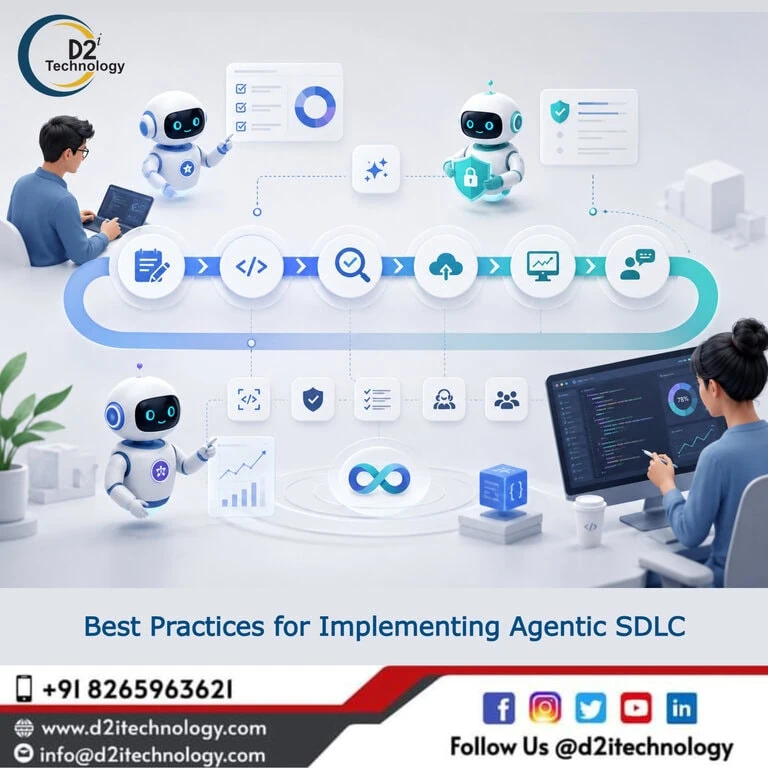
The software development lifecycle has been through many iterations — waterfall to agile, monolith to microservices, manual QA to automated testing. The next shift is happening now, and it’s a meaningful one. Agentic SDLC best practices are emerging as a distinct discipline as AI agents move from experimental tools to active participants in the development process — planning features, writing code, running tests, reviewing pull requests, and in some configurations, deploying to production. Organizations that get this transition right will ship faster and with fewer defects. Those that get it wrong will discover that autonomous AI in an undisciplined development environment creates problems at a speed and scale that manually written code rarely does.
This post covers the practical governance, security, testing, and collaboration practices that distinguish well-run agentic SDLC implementations from ones that generate impressive demos and unreliable outcomes.
What Agentic SDLC Actually Means in Practice
The term “agentic” refers to AI systems that take goal-directed actions across multiple steps — pursuing an objective, making decisions along the way, invoking tools and APIs, and adapting based on intermediate results, rather than simply generating text in response to a single prompt. In an SDLC context, this means AI agents that might autonomously research a feature requirement, draft code across multiple files, write corresponding tests, open a pull request, and flag it for human review — or in a more autonomous configuration, merge and deploy it.
This is a fundamentally different kind of AI integration than a code suggestion tool like GitHub Copilot operating in a single developer’s editor. Agentic systems take sequences of consequential actions. That autonomy changes the risk profile substantially, and it’s why the governance practices that work for conventional AI tooling in development need to be meaningfully extended for agentic implementations. The security risks specific to agentic AI systems operating in web application environments illustrates how the attack surface expands when AI agents can invoke APIs, access credentials, and take actions autonomously.
Establish Governance Before Deploying Agents
Define Agent Authority Boundaries Explicitly
The first governance decision in any agentic SDLC implementation is: what can agents do without human review, and what requires explicit approval? This isn’t a philosophical question — it’s an operational design decision that needs to be documented and enforced technically, not just stated in a policy.
Common authority boundaries include: agents can read any codebase, but writes require approval; agents can run tests and report results, but cannot merge to production branches; agents can create draft pull requests, but cannot resolve review comments or approve their own changes. Whatever boundaries you set, they need to be implemented at the system level — access controls, branch protection rules, API scopes — rather than relying on the agent to self-limit appropriately.
How AI agent governance and monitoring should be structured for production systems covers the monitoring and enforcement side of this: knowing what agents are doing in real time matters as much as defining what they’re allowed to do.
Build Audit Trails as a Non-Negotiable Baseline
Every action an agent takes — every API call, every file write, every test run, every external resource accessed — needs to be logged in a way that allows reconstruction of what happened and why. This isn’t primarily about catching malfeasance; it’s about debugging the inevitable cases where an agent does something unexpected, and about having evidence that your development process met regulatory requirements.
What the EU AI Act compliance process actually looks like when you’re implementing it makes clear that documentation of AI system behavior isn’t optional in regulated contexts — the compliance requirement is for demonstrated, verifiable governance, not just stated policy. The same principle applies to any enterprise AI system making consequential development decisions.
Security Practices for Agentic Development Environments
Treat Agents Like External Services, Not Trusted Insiders
A well-designed agentic system should operate with the minimum permissions necessary to accomplish its task. This means scoped API credentials rather than global access, read-only access to everything agents don’t need to write, and no access to production environments for agents that work in development and staging. The principle of least privilege, already standard practice for service accounts, applies with equal force — and arguably greater force — to autonomous AI agents.
Security testing approaches for agentic AI systems focusing on reliability, security, and accuracy covers how to evaluate whether an agent’s security implementation is actually holding up in practice, including prompt injection resistance, credential isolation, and behavior under adversarial inputs.
Test Agent Behavior Under Adversarial Conditions
Code generation and review agents process a lot of third-party content — library documentation, API specifications, user stories, external code being analyzed for integration. Any of this content could contain prompt injection attempts, maliciously crafted inputs designed to redirect the agent’s behavior. Testing agent systems for resistance to these attacks isn’t optional security hygiene — it’s a prerequisite for deploying agents in any environment where they have write access to a codebase.
D2i Technology’s AI agent testing guide covering reliability, security, and performance evaluation methods provides a structured framework for this kind of adversarial testing — designed specifically for the security and reliability characteristics that autonomous AI systems need to demonstrate before being trusted with production-adjacent workflows.
Testing and Quality Assurance in Agentic SDLC
Test AI-Generated Code With the Same Rigor as Human-Written Code
This should be obvious but is often not operationalized carefully: code generated by an AI agent is not inherently safer, better-tested, or more reliable than code written by a human. AI-generated code passes style standards, compiles, and runs — but it can contain subtle logical errors, security vulnerabilities, and edge-case failures that neither the generating model nor a cursory review will catch.
Every AI-generated code contribution should go through the same automated test suite, the same static analysis, the same security scanning, and the same human code review process that governs human-written contributions. How code review automation affects development efficiency and what the limits of that automation are is relevant context here — automated review tools catch different things than human reviewers do, and agentic SDLC doesn’t change that fundamental complementarity.
Use CI/CD Pipelines to Gate Agent-Generated Changes
The CI/CD pipeline is the right enforcement layer for quality standards on AI-generated code — build failures, failing tests, security scan findings, and accessibility check failures should all block agent-generated changes from merging, exactly as they block human-generated ones. Why well-structured CI/CD pipelines are fundamental to reliable software delivery is as applicable to agentic output as it is to traditional development — arguably more so, because agents can generate changes faster than human review alone can catch.
Incorporate Manual Review as a Deliberate Design Choice
Agentic SDLC doesn’t mean removing humans from the loop — it means deciding carefully and deliberately where human review adds the most value and ensuring those checkpoints are enforced. For consequential decisions — merging to main branches, changes to security-critical code paths, modifications to data handling logic — human review isn’t an optional extra. Why manual test engineers remain essential even in highly automated development environments makes this case directly in the context of AI-assisted development: AI makes engineers more productive, not redundant.
Collaboration Practices for Human-AI Development Teams
Define Clear Handoff Points
Productive human-AI collaboration in development requires knowing exactly where AI agent responsibility ends and human responsibility begins — for each task type, each code path, each stage of the pipeline. Vague handoffs produce dropped responsibility: humans assuming the agent verified something the agent assumed the human would verify.
Document and enforce these handoffs: agents draft, humans review; agents test to defined specifications, humans own the specifications; agents deploy to staging, humans authorize production. The specific boundaries will vary by team and risk tolerance, but the fact that clear boundaries exist — and are followed in practice — is what distinguishes a functional human-AI team from one that generates incidents.
Maintain Developer Context and Codebase Ownership
One of the risks of agentic SDLC that rarely gets discussed is diffusion of expertise. When agents write significant portions of a codebase, the developers who work in that codebase need to be deliberately engaged with understanding it — not just reviewing generated changes, but maintaining a working mental model of how the system operates. Code that nobody on the team fully understands is a significant long-term liability, regardless of whether it was generated by an agent or written by a contractor who no longer works there.
Deliberate practices that maintain developer understanding — architecture reviews, documentation requirements for agent-generated modules, rotation of human development work in critical code paths — are worth building into the team’s operating model from the start.
AI Governance, Compliance, and Continuous Improvement
Align With Emerging AI Regulatory Frameworks
The regulatory landscape for AI in software development is evolving quickly. A complete guide to the European AI Act and what it means for businesses building and using AI systems in 2026 is essential reading for any organization deploying agentic systems in markets subject to EU regulation. Even organizations operating outside EU jurisdiction often find that building to these standards positions them better for whatever regulatory requirements emerge in their own markets.
Build Monitoring Into the Agent Architecture From Day One
Retrospective monitoring of agent behavior is significantly less useful than real-time monitoring with defined alert conditions. Build monitoring into the agent architecture from the start: track what actions agents take, what resources they access, how often their outputs require human correction, and where performance degrades. This data isn’t just for debugging — it’s the foundation for systematic improvement of agent capabilities over time.
Treat Agentic SDLC as a Living System, Not a Project
The most common mistake organizations make with agentic SDLC implementation is treating the initial deployment as a finished state. Agent capabilities evolve, model versions change, codebase complexity grows, and team composition shifts. The governance model, testing practices, and collaboration boundaries that work at day thirty need to be revisited at month six, at year one, and whenever significant changes in agent capability or team practice occur.
D2i Technology’s AI development services approach enterprise AI implementation with this continuous improvement framing — building systems that are designed to be monitored, refined, and extended rather than deployed and left alone. The vision behind how D2i builds AI that solves real problems rather than creating new ones reflects the practical, outcome-focused philosophy that sustains AI investment over the long term.
Conclusion
Implementing agentic SDLC well isn’t primarily a technical problem — it’s a governance, security, and collaboration problem that happens to involve advanced technology. Agentic SDLC best practices converge on a consistent set of principles: define agent authority explicitly and enforce it technically, audit everything, test AI-generated code with the same rigor applied to human-written code, maintain clear human-AI handoffs, and build monitoring and continuous improvement into the architecture from the start.
Organizations that approach this with deliberate governance and genuine security discipline will find that AI agents meaningfully accelerate development without proportionally increasing risk. Those that treat agent deployment as a speed play without governance infrastructure tend to discover the risk side of the equation before they expected to.
Frequently Asked Questions
Ready to Implement Agentic AI in Your Development Lifecycle?
D2i Technology helps engineering organizations implement agentic AI systems with the governance, security testing, and collaboration frameworks needed to make autonomous AI a reliable part of the software development lifecycle — not an unpredictable one.