- AI Development
- September 25, 2026
Top AI Tools for Agentic Software Development in 2026
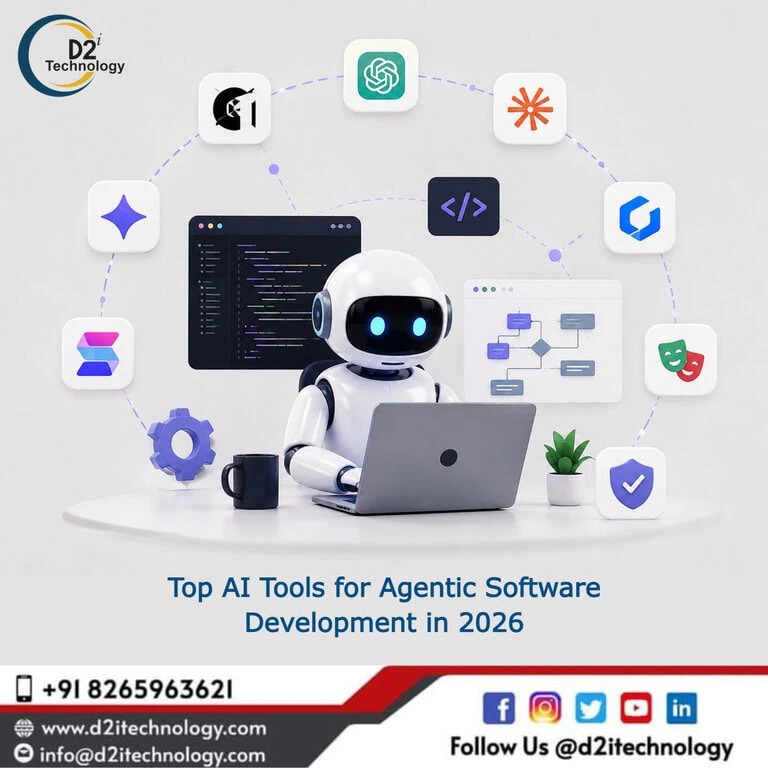
The AI tool landscape for software development has matured considerably. Two years ago, most teams were evaluating code completion assistants as discrete productivity add-ons. By 2026, the better question is how to assemble a coherent AI tools for software development ecosystem that spans the full development lifecycle — tools that work together across code generation, testing, security analysis, deployment automation, and monitoring — rather than deploying isolated capabilities that don’t connect. This post organizes the most relevant AI development tools by function, covers the meaningful distinctions between them, and addresses how to build a toolchain that actually holds together.
Code Generation and Completion Tools
This is where most teams start. Code generation tools differ more than they appear to at first glance — in how much codebase context they incorporate, how they handle multi-file edits, and whether they operate as autocomplete suggestions or as agentic task executors.
GitHub Copilot
GitHub Copilot remains the most widely deployed code generation tool in enterprise contexts, primarily because of its GitHub ecosystem integration. Its strength is inline suggestion — completing lines and functions as developers write, with reasonable codebase context from open files. The 2026 version has expanded toward more agentic behavior with Copilot Workspace, which can handle multi-file tasks from natural language descriptions.
Its limitation for agentic workflows is that it’s still primarily developer-facing rather than pipeline-integrated. Copilot suggestions require a developer in the loop to accept or reject.
Cursor
Cursor has become the preferred environment for developers who want code generation with deeper agentic capability — the ability to give a natural language goal and have the editor handle multi-file implementation rather than completing one line at a time. Its strength is the tight integration between the editing environment and the agent, which makes the handoff between human direction and agent execution feel more natural than in tools where the agent operates in a separate interface.
Claude Code (Anthropic)
Claude Code represents the terminal-native, agentic end of the code generation spectrum — designed for developers who want to delegate substantial implementation tasks to an agent operating in their development environment, with access to the filesystem, terminal, and version control. It’s particularly strong for tasks that require reading and modifying multiple files coherently, understanding existing code conventions, and producing implementations that fit naturally into an existing codebase.
D2i Technology builds AI solutions grounded in solving actual engineering problems — which is the practical philosophy that distinguishes deployments of tools like Claude Code that succeed from those that generate impressive outputs that don’t fit the actual codebase.
Agentic Orchestration Frameworks
Beyond individual code generation tools, agentic development increasingly relies on orchestration frameworks that coordinate multiple agents or tools toward a complex, multi-step goal.
LangChain and LangGraph
LangChain and its graph-based extension LangGraph provide the plumbing for building agent workflows — chaining together LLM calls, tool invocations, memory systems, and conditional logic into coherent pipelines. They’re framework-level infrastructure rather than end-user tools: the technology that engineering teams use to build custom development agents rather than something developers interact with directly.
For organizations building custom agentic SDLC tooling — agents that interact with their specific issue tracker, codebase conventions, and deployment environment — LangChain provides the composability layer that makes this feasible without building from scratch.
AutoGen (Microsoft)
AutoGen is Microsoft’s framework for building multi-agent conversations — systems where multiple specialized agents collaborate on a task, with each handling the aspects it’s best suited for. In software development contexts, this maps to scenarios where a planner agent breaks down requirements, a coder agent implements, a critic agent reviews, and a test agent verifies — all coordinated through AutoGen’s conversation framework.
How AI innovation and intelligent automation are reshaping how software development workflows get structured provides broader context for where multi-agent frameworks fit within the development automation landscape.
AI-Assisted Testing Tools
Diffblue Cover
Diffblue Cover focuses specifically on Java test generation — analyzing existing code and generating JUnit unit tests that achieve meaningful coverage without requiring developers to specify what to test. For Java-heavy enterprise codebases with large testing backlogs, it addresses a specific, high-volume problem with a specialized tool.
Codium AI (now Qodo)
Codium (rebranded as Qodo) takes a broader approach to AI-assisted testing — generating tests for multiple languages, but more importantly, generating tests that focus on edge cases and potential failure points rather than just coverage metrics. Its emphasis on testing for intent (what should this code do?) rather than just testing for behavior (what does this code currently do?) makes its outputs more useful for finding actual bugs rather than just increasing line coverage numbers.
Playwright with AI Integration
Playwright has become a leading end-to-end testing framework, and its 2026 integration with AI tooling — including AI-assisted test generation from UI descriptions and AI-driven test maintenance when application interfaces change — addresses one of the most persistent pain points in browser testing: the fragility of UI test selectors when applications evolve. How Playwright integrates into modern web testing workflows covers its capabilities in practical depth.
A critical note on AI testing tools: AI-generated tests test what the specification says, not what the system should do in unanticipated conditions. Exploratory testing and adversarial evaluation remain human activities that no current AI testing tool replaces. D2i Technology’s automation testing services and manual testing services complement AI-generated test coverage with human-led evaluation that catches what automated generation misses.
When the software itself is built using AI agents, the agents themselves become part of what needs to be tested. A guide to testing AI agents for reliability, security, and performance and testing agentic AI systems for security and accuracy in production contexts cover this specialized evaluation category that goes beyond standard software testing methodology.
AI-Powered Security Analysis Tools
Snyk
Snyk occupies a dominant position in AI-assisted security scanning for development teams — providing dependency vulnerability scanning, container security analysis, and code-level security issue detection integrated directly into development workflows. Its AI capabilities in 2026 have expanded toward suggesting fixes alongside flagging issues, reducing the gap between detection and remediation.
GitHub Advanced Security with Copilot Autofix
GitHub Advanced Security’s Copilot Autofix feature integrates directly with its code scanning to generate fix suggestions for identified security vulnerabilities — not just flagging issues but proposing code changes that address them. For teams already in the GitHub ecosystem, this tight integration between detection and remediation is practically valuable.
Semgrep with AI Extensions
Semgrep’s rule-based static analysis has been extended with AI capabilities that allow it to identify vulnerability patterns that don’t map cleanly to existing rules — applying learned pattern recognition rather than strictly defined templates. This is particularly relevant for application-specific security issues that generic rules don’t cover well.
The security tool caveat: All of these tools detect known patterns and documented vulnerability types efficiently. None of them find novel attack vectors, business logic vulnerabilities, or exploitable combinations of individually safe behaviors. The security risks specific to agentic AI systems operating in production environments covers a category of risk that standard security scanning doesn’t address: the attack surface introduced by the agent infrastructure itself. D2i Technology’s security testing and penetration testing services provide the expert-led evaluation that automated scanning can’t replace.
CI/CD and Deployment AI Tools
Harness AI
Harness has built significant AI capability into its CI/CD platform — AI-assisted pipeline generation, anomaly detection in deployment metrics, and intelligent rollback triggering based on production signals. Its AI features are embedded in the deployment orchestration layer rather than added as external integrations, which makes them more reliable in practice than bolt-on AI capabilities.
Jenkins with AI Plugins
Jenkins remains widely deployed in enterprise environments, and its 2026 AI plugin ecosystem has expanded to include AI-assisted pipeline configuration, intelligent test selection (running only the tests relevant to changed code), and automated root cause analysis when builds fail.
CircleCI with Predictive Test Selection
CircleCI’s Predictive Test Selection feature uses machine learning to identify which tests are most likely to fail given a specific set of code changes — running those tests first rather than waiting for a full suite to fail. For large test suites where full runs take hours, this meaningfully reduces the feedback cycle between code change and quality signal.
Why well-structured CI/CD pipelines are the foundation that makes agentic deployment reliable remains the relevant framing: AI capabilities in deployment tools amplify the quality of the underlying pipeline, which means the pipeline itself needs to be well-designed before AI features add meaningful value. D2i Technology’s DevOps services cover the pipeline design and infrastructure that makes AI-assisted deployment safe rather than just fast.
AI Monitoring and Observability Tools
Datadog AI Monitoring
Datadog has integrated AI capabilities into its observability platform — AI-assisted anomaly detection that learns baseline behavior and alerts on statistically significant deviations, AI-powered log analysis that surfaces meaningful patterns from high-volume log streams, and AI-generated incident summaries that give on-call engineers context rather than raw data.
New Relic AI
New Relic’s AI capabilities focus specifically on reducing alert fatigue — using AI to correlate related alerts, suppress noise, and surface the underlying causes of incidents rather than their symptoms. For teams managing complex, distributed systems where traditional alerting produces hundreds of low-signal notifications, AI correlation meaningfully improves the on-call experience.
How agent governance and monitoring infrastructure should be structured for AI systems in production is worth reading alongside AI monitoring tool evaluation — the monitoring infrastructure for AI agent behavior is distinct from general application monitoring, and both are necessary in agentic development environments.
Building a Coherent AI Toolchain
Selecting individual tools is less important than ensuring they work together coherently. The most common failure mode in AI tool adoption for development teams isn’t choosing the wrong tool — it’s adopting multiple capable tools that create conflicting signals, overlap in ways that waste money, or require integration work that offsets the productivity gains.
A coherent toolchain for agentic software development typically has:
- One primary code generation environment (Cursor, Claude Code, or Copilot Workspace) rather than three competing suggestions
- Test generation integrated with the same framework the team actually uses for testing
- Security scanning embedded in the CI/CD pipeline rather than run separately
- Monitoring AI that connects to the same observability infrastructure already in use
D2i Technology’s AI development services help engineering organizations navigate these decisions — not just recommending tools, but designing the toolchain architecture that makes multiple AI capabilities work together rather than against each other.
Conclusion
The best AI tools for software development in 2026 aren’t the ones with the most impressive demo — they’re the ones that fit into how your team actually works, connect with the infrastructure you already have, and improve the stages of development where you have the most friction. Building a coherent agentic development toolchain requires thinking across the full lifecycle, not just optimizing for the most visible bottleneck.
D2i Technology brings both the AI development expertise to help implement these tools and the security testing, quality assurance, and DevOps infrastructure to make them reliable in production.
Frequently Asked Questions
Build Your AI Development Toolchain With Expert Guidance
D2i Technology helps engineering teams select, integrate, and govern the AI tools for software development that fit their actual workflows — covering the full stack from code generation through security, testing, and deployment.