- AI Development
- September 16, 2026
The Future of Software Engineering: Agentic AI
Every major shift in software engineering has followed the same pattern: a capability that seemed futuristic becomes standard practice within a decade, and the skills that defined the previous generation become table stakes for the next. Assembly language gave way to high-level programming. Manual testing gave way to automated test suites. Hand-configured servers gave way to infrastructure as code. In each transition, the concern was the same — will this technology replace engineers? — and the answer was consistently the same: it changed what engineers do, not whether they’re needed. Agentic AI represents the current inflection point in that pattern, and understanding where it leads is genuinely important for everyone who builds software for a living.
This post looks at where the trajectory of agentic AI in software engineering points — not as prediction, but as a considered reading of what’s already happening and where the momentum is carrying the field.
What Makes This Transition Different From Previous Ones
Prior automation waves in software engineering automated discrete, well-bounded tasks: a compiler translates source code to machine code; a CI/CD pipeline automates build-test-deploy sequences; a linter enforces style rules. In each case, the automation operated within a fixed scope with deterministic behavior — it did exactly what it was configured to do.
Agentic AI operates differently. Rather than executing a fixed procedure, agentic systems pursue goals — they break down objectives into sub-tasks, decide how to approach each, invoke tools, interpret results, and adapt. This goal-directedness means the scope of what agents can take on isn’t inherently bounded by what was explicitly configured. An agent told to “implement this feature” can research the codebase, draft code across multiple files, write tests, resolve test failures, and produce a pull request — a sequence of decisions and actions that previously required a developer to execute step by step.
That difference in kind, not just degree, is why the current transition feels more significant than previous automation waves to many experienced engineers. How AI innovation and intelligent automation are changing the structure of software development work itself covers the practical dimension of this shift — the tasks that are being restructured, and what the new distribution of work between humans and AI systems looks like.
The Near-Term Future: Parallel Agent Teams
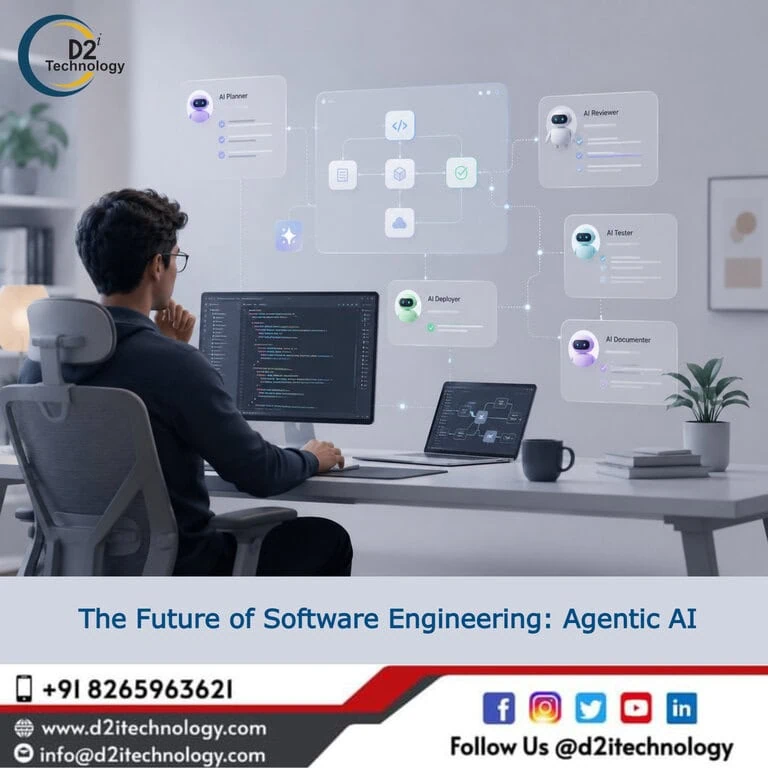
The most immediately plausible evolution from where we are now is the deployment of parallel agent teams — multiple specialized AI agents working on different aspects of a codebase simultaneously, coordinated by a higher-level orchestration layer, with human engineers providing direction, review, and governance.
In this model, a product team specifies a feature and the work fans out: a requirements agent structures the specification, a research agent surveys relevant existing code, multiple implementation agents work on separate components, a testing agent validates their output, and a security agent reviews the combined changes — all in parallel rather than sequentially. The calendar time from specification to pull request might compress from days to hours.
This isn’t science fiction. Multi-agent frameworks like Microsoft’s AutoGen are already providing the architectural plumbing for exactly these kinds of workflows, and the limiting factor today is less technical than organizational — teams need governance models and review workflows that can handle agent-generated outputs at that velocity before deploying agents at that scale.
How AI agent governance and monitoring need to be structured as agent capabilities scale is the foundational question this evolution raises: human review processes designed for one developer’s daily pull request volume don’t scale to parallel agent team output without deliberate redesign.
The Medium-Term Future: Self-Improving Engineering Systems
The more speculative — but already visible in early form — development is AI systems that don’t just execute development tasks but also improve their own processes. Systems that learn from code review feedback, identify patterns in which of their outputs required the most human correction, and adjust their behavior accordingly.
Early versions of this are visible in code generation tools that learn from developer acceptance or rejection patterns. More advanced versions would involve agents that identify recurring failure modes in their own outputs, generate hypotheses about why those failures occur, test those hypotheses by varying their approach on similar tasks, and update their behavior accordingly.
Why building AI that solves real engineering problems — rather than demonstrating capability — requires continuous refinement rather than one-time deployment captures the engineering discipline that makes this kind of system improvement sustainable: grounded in measurable outcomes, not impressive-sounding capabilities.
The Evolving Role of Software Engineers
The profession isn’t disappearing — its composition is shifting. Engineering work is moving toward a distribution where AI handles more of the volume and humans handle more of the judgment.
From Code Writers to System Directors
The engineer of the next decade will spend less time writing routine code and more time directing agent behavior — specifying what to build, defining quality standards, reviewing agent output, making architectural decisions, and maintaining the governance frameworks that keep autonomous systems operating safely within intended bounds. This is a meaningful shift in cognitive mode: from producer to director, from implementation to architecture and oversight.
Engineering Judgment Becomes More Valuable
A counterintuitive effect of AI automation is that the premium on genuine engineering judgment increases, not decreases. When routine implementation work is handled by agents, what distinguishes strong engineers isn’t their typing speed or their ability to recall syntax — it’s their ability to evaluate a proposed architecture’s long-term implications, identify when an agent’s implementation is technically correct but strategically wrong, recognize edge cases the specification didn’t anticipate, and make the trade-off decisions that determine whether software actually serves its purpose over time.
Why experienced manual test engineers remain indispensable even in highly automated development environments makes this case directly in the testing domain, and the logic extends across engineering roles: the expertise that makes humans valuable in software development has always been judgment, not mechanical execution.
Security and Reliability Engineering Become More Critical
As software is increasingly produced by AI agents operating at scale, the surface area for unexpected behavior expands. Security engineers who understand how to evaluate AI-generated code for subtle vulnerabilities, reliability engineers who can design systems that fail safely when agent outputs are incorrect, and quality engineers who develop evaluation frameworks for agent behavior all become more important, not less.
Security risks specific to agentic AI systems operating in web applications — both the applications they build and the agents themselves is a concrete example of the security engineering challenge that agentic AI creates: evaluating not just the application but the development infrastructure.
Regulatory and Governance Futures
Software engineering doesn’t evolve in a vacuum. The regulatory environment for AI is developing in parallel with the technical capabilities, and agentic software development exists in the space where those two trajectories intersect.
A complete guide to what the European AI Act means for businesses building and deploying AI systems in 2026 reflects the current state of this intersection — AI systems that make consequential decisions fall within regulatory scope that’s specific and enforcement-oriented, not aspirational. For software engineering, this means that agentic development systems — particularly those used to produce software for regulated industries — will increasingly need to demonstrate auditable behavior, not just impressive outcomes.
What EU AI Act compliance looks like in practice for organizations implementing AI systems covers the practical compliance dimension. The organizations that build governance infrastructure now — comprehensive audit logging, defined authority limits, human oversight at critical decision points — are positioning themselves well for whatever regulatory requirements emerge next, not just satisfying current ones.
This is also where accessibility intersects with the future of agentic development. AI-generated user interfaces are not reliably accessible by default, and as agentic AI produces more of the front-end code that users interact with, ensuring that WCAG and ADA standards are built into the agent’s quality gates becomes a compliance requirement rather than a design aspiration. How accessibility testing requirements are evolving alongside AI development practices in 2026 covers this intersection directly.
What This Means for Organizations Building Software Now
Invest in Governance Infrastructure, Not Just Capability
The organizations that will benefit most from agentic AI in software engineering over the next five years are those that build the governance infrastructure — access controls, audit logging, review workflows, quality gates — before they need it. Organizations that rush to deploy agent capabilities and retrofit governance later tend to encounter the problems at inconvenient moments.
Why proactive governance and testing consistently produce better outcomes than reactive fixes — while written about accessibility specifically — applies as a principle to agentic AI governance as well: the cost of building the right infrastructure upfront is consistently lower than the cost of addressing failures after they occur.
Develop Evaluation Capability for AI-Generated Artifacts
As more software is produced by AI agents, the ability to evaluate AI-generated code, tests, documentation, and architectural designs becomes a core engineering capability — distinct from the ability to write those artifacts. Organizations that develop strong evaluation frameworks now build the institutional capability to maintain quality standards as agent autonomy increases.
Testing AI agents for reliability, security, and performance — not just the applications they produce covers the technical side of this evaluation capability.
Maintain Human Engineering Depth Alongside Agent Capability
The long-term risk in agentic software development isn’t that agents produce bad code — it’s that engineering teams lose the depth to evaluate agent output reliably. Maintaining deliberate human engineering practice — writing some code manually, reviewing agent output substantively, owning architectural decisions — is what sustains the evaluation capability that makes agent-produced code trustworthy over time.
D2i Technology’s AI development services are built on this principle: combining AI capabilities with the human engineering depth that makes those capabilities reliable. The broader AI innovation services that support intelligent automation implementation reflect how this combination produces sustainable outcomes rather than impressive demonstrations.
Conclusion
Agentic AI in software engineering is following the same pattern as every previous major transition in the field: it’s changing what engineers do, the skills that are most valuable, and the infrastructure needed to produce software reliably. The engineers who navigate this transition most successfully won’t be those who resist the change or those who hand off all judgment to AI systems — they’ll be those who understand where agent capability ends and human judgment begins, and who build the governance, evaluation, and engineering depth to maintain that distinction over time.
D2i Technology is building for this future now — combining AI development capability with the security testing, quality assurance, and governance infrastructure that makes agentic systems trustworthy in production.
Frequently Asked Questions
Build for the Future of Software Engineering With D2i Technology
D2i Technology helps engineering organizations implement agentic AI development with the governance, security, and quality infrastructure that makes autonomous AI reliable — not just capable. Let's talk about where your engineering organization is headed.