- Web Accessibility
- August 31, 2026
What Is ASDLC (Accessible Software Development Life Cycle)?
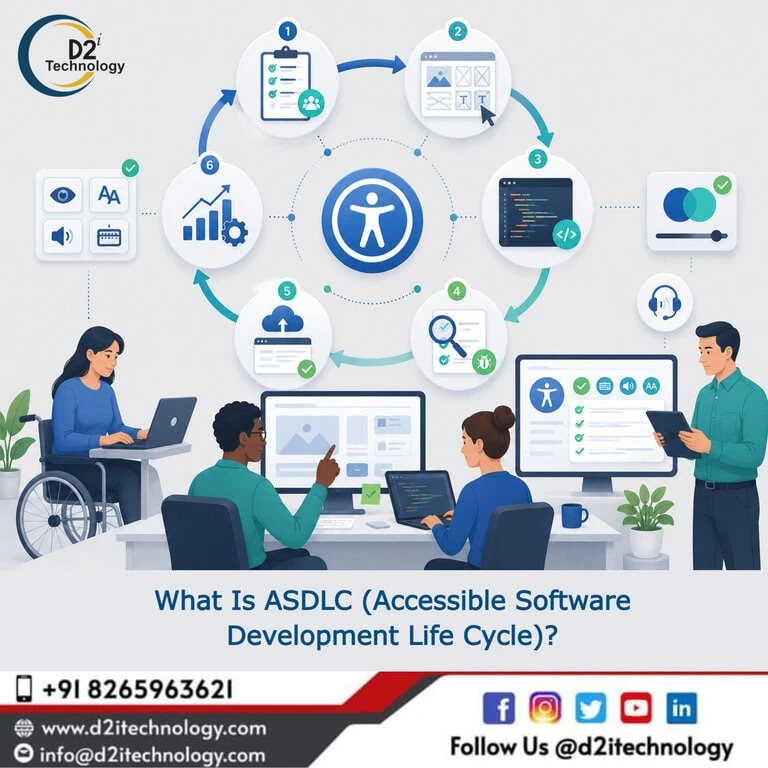
The phrase “we’ll address accessibility before launch” has ended the same way more times than it’s possible to count: with an audit report, a long backlog of violations, and a remediation program that competes indefinitely with new feature development. The structural problem is that accessibility is treated as a launch checklist item rather than a development quality standard. The Accessible Software Development Life Cycle (ASDLC) is the methodology that fixes this at the process level — integrating accessibility requirements, verification activities, and quality checkpoints into every phase of software development, from requirements through deployment and ongoing maintenance, rather than deferring them to a single audit at the end.
This post defines ASDLC clearly, explains what it comprises, traces how it applies to each development phase, identifies the standards it implements, and covers what organizations need to adopt it in practice.
Defining the Accessible Software Development Life Cycle
ASDLC stands for Accessible Software Development Life Cycle. It describes a software development methodology in which accessibility is a native quality dimension — embedded in how software is specified, designed, built, tested, and maintained — rather than an external quality assessment applied after the software exists.
The “life cycle” framing is intentional. Accessibility in ASDLC isn’t a one-time event, a single sprint, or an annual audit program. It’s a continuous practice that runs alongside functional development through every phase the software passes through, from the moment a feature is specified to the ongoing maintenance of a production system.
The contrast with traditional software development practice is direct. In a traditional SDLC, accessibility requirements — if present at all — typically live in a separate policy document that developers are expected to follow without specific guidance at the feature level. Accessibility verification typically occurs through external audit, triggered periodically or before a compliance deadline. Issues discovered in these audits represent violations that accumulated over the development period between audits.
ASDLC moves accessibility upstream: requirements appear in feature specifications, design decisions are verified against accessibility criteria, implementations are reviewed by both linting tools and human developers, test suites include accessibility verification, and formal audits evaluate a software product that has already been accessibility-reviewed through development rather than one that hasn’t.
The Standards That ASDLC Implements
ASDLC isn’t an independent accessibility standard — it’s a development methodology that implements existing standards throughout the development process. The primary technical standard ASDLC implements is WCAG (Web Content Accessibility Guidelines), published by the W3C Web Accessibility Initiative.
WCAG 2.1 Level AA is the current baseline. It encompasses 50 success criteria organized around four principles:
- Perceivable: Content must be presentable in ways all users can perceive — including text alternatives for non-text content, captions for audio and video, sufficient color contrast, and content that can adapt to different presentation formats.
- Operable: User interface components and navigation must be operable — including keyboard accessibility, sufficient time to interact with content, no flashing content that can cause seizures, and navigation mechanisms that help users orient.
- Understandable: Information and operation of the interface must be understandable — including readable text, predictable behavior, and input assistance that helps users avoid and correct mistakes.
- Robust: Content must be robust enough to be interpreted reliably by assistive technologies — including valid markup and compatibility with current and future user agents.
WCAG 2.2 extends this baseline with nine additional success criteria, including requirements for visible focus indicators with sufficient contrast (2.4.11), minimum touch target sizes (2.5.8), single-pointer alternatives to dragging interactions (2.5.7), and accessible authentication that doesn’t rely on cognitive function tests (3.3.8).
These standards apply across the regulatory frameworks that ASDLC helps organizations meet: ADA and ADA Title II in the United States, Section 508 for US federal contexts, the European Accessibility Act in EU markets, and SEBI accessibility requirements for India’s financial sector. The 2026 accessibility testing landscape and how WCAG standards are evolving alongside regulatory requirements provides useful context for where this standards landscape is heading.
ASDLC Phase by Phase
Phase 1: Requirements and Planning
The first distinguishing characteristic of ASDLC is what appears in feature requirements. In a traditional SDLC, user stories describe functional behavior. In ASDLC, user stories include accessibility acceptance criteria alongside functional requirements — specific, testable criteria that describe the accessible behavior the feature must implement.
For a login form, these criteria might specify: all inputs have programmatically associated labels; required field indicators use both color and text; inline validation errors announce when they appear; the form is fully operable by keyboard; authentication doesn’t require solving a CAPTCHA without an alternative (WCAG 3.3.8).
The key word is “specific.” Generic requirements to “follow WCAG” don’t produce accessible implementations because they don’t give developers concrete targets. Feature-level accessibility acceptance criteria do.
ASDLC also addresses the Definition of Done at the planning stage — ensuring that accessibility verification is a required criterion for closing any user-facing story, not an optional add-on that can be waived under deadline pressure.
What an accessibility checklist for software development should include provides a practical reference for the types of criteria that belong in feature-level accessibility requirements.
Phase 2: Design
In the ASDLC design phase, accessibility verification occurs at the design decision level — before any code is written. This is where the most cost-effective accessibility work happens, because design-stage accessibility problems prevent implementation-stage accessibility violations.
Color and contrast: Every color combination in the design system — text on background, UI component boundaries, focus indicators — is checked against WCAG contrast thresholds during design system creation. D2i Technology’s free Color Contrast Analyzer supports this real-time contrast verification for any color pairing.
Interactive component specifications: Every interactive component — modal dialogs, dropdown menus, date pickers, carousels, data tables — is specified with its keyboard interaction model and screen reader behavior alongside its visual states. Designers document what keyboard keys do what, what ARIA roles apply, what announcements screen readers should make when the component opens or changes, and where focus goes when the component closes.
Accessible component libraries: ASDLC encourages building and maintaining libraries of pre-tested, accessible component patterns that developers implement rather than invent. Components validated once propagate correct accessible patterns across every feature that uses them.
Phase 3: Implementation (Development)
ASDLC’s development phase introduces accessibility verification at two points: as code is written, and before code is merged.
Write-time checking: Accessibility linting tools — ESLint with jsx-a11y for React projects being the most widely used — flag accessibility violations inline as developers write code. Missing ARIA attributes, incorrect semantic HTML, empty button text, form inputs without labels — these issues surface in the developer’s editor at the moment they’re introduced, when fixing them takes seconds.
CI/CD pipeline gates: Automated WCAG scanning integrated into the CI/CD pipeline runs on every pull request and fails contributions that introduce high-severity accessibility violations. This gate is the most scalable accessibility mechanism in ASDLC because it’s automatic, consistent, and requires no per-developer attention beyond addressing failures.
The best accessibility testing toolkit and CI/CD integration options for 2026 covers the specific tools that implement these development-phase checks. D2i Technology’s automation testing services support CI/CD accessibility integration setup for teams implementing ASDLC.
Phase 4: Testing and Quality Assurance
The testing phase in ASDLC extends QA verification to include accessibility behavior that automated tools can’t evaluate. Automated pipeline scanning catches approximately 30–40% of WCAG violations — those detectable by analyzing code structure and rendered DOM. The remaining violations require human evaluation using real assistive technologies.
Keyboard navigation testing: QA verifies that key user flows are fully operable by keyboard alone — all interactive elements reachable by Tab, logical focus order throughout, no keyboard traps, visible focus indicators throughout, and focus managed correctly when dynamic content changes.
Screen reader testing: Using NVDA or JAWS on Windows and VoiceOver on macOS/iOS, QA evaluates whether form interactions, dynamic content updates, error states, modal dialogs, and navigation patterns work correctly when accessed through assistive technology rather than visual interaction.
Accessibility regression testing: When shared components or templates are modified, accessibility regression testing verifies that the modification didn’t break previously working accessible patterns.
What manual and automated accessibility testing each cover and why both are necessary explains the coverage division that makes both testing types necessary in ASDLC. D2i Technology’s accessibility testing services provide the certified manual evaluation layer that completes what automated testing begins.
Phase 5: Release, Deployment, and Maintenance
ASDLC’s fifth phase addresses both the release verification and the ongoing maintenance that keeps accessibility quality stable as software evolves.
Pre-release accessibility review: Before major releases, ASDLC includes a final verification pass covering the changes introduced since the last formal evaluation. This isn’t a comprehensive audit of the entire application — it’s a targeted review of new and changed features against the accessibility acceptance criteria from their specifications.
Periodic formal audits: ASDLC includes scheduled formal accessibility audits by certified accessibility professionals. These audits evaluate WCAG conformance comprehensively — including the 60–70% of issues that automated tools don’t detect — and produce compliance documentation for regulatory purposes. The key difference from traditional audit programs is that ASDLC audits find fewer violations because development-phase checks have already addressed the most common issues.
Ongoing monitoring: ASDLC treats accessibility as a maintenance concern — new features, dependency updates, and design system changes can introduce accessibility issues into otherwise conformant software. Regular automated scanning of production pages, combined with periodic formal evaluation, maintains the accessibility baseline over time.
What the step-by-step product accessibility audit process actually involves and what professional accessibility audit companies deliver cover the formal audit component of this phase. D2i Technology’s accessibility remediation services address the findings those audits surface.
What Organizations Need to Implement ASDLC
ASDLC isn’t a product to purchase or a certification to achieve — it’s a set of practices, tools, and organizational habits that development teams adopt. The most important implementation elements:
Specification templates with accessibility AC: Pre-built templates that include accessibility acceptance criteria for common feature types (forms, modals, navigation, authentication, data tables) so teams don’t write criteria from scratch for every story.
CI/CD accessibility automation: Automated WCAG scanning integrated into the pipeline as a required gate, not an advisory step.
Developer training: Foundational WCAG knowledge that allows developers to implement specified accessible patterns, interpret linting output, and understand what they’re verifying during keyboard testing.
External evaluation partner: Certified accessibility professionals who provide the formal audit layer, remediation guidance, and compliance documentation that internal ASDLC processes can’t produce independently. Why businesses need professional accessibility testing services as a standard operational practice covers why this external partner relationship matters.
Conclusion
The Accessible Software Development Life Cycle is the answer to accessibility debt that doesn’t stop accumulating in organizations that treat accessibility as a post-launch concern. By integrating accessibility requirements, verification, and quality assurance into every SDLC phase, ASDLC makes accessibility a development quality standard with the same workflow integration as security and performance — caught during development, verified at release, and maintained over time.
D2i Technology helps organizations implement ASDLC — from specification template development and CI/CD integration through certified formal audits and remediation programs that address what automated processes don’t catch.
Frequently Asked Questions
Implement Accessible SDLC With D2i Technology's Support
D2i Technology provides the accessibility testing, automation, and expert evaluation needed to make Accessible Software Development Life Cycle work in practice — from pipeline setup through WCAG-certified formal audits. Let's talk about where your organization needs to start.