- AI Development
- July 16, 2026
From Requirements to Deployment: The Complete ASDLC Guide
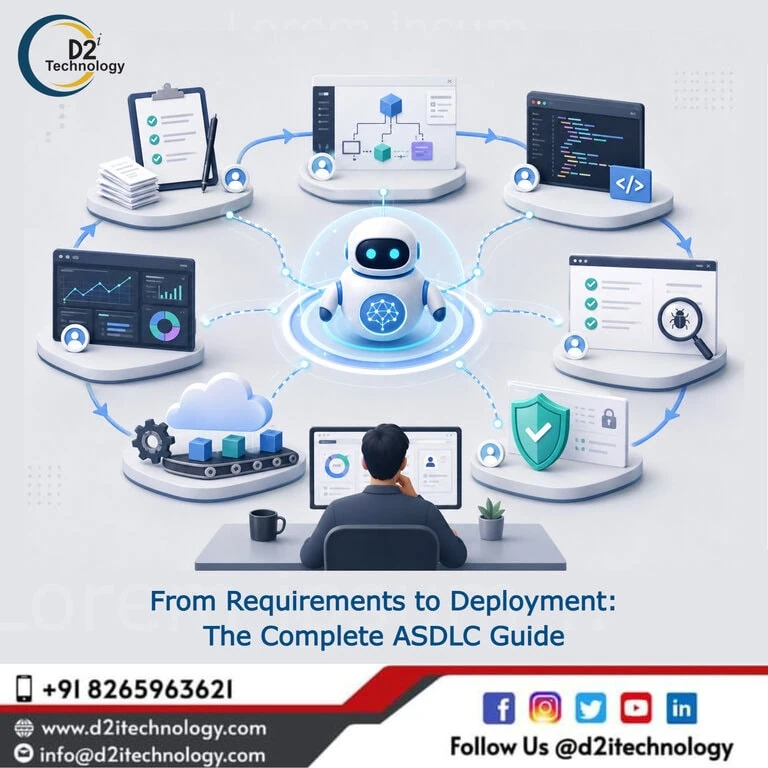
The traditional software development lifecycle — gather requirements, design, build, test, deploy, maintain — hasn’t fundamentally changed its phase structure in decades. What’s changing is who (or what) does the work within each phase, and how much of that work can be automated while still producing outcomes humans are prepared to trust. This Agentic SDLC guide maps the full development lifecycle through the lens of AI agents — not as a hypothetical future state, but as a practical framework for how engineering teams are structuring agent-assisted development right now, and where the human-AI boundary sits at each stage.
The Agentic Software Development Lifecycle (ASDLC) isn’t a replacement for structured development discipline. It’s the same discipline applied with AI agents operating as active participants rather than passive tools, which changes the speed, the risk profile, and the review structure at every phase.
Phase 1: Requirements and Planning
What AI Agents Do Here
Requirements gathering and analysis have historically been some of the most labor-intensive parts of the development process — synthesizing stakeholder input, identifying gaps and conflicts, translating business language into engineering-ready specifications, and estimating complexity. AI agents in the planning phase take on specific, bounded versions of this work:
- Parsing and summarizing large volumes of stakeholder documents, tickets, and interview transcripts
- Identifying conflicting or ambiguous requirements by cross-referencing input sources
- Generating initial user story breakdowns from high-level feature descriptions
- Comparing new requirements against existing codebase capabilities to surface potential conflicts or reuse opportunities
- Producing first-draft effort estimates based on similar historical tasks in the project’s issue tracker
Where Human Judgment Stays Essential
The critical judgment calls in requirements — what to build, what trade-offs to make between features and scope, what priorities reflect genuine business value — remain human responsibilities. An agent can flag that two requirements are in tension; only a product owner and engineering lead can decide which one takes precedence.
The planning phase also sets the governance boundaries for what agents are authorized to do in subsequent phases. How to structure governance and monitoring for AI agents operating in production systems covers this in detail — the access controls and authority limits defined in planning carry through the entire lifecycle.
Phase 2: Architecture and Design
What AI Agents Do Here
Architecture decisions are where AI assistance is genuinely useful but where the risks of over-reliance are most significant. Agents can:
- Suggest architectural patterns that match stated requirements and constraints
- Generate initial component diagrams and data models from requirement summaries
- Identify potential scalability or security concerns in proposed architectures by comparing against known anti-patterns
- Produce boilerplate design documentation from structured inputs
Where Human Judgment Stays Essential
Architectural decisions carry consequences that compound over years. An AI agent can suggest a microservices decomposition; it cannot fully account for your team’s operational maturity, your current infrastructure costs, the skill distribution of your existing engineers, or the long-term strategic direction that makes one architecture meaningfully better than another for your specific organization.
Design review at this phase needs to involve experienced engineers who understand both the technical options and the organizational context — not just a check that the AI-suggested design is internally consistent. What enterprise-scale application development actually requires at the architecture level provides useful framing for why architecture decisions at scale carry more weight than they appear to when evaluated against requirements alone.
Phase 3: Implementation (Code Generation)
What AI Agents Do Here
This is the phase where ASDLC delivers its most visible productivity gains. Code generation agents — given well-formed specifications, access to the existing codebase context, and clear style and convention guidelines — can produce working implementations for defined features, write corresponding unit tests, update inline documentation, and open pull requests for human review.
For well-defined, bounded tasks: implementing a specified API endpoint, adding a database migration, creating a UI component matching a design spec — agent-generated code is often production-quality on the first pass, requiring review rather than rewriting.
Where Human Judgment Stays Essential
Ambiguous requirements produce ambiguous implementations. The quality of agent-generated code is directly proportional to the quality of the specification it receives. Requirements that are clear enough for an experienced human engineer to implement correctly often aren’t clear enough for an agent to interpret without drift.
Human engineers also need to maintain genuine understanding of the codebase — not just review agent-generated changes in isolation, but understand how those changes fit into the broader system. A pattern of approving agent-generated code without deep engagement is how codebases accumulate architectural debt that no individual change introduced visibly.
The irreplaceable role of code review in agent-assisted development — and what makes review effective covers this directly: automated review tools and agents catch different things than human reviewers, and neither substitutes for the other.
Phase 4: Testing and Quality Assurance
What AI Agents Do Here
Testing is where ASDLC provides some of its most clear-cut value — the tasks that human testers find most tedious and time-consuming are often exactly the tasks that agents handle well:
- Generating unit and integration test suites from function signatures and specifications
- Identifying coverage gaps in existing test suites and proposing additional test cases
- Running regression suites and reporting on failures with contextual information
- Performing static analysis and flagging code patterns associated with common vulnerabilities
- Generating test data at scale for performance and load testing scenarios
How to test AI agents themselves for reliability, security, and performance adds a dimension specific to ASDLC: when agents are generating code, the agents themselves become part of the system under test. Adversarial testing of agent behavior — checking for prompt injection resistance, verifying behavior under unexpected inputs, confirming output quality under edge-case conditions — is a testing category that conventional QA approaches didn’t need to address.
Testing agentic AI systems specifically for security, accuracy, and reliability in production contexts covers the security dimension of agent testing in depth.
Where Human Judgment Stays Essential
Test quality is not the same as test quantity. AI agents can generate many tests quickly; the tests they generate test what the specification says, not necessarily what the system should actually do in real-world conditions. Exploratory testing — probing for behaviors that the specification didn’t anticipate — remains a fundamentally human activity. The value that experienced manual test engineers bring even in highly automated testing environments makes this case directly.
D2i Technology’s automation testing services and security testing capabilities are designed to complement agent-generated test coverage with the human-led evaluation that catches what automated generation misses.
Phase 5: Security Review and Penetration Testing
What AI Agents Do Here
Security analysis agents can scan codebases for known vulnerability patterns, check dependencies against published CVE databases, review configuration files for security misconfigurations, and flag code patterns associated with common weakness enumerations (CWEs). For routine security hygiene — the security equivalent of code style review — agents provide consistent, high-throughput analysis.
Where Human Judgment Stays Essential
Novel attack vectors, business logic vulnerabilities, and context-dependent security flaws require human security expertise. An agent can flag that a function uses a deprecated cryptographic library; it cannot reason about whether a particular business logic flow creates an exploitable race condition that a sophisticated attacker could abuse.
The security risks specific to agentic AI systems themselves in web application environments is particularly relevant at this phase — the security review needs to cover both the application being built and the agent infrastructure being used to build it. D2i Technology’s penetration testing services and SecOps capabilities provide the expert-led security validation that automated scanning cannot replace.
How database security and DevSecOps practices intersect is also worth reviewing during this phase, particularly for applications with significant data layer complexity where AI-generated data access patterns need specific security scrutiny.
Phase 6: CI/CD and Deployment
What AI Agents Do Here
CI/CD pipelines are a natural fit for agentic automation — structured, rule-governed, highly parallelizable processes where agents can manage build orchestration, environment provisioning, test execution coordination, deployment sequencing, and rollback triggering based on predefined health criteria.
Why well-structured CI/CD pipelines are fundamental to reliable software delivery applies directly to agentic workflows — the pipeline is both the enforcement mechanism for quality standards on agent-generated code and the operational context within which deployment agents operate. A structured approach to implementing DevOps successfully provides the foundational framework that agent-assisted CI/CD builds on.
D2i Technology’s DevOps services cover the pipeline design and infrastructure automation that make agent-assisted deployment both possible and safe.
Where Human Judgment Stays Essential
Deployment decisions that carry significant business risk — major releases, database migrations, changes that affect regulatory compliance — warrant human authorization regardless of how confident the automated quality gates are. Building a “human in the loop” checkpoint for high-stakes deployments isn’t a failure of automation maturity; it’s sound engineering governance.
Phase 7: Monitoring and Maintenance
What AI Agents Do Here
Post-deployment, agents contribute meaningfully to operational monitoring: parsing logs at scale to identify anomalies, correlating error patterns with recent deployments, surfacing performance degradation before it becomes visible to users, and generating incident summaries that give on-call engineers context at 2 AM rather than raw log dumps.
Agent governance and monitoring for AI systems in production extends naturally to this phase — the monitoring infrastructure that tracks agent behavior during development also provides the operational visibility needed during production operation.
Where Human Judgment Stays Essential
Incident response decisions — particularly around outages, data integrity issues, or security events — require human judgment that accounts for business context, customer impact, and regulatory implications that automated systems can’t fully evaluate. Agents inform incident response; humans direct it.
D2i Technology and the Complete ASDLC
D2i Technology supports teams across the full agentic SDLC — from AI system development through the security testing, quality assurance, and DevOps infrastructure that makes autonomous AI reliable in production.
Our AI development services cover the agent development side; our security, testing, and DevOps practices cover the infrastructure side. D2i Technology’s approach to building AI that solves real problems rather than generating technical demonstrations reflects the full-lifecycle view that makes ASDLC work sustainably rather than impressively.
Conclusion
This Agentic SDLC guide describes a lifecycle that’s already operating in engineering organizations that have done the governance work to make it safe. The ASDLC doesn’t replace the phases of conventional software development — it restructures the work within those phases, with AI agents handling the high-volume, well-defined tasks and human engineers focusing on the judgment-dependent decisions that determine whether software actually serves its purpose over time.
Getting the human-AI boundary right at each phase — clear, enforced, and periodically reviewed — is what separates ASDLC implementations that deliver sustained value from those that deliver impressive sprint demos and production incidents.
Frequently Asked Questions
Ready to Implement ASDLC With the Right Infrastructure?
D2i Technology helps engineering teams implement agentic software development with the security testing, quality assurance, and DevOps infrastructure needed to make it reliable — not just fast. Let's talk about where your lifecycle needs the most support.