- Mobile App Development
- July 22, 2026
Why Businesses Prefer Dedicated Mobile App Developers from India
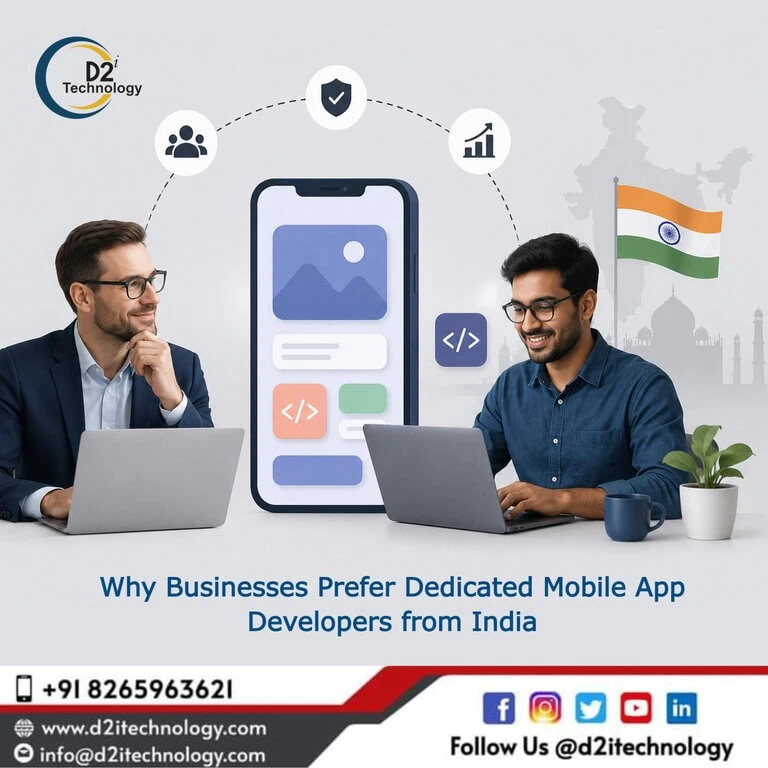
A mobile app that works well is a genuine business asset. One that doesn’t — slow, buggy, or badly designed — can quietly damage customer relationships in ways that are difficult to repair. This is why the decision of who builds your app carries real weight. For companies across the US, UK, Australia, and the Middle East, the choice to hire dedicated mobile app developers from India has become one of the more consistent patterns in how successful digital products get built. It’s not a trend — it’s a recurring outcome of businesses finding that the combination of skills, flexibility, and value offered by Indian development teams is genuinely hard to match elsewhere.
This post breaks down why that preference exists, what to look for when you make the hire, and how to structure the engagement to get the best results.
The Business Case for Hiring Dedicated Mobile App Developers from India
Cost Efficiency Without the Quality Compromise
Let’s address the obvious part first. Mobile app development in India costs significantly less than equivalent work in Western markets — often 40% to 70% less, depending on the scope and seniority level required. That’s a real difference that affects what your development budget can achieve.
But framing this purely as a cost story misses something important. The savings exist because of market rate differences, not because of skill gaps. India’s mobile development ecosystem has matured significantly, with developers working daily across React Native, Flutter, Swift, Kotlin, and the full spectrum of cross-platform and native tools. Understanding the cost factors involved in building an app helps put this in context — you’re not choosing between expensive-and-good and cheap-and-mediocre. You’re accessing a skilled talent pool at a different price point.
Deep Technical Expertise in Modern Mobile Stacks
India produces a substantial volume of engineering graduates every year, and a significant portion of that talent ends up in mobile development. The result is a developer community that’s both large and genuinely competitive — which drives quality up rather than down.
Whether you need native Android development in Kotlin, native iOS in Swift, cross-platform builds in Flutter or React Native, or teams that can handle the full stack including backend APIs and cloud infrastructure — that expertise is available. Building seamless mobile apps with Expo and React Native is an area where skilled Indian developers have particularly strong depth, given how widely those frameworks are used across international projects.
Flexibility That Scales With Your Business
One of the structural advantages of the dedicated team model is the ability to right-size your development capacity as your project evolves. Early-stage startups building an MVP need something different from a growth-stage company adding new features to a live product, which is again different from an enterprise team managing multiple platform releases simultaneously.
When you hire dedicated mobile app developers as an external team, scaling up or down doesn’t require a hiring freeze or a round of layoffs. You adjust the engagement. This kind of flexibility is genuinely difficult to replicate with an in-house model, particularly for companies that aren’t large enough to absorb headcount fluctuations easily.
What “Dedicated” Actually Means — and Why It Matters
The word “dedicated” gets used loosely in outsourcing. It’s worth being precise about what it should mean in a quality engagement.
A dedicated mobile app developer isn’t someone who fits your project in between other client work. They’re assigned specifically to your product, they attend your standups, they build context over time, they understand your roadmap, and they function as a working extension of your team — not a contractor who delivers code and disappears.
This model produces better software. Developers who understand the codebase they’re working in, the business logic behind features, and the users the app is built for make better decisions than those who are handed isolated tickets without context. It’s the difference between someone who is building your product and someone who is completing tasks in your product.
D2i Technology’s custom mobile app development services are structured around this model — dedicated teams with sustained engagement, not project handoffs to whoever is available.
Key Capabilities to Look For
Native vs. Cross-Platform Expertise
Both native and cross-platform development have legitimate use cases, and the right choice depends on your specific requirements — performance needs, budget, platform priorities, and timeline.
Native development (Swift for iOS, Kotlin for Android) gives you the best performance and the deepest integration with platform-specific features. Cross-platform frameworks like Flutter and React Native offer faster development cycles and shared codebases across platforms, which can significantly reduce cost and time to market for apps that don’t need pixel-perfect native behavior.
The programming language decisions that shape long-term mobile development are worth understanding before your project scoping conversation — top programming languages for mobile app development covers the tradeoffs in a way that’s useful for making an informed choice.
Quality Assurance as a First-Class Practice
Shipping a mobile app without adequate testing is, to put it bluntly, not really shipping a product. It’s releasing something and hoping for the best. App store reviews move fast, and a poor first impression is hard to recover from.
Look for development teams where QA isn’t an afterthought. This means unit testing during development, integration testing before releases, device fragmentation testing for Android (where screen sizes and OS versions vary enormously), and proper regression testing whenever new features are added.
Teams that work alongside manual testing services and incorporate automation testing into their release cycles build significantly more reliable products. Open source tools for mobile application performance testing offer additional insight into how rigorous teams approach quality at scale.
Security-Aware Mobile Development
Mobile apps handle sensitive user data — login credentials, payment details, health records, location information. That sensitivity requires developers who understand mobile security: secure storage, encrypted communications, proper authentication flows, protection against reverse engineering, and compliance with platform security guidelines.
The Android penetration testing capabilities that D2i Technology offers alongside its development work reflect exactly this kind of security integration — not as an external audit bolted on after launch, but as a practice embedded in how the product is built and validated.
AI and Intelligent Features Integration
Mobile apps increasingly include features powered by machine learning and AI — personalization, on-device inference, recommendation systems, natural language interfaces, image recognition. These capabilities are no longer reserved for well-resourced tech companies.
Development teams that can integrate AI development services into mobile builds give businesses a meaningful competitive edge. Rather than building a static app and revisiting it later to add intelligence, you can architect for these capabilities from the start.
How to Structure the Engagement
Define the Scope Before You Hire
The clearest path to a failed outsourcing engagement is vague requirements. Before you bring on a dedicated team, invest time in documenting what the app actually needs to do — user flows, feature prioritization, platform requirements, performance expectations, and integration points with existing systems.
This isn’t about creating a 100-page specification. It’s about having enough shared understanding that developers can make good decisions independently rather than blocking constantly on ambiguity.
Choose the Right Engagement Model
Dedicated team models work best when your project is ongoing or when you anticipate regular iteration after launch. If you have a clearly scoped, time-bounded deliverable, a fixed-price project model might be more appropriate. Most experienced firms — including D2i Technology — can work across both, and a good initial conversation will surface which structure fits your situation.
For a broader view of the build-vs-hire tradeoffs relevant here, comparing an in-house development team against an external development company is a useful framework, even though it’s framed around web applications — the underlying logic applies equally to mobile.
Establish Communication Rhythms Early
The single biggest predictor of a successful dedicated team engagement is communication quality. Set up daily or every-other-day standups, agree on how urgent issues get escalated, and establish clear documentation standards for decisions made asynchronously.
Time zone differences between India and the US, UK, or Australia are real, but they’re manageable with some intentional scheduling. Most experienced Indian development companies — including D2i Technology, which operates with both Noida and Charlottesville presences — have already worked out how to make this function smoothly for international clients.
Why D2i Technology
D2i Technology combines mobile app development expertise with the broader engineering capabilities that make mobile products actually production-ready — QA, security testing, AI integration, and performance validation all sit within the same team. That means you’re not juggling multiple vendor relationships to get from idea to a tested, deployed, maintainable product.
The top software development companies in India for 2026 are distinguished by exactly this kind of integrated capability — and it’s a reasonable benchmark to apply when evaluating any firm you’re considering.
If you’re exploring what finding the best mobile development company in the USA looks like, D2i Technology’s dual presence — technical delivery from India, client relationships managed from the US — sits at a useful intersection for companies that want the best of both.
Conclusion
The preference for dedicated mobile app developers from India isn’t a trend that businesses have discovered recently. It’s a well-established pattern, grounded in practical outcomes: cost efficiency that opens up budget, technical depth that doesn’t require compromise, and engagement flexibility that adapts to how products actually evolve.
What separates the best experiences from the disappointing ones is usually the quality of the vendor relationship — how clearly expectations are set, how well communication is managed, and whether the development team is genuinely invested in the product’s success. When those elements are in place, the combination of skilled Indian developers and a dedicated team structure consistently produces strong results.
Frequently Asked Questions
Ready to Build a Mobile App With a Team That's Fully Invested in Your Product?
D2i Technology provides dedicated mobile app developers with genuine expertise in Android, iOS, and cross-platform development — backed by integrated QA, security testing, and AI capabilities. Let's talk about what you're building and how we can help bring it to life.