- Web Accessibility
- September 4, 2026
Why Every Development Team Needs Accessible SDLC
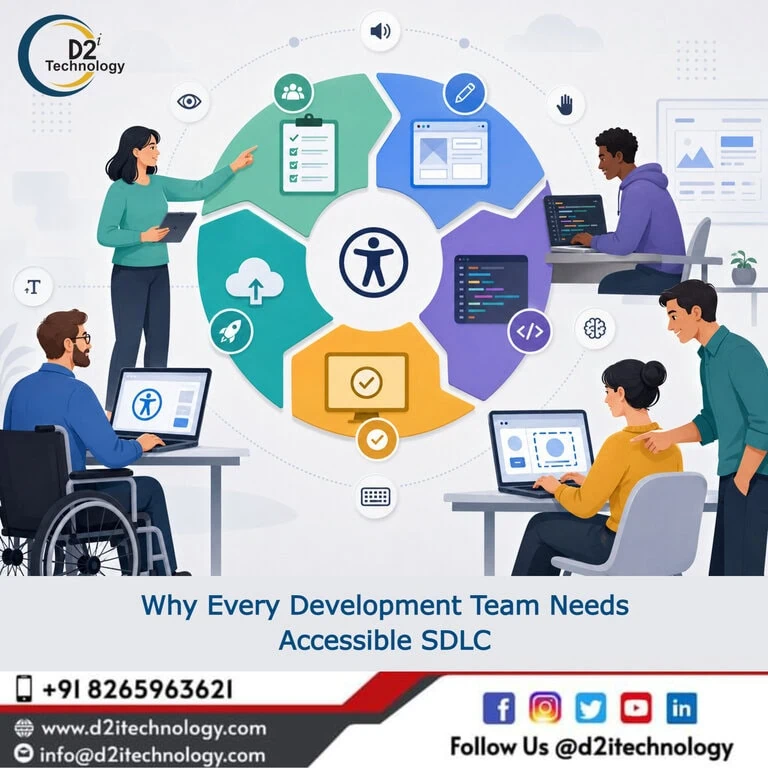
There’s a version of accessibility that teams can keep deferring indefinitely: “we’ll address it in the next sprint,” “we have a planned accessibility audit for Q3,” “it’s on the backlog.” This version of accessibility never actually produces accessible software — it produces a growing list of accessibility debt, interrupted periodically by remediation projects that address some of what the list contains before new features add more to it. Accessible SDLC breaks this cycle not by adding an accessibility workstream alongside development, but by making accessibility a native quality dimension of the development process itself. Every team that builds software used by real people has a compelling reason to adopt it — and most teams that haven’t adopted it are paying more in remediation costs, compliance risk, and user trust than the adoption would have cost.
This post makes the case for Accessible SDLC adoption — not as a compliance exercise but as a development quality and business decision.
The Core Argument: Accessibility Is a Quality Dimension, Not a Separate Program
The framing that causes Accessible SDLC adoption to stall is treating accessibility as a separate program — something that happens alongside development rather than within it. Security isn’t treated this way anymore. Most development teams run security scanning in CI/CD, incorporate security requirements in specifications, and consider security a first-class quality attribute. Performance isn’t treated as a separate program — performance budgets, load testing, and performance profiling are standard parts of how mature teams develop software.
Accessibility is the quality dimension that hasn’t yet made this transition in most engineering organizations. The consequences of that delayed transition are entirely predictable: violations accumulate during development because they’re not caught, audits find them in batches, remediation competes with feature work, and the cycle repeats.
Accessible SDLC is what it looks like when accessibility makes the same transition that security and performance made — from external audit concern to internal quality standard with the same development workflow integration.
The importance of web accessibility remediation and why it’s more expensive when it arrives late makes the cost case for this transition. Why proactive accessibility consistently outperforms reactive remediation makes the strategic case.
Reason 1: Accessibility Violations Are Preventable — and Preventing Them Is Cheaper
The most pragmatic argument for Accessible SDLC is economic. The cost of an accessibility violation scales dramatically with how late it’s discovered. A form labeling violation caught by a linting tool while a developer writes the code costs less than a minute to fix. The same violation discovered in a post-launch audit requires the auditor to document it, the development team to triage it, a developer to locate and fix it in production, QA to retest it, and a DevOps engineer to deploy the fix. Multiply this across the dozens or hundreds of violations a typical application accumulates, and the audit-and-remediate model carries a cost structure that the develop-with-accessibility model avoids almost entirely.
Most development teams that have run formal accessibility audits are surprised by the volume of findings — not because their developers are careless, but because a process that doesn’t include accessibility checking produces accessibility violations the way any unsupervised quality dimension accumulates problems. Accessible SDLC doesn’t require developers to be more careful — it gives them the tools and requirements to catch issues that existing processes don’t surface.
What a checklist should include for website accessibility throughout the development process gives teams a practical starting point for understanding what “catching issues throughout the process” actually covers.
Reason 2: Regulatory Compliance Is Becoming Non-Optional
The argument that accessibility compliance is optional has a declining evidence base. ADA litigation against websites and apps has grown consistently. ADA Title II’s 2024 final rule established WCAG 2.1 Level AA as the explicit technical standard for state and local government digital content, with enforcement deadlines now active. The European Accessibility Act is in enforcement with deadlines spanning 2025 and 2026. SEBI has established accessibility requirements for India’s financial sector. The direction is clear: digital accessibility requirements are expanding in scope, technical specificity, and enforcement.
For development teams building software used by people in any of these markets — which is most teams — the question isn’t whether to meet accessibility requirements, but whether to meet them through proactive compliance or reactive enforcement response. Proactive compliance through Accessible SDLC is significantly cheaper and less disruptive than retrofitting accessibility under regulatory pressure.
ADA Title II digital accessibility requirements for US organizations and what they actually require and why businesses increasingly need accessibility testing services as standard practice cover the regulatory landscape in detail.
Reason 3: Accessible Software Is Better Software
The design constraints that WCAG imposes on software — sufficient contrast, clear labeling, logical structure, keyboard operability, plain language — don’t just produce software that’s usable for people with disabilities. They produce software that’s better for everyone.
Consider what meeting these requirements actually requires:
- Color contrast sufficient for users with low vision is also easier to read in bright sunlight, on low-quality displays, and at a distance
- Form labels that screen reader users need are also the labels that make forms faster to complete for sighted users
- Keyboard navigation that blind users require is also the navigation pattern that power users prefer
- Error messages that are specific enough to guide screen reader users through correction are also the error messages that reduce support burden for all users
- Page structure that gives screen reader users orientation through headings is also the structure that improves comprehension and readability for every user
How web accessibility testing improves the overall user experience for all visitors makes this case with practical examples. How accessibility improvements benefit all visitors to a site, not just those using assistive technology extends it further.
This argument matters for development teams because it reframes the accessibility conversation from “we need to accommodate a subset of users” to “we need to build software that actually works well for everyone.” The former feels like a cost center; the latter is just good development practice.
Reason 4: Accessible SDLC Improves Developer Experience
This reason is less often cited but genuinely important. Accessibility violations that reach production come back to developers as support issues, bug reports, and compliance findings — context-switching away from current work to address problems from features that were supposedly complete. Accessible SDLC moves this work into the development flow rather than interrupting it from outside.
When accessibility requirements are in the specification, developers know what they’re building toward. When linting tools flag accessibility issues inline, developers fix them in the same mental context as the original implementation. When CI/CD gates catch violations at PR time, the developer addressing them hasn’t yet moved on to something else. All of this is a better developer experience than getting accessibility findings three months after a feature shipped and having to reconstruct the context to fix it.
The web accessibility guide written specifically for developers is the kind of resource that supports developers in understanding what accessible implementation looks like — which is the prerequisite for accessibility requirements being meaningful rather than opaque.
Reason 5: It’s What Inclusive Product Development Actually Looks Like
Beyond cost, compliance, and quality, there’s a straightforward ethical argument: software that excludes users with disabilities because accessibility wasn’t addressed during development is software that failed those users by design — not by intent, but by omission.
Accessible SDLC is what inclusive product development looks like when it moves from mission statement to engineering practice. How web accessibility and cognitive disability considerations affect real users and why accessibility goes beyond blindness to serve a broad population give this abstract argument specific, human content.
For development teams working in consumer products, enterprise software, or public services, the audience for their software includes people with visual impairments, motor disabilities, cognitive differences, hearing impairments, and situational limitations. Building software that doesn’t work for those users isn’t a neutral outcome — it’s a failure that Accessible SDLC prevents.
What Accessible SDLC Requires to Actually Work
Stating that every development team needs Accessible SDLC is easy. The honest question is what that actually requires from teams that are starting from a traditional SDLC baseline.
It requires specification habits to change. Accessibility acceptance criteria in user stories are the cornerstone of Accessible SDLC. Without them, the rest of the process has nothing to verify against.
It requires CI/CD investment. Automated accessibility scanning in the pipeline is the most scalable accessibility mechanism available — and it requires someone to set it up, configure it correctly, and maintain it as standards evolve. D2i Technology’s automation testing services support this setup for teams making the transition.
It requires basic developer capability. Developers don’t need to be accessibility specialists, but they need enough WCAG fluency to implement specified accessible patterns and interpret linting tool output. This is a training and documentation investment, not a headcount investment.
It requires periodic external evaluation. Accessible SDLC reduces the volume and severity of violations that reach formal audits; it doesn’t eliminate the need for audits. D2i Technology’s accessibility testing services provide the formal evaluation layer that validates what the internal Accessible SDLC process delivers.
It requires patience with the transition. The first sprint that includes accessibility acceptance criteria and a CI/CD accessibility gate will surface violations that existing code introduced — which means the team is doing more remediation initially, not less. The benefit compounds over time as new violations stop accumulating at the rate they were. Teams that give up after one sprint of elevated remediation don’t see the long-term cost curve inversion.
What accessible software development looks like for organizations committed to digital inclusion reflects the organizational mindset shift that makes Accessible SDLC sustainable rather than a temporary program.
Conclusion
Accessible SDLC is the answer to accessibility debt that doesn’t stop accumulating under the traditional model. It’s not a specialized program for teams that happen to serve users with disabilities — it’s a quality standard that every team building software for real users should apply, for the same reasons they apply security testing and performance monitoring: because it’s cheaper to build quality in than to remediate it out, because regulations require it, and because software that excludes users is software that isn’t doing its job.
D2i Technology helps development teams make this transition — providing the specification guidance, CI/CD integration support, developer training resources, and formal accessibility testing that turns the Accessible SDLC commitment from aspiration to practice.
Frequently Asked Questions
Make Accessible SDLC the Standard for Your Development Team
D2i Technology helps development teams adopt Accessible SDLC — from specification templates and CI/CD accessibility integration through periodic formal audits that verify the quality your process delivers. Let's talk about where your team is starting from.