- Web Application
- May 25, 2026
Custom Web Application Development Company in India
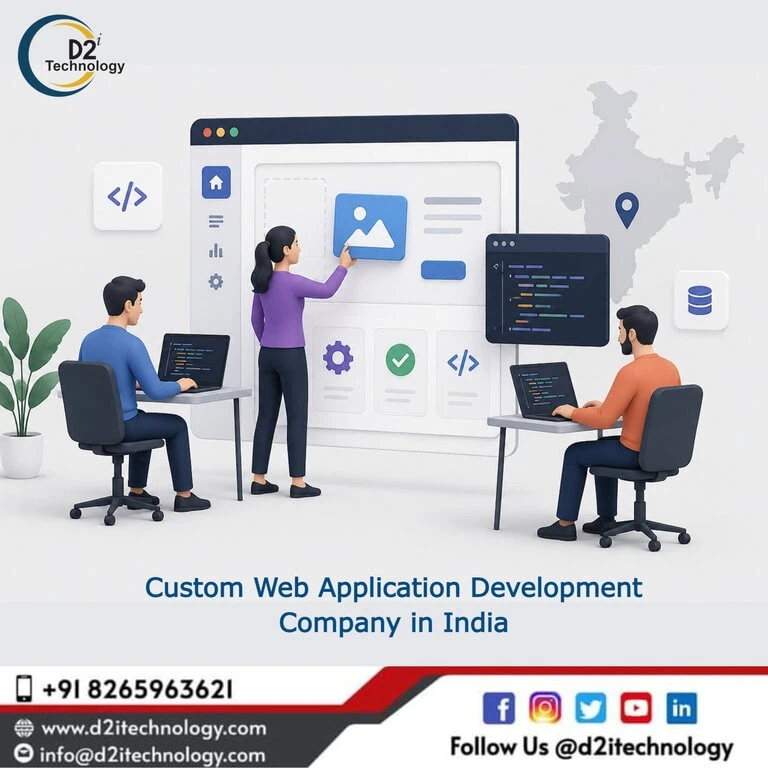
Choosing a custom web application development company in India has quietly become one of the smarter decisions businesses make when they need software that actually fits how they operate. Off-the-shelf tools cover the basics, but the moment your processes get specific, you start patching workarounds onto someone else’s product. A custom web app flips that equation. The software bends to your business instead of the other way around. India sits at the centre of this conversation because the engineering talent here has spent two decades shipping enterprise-grade applications for clients across the US, UK, Europe, the Middle East, and Australia, and the depth of that experience shows up in the work.
What Is Custom Web Application Development?
A custom web application is software that runs in a browser, built from scratch (or close to it) to handle a specific set of tasks for a specific business. Think of an internal claims-processing tool for an insurance company, a multi-tenant SaaS dashboard for a logistics startup, or a patient-intake portal for a hospital network. None of those problems get solved well by generic software, and that is exactly the gap custom development fills.
The word “custom” matters here. Some teams stitch together no-code tools and call the result custom. That works until you hit a wall, and then you are rebuilding anyway. A proper custom web app partner treats the codebase as a long-term asset, written so your team can own it, extend it, and migrate it if circumstances change. If you are weighing your options, the comparison between a custom-built application and a WordPress site is a useful place to start.
Why India Is a Preferred Destination for Web App Development
A few honest reasons businesses keep coming back:
Cost without the compromise: Hourly rates in India typically run 40 to 60 percent lower than equivalent rates in the US or UK, and the quality gap (if any still exists) has narrowed sharply over the last decade.
English-fluent communication: Daily standups, written specs, and client demos happen in English without a translation layer, which removes a surprising amount of friction.
Time-zone math that works in your favour: A US client signs off on a feature at 6 PM EST and reviews progress the next morning. That is roughly a full engineering shift completed while the client team sleeps.
Deep domain specialisation: Indian agencies have built for fintech, healthcare, e-commerce, edtech, and logistics for so long that domain knowledge is baked into the engineering culture, not bolted on at the end.
A mature outsourcing ecosystem. Contracts, IP protection, NDAs, GDPR compliance, and security frameworks are well-understood territory here. If you want a closer look at the current landscape, the breakdown of top web application development companies in India and the latest custom web app trends is worth a read.
Key Services Offered by a Custom Web App Development Company in India
The right partner does more than write code. A serious custom web app development services India provider usually covers the full lifecycle:
- Discovery and product strategy that maps business goals to a real feature set before anyone opens a code editor.
- UI/UX design with wireframes, prototypes, and a design system built around the people who will actually use the app.
- Frontend development in React, Next.js, Vue, or Angular, picked based on the project rather than the trend cycle.
- Backend development in Node.js, Python (Django, Flask, FastAPI), Java (Spring), PHP (Laravel), or .NET.
- Database design across relational systems like PostgreSQL and MySQL, NoSQL options like MongoDB, and hybrid setups when the data shape calls for it.
- API development and third-party integrations covering REST, GraphQL, payment gateways, CRMs, and ERPs.
- Cloud deployment and DevOps on AWS, Azure, or GCP with CI/CD pipelines that make releases boring, which is exactly what you want.
- Quality assurance including manual testing, automated testing, performance testing, security testing, and accessibility audits.
- Ongoing support and maintenance for bug fixes, feature additions, and version upgrades long after launch.
If your project leans into emerging tech, this scope often extends into AI development and mobile app development as well.
Industries Where Custom Web Apps Earn Their Keep
Some industries get more out of custom development than others. Healthcare and insurance lean on it heavily because their workflows are too regulated and too specific for shrink-wrapped software. Financial services and SEBI-regulated entities in India need custom platforms that meet compliance requirements while staying usable. E-commerce brands at scale outgrow Shopify and WooCommerce. Logistics, manufacturing, and supply chain businesses run on internal tools no vendor sells off the shelf. EdTech platforms need custom assessment engines, content delivery, and learner analytics that generic LMS products cannot match. The pattern is consistent: when the workflow is the product, custom is the only path that holds up.
The Development Process: How a Custom Web App Actually Gets Built
Most reputable companies follow a similar arc, though the labels vary.
Discovery: Stakeholder interviews, workflow mapping, technical feasibility checks, and a clear scope document. This is the phase where good companies push back on requirements that do not serve the business, which saves money later.
Design: Wireframes evolve into high-fidelity mockups and an interactive prototype. Accessibility, responsive behaviour, and edge cases get baked in here rather than retrofitted at the end.
Development: Sprints of two weeks, with working software at the end of each one. Code reviews, version control, and a staging environment are standard, not optional.
Testing: Functional QA, regression, security, performance, and (ideally) WCAG-level accessibility testing all happen before launch. Skipping this stage is where most rushed projects come back to bite their owners.
Deployment: A staged rollout, monitoring set up from day one, and a rollback plan in writing.
Support and iteration: The application is alive after launch. Real users find edge cases, business needs shift, and the codebase needs continued attention. A good partner stays in the picture for this part.
For a deeper look at building applications meant to grow, the piece on web apps built to scale globally rather than rebuilt later covers the architectural decisions that matter most.
How to Choose the Right Custom Web Application Development Company in India
A few practical filters that hold up well:
Look at the portfolio honestly: Anyone can show pretty screenshots. Ask what business problem the app solved, how long it took, and what happened after launch.
Talk to the engineers, not just the sales team: The people who will actually build your software should be in the room before the contract is signed.
Check the testing and security maturity: A team that treats QA, security, and accessibility as afterthoughts will ship you software that becomes a liability.
Understand the contract clearly: IP ownership, source code access, payment milestones, and exit terms should be unambiguous before you sign anything.
Ask about communication: Slack, weekly demos, written sprint summaries, and a dedicated project manager are not luxuries. They are how outsourcing actually works without friction.
If you are doing a wider comparison, the list of top software development companies in India for 2026 gives you a useful benchmark to evaluate against.
Why D2i Technology Fits the Description
D2i Technology has been building custom web applications for businesses across the US, UK, Middle East, and India for years, with a team that has worked across web development, DevOps, AI, accessibility, and quality engineering. What sets the work apart is the insistence on building for accessibility, security, and performance from day one rather than treating these as bolt-on services. The team holds IAAP certifications for accessibility, follows WCAG 2.2 standards as a baseline, and ships software that holds up under real-world load.
If you want a clearer sense of the company’s approach and values, the About D2i Technology page is a good starting point.
A Closing Thought
A custom web app is a long-term commitment, not a one-time purchase. The right development partner is one you can grow with over years, not one that disappears after the final invoice. India has plenty of agencies that will write code cheaply. The harder thing is finding one that thinks about your business the way you do, and stays in the conversation long after the launch party.
Frequently Asked Questions
Ready to Build a Web Application That Actually Fits Your Business?
Whether you are starting from a rough idea or replacing software that has outgrown its usefulness, the team at D2i Technology can help you scope, design, and build a custom web application that works for your business in the long run. Talk to an expert today, no obligation, no sales pressure.