- Web Accessibility
- October 2, 2026
ASDLC Best Practices for Enterprise Applications
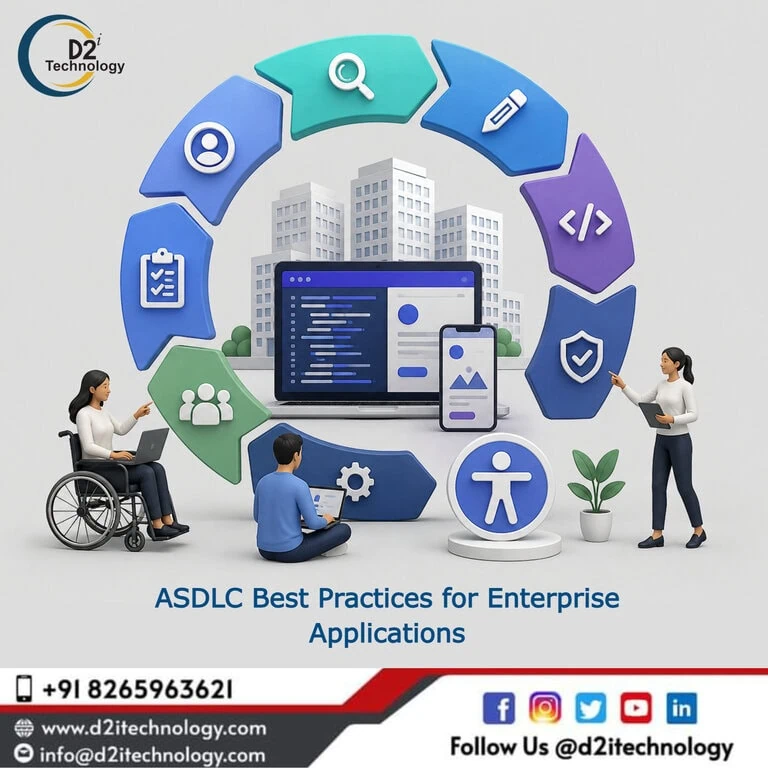
Enterprise applications face a set of accessibility challenges that small-scale web properties simply don’t encounter at the same intensity: tens of thousands of users with varying ability profiles, hundreds of features developed across dozens of teams, integration requirements with legacy systems that were never designed with accessibility in mind, and regulatory compliance obligations that vary by market, sector, and product type. Implementing ASDLC best practices in this environment requires more than a good CI/CD accessibility gate and an agent instruction set that defaults to semantic HTML — it requires an enterprise-grade governance program that keeps accessibility quality consistent across organizational complexity that no single team can fully see.
This post covers the ASDLC best practices specifically relevant to enterprise application development: how to govern accessibility at scale, how to integrate accessibility requirements across distributed development teams, how to handle the vendor and procurement dimension, and how to build the compliance documentation infrastructure that enterprise regulatory obligations require.
Why Enterprise Applications Are a Different Accessibility Challenge
The accessibility challenge at enterprise scale isn’t just more of the same challenge that smaller applications face. Several factors compound in ways that require specifically enterprise-oriented approaches:
Codebase size and team distribution. An enterprise application maintained by multiple development teams, each working on different feature areas, produces accessibility quality that varies across the product unless governance is deliberately distributed. One team’s careful accessibility implementation doesn’t automatically extend to another team’s feature area.
Legacy integration requirements. Enterprise applications frequently integrate with legacy systems, third-party vendor portals, and embedded tools that carry their own accessibility debt — which becomes the enterprise’s accessibility problem as soon as it’s embedded in the user-facing product.
Multiple user types with distinct needs. Enterprise applications often serve diverse user populations — employees with varying ability profiles, customers across demographic ranges, external partners with their own device and assistive technology configurations — whose needs don’t uniformly map to a single WCAG compliance standard.
Compliance across multiple regulatory frameworks. An enterprise operating across the US, EU, and India faces ADA, EAA, Section 508 (if a federal contractor), and SEBI requirements simultaneously. Managing compliance across all of them with a single, coherent accessibility governance program is an enterprise-specific challenge.
What enterprise-scale application development actually involves and why it requires approaches that small-team development doesn’t provides the foundational context for understanding why enterprise accessibility governance is a distinct discipline.
Best Practice 1: Establish a Centralized Accessibility Governance Function
In organizations where accessibility responsibility is distributed informally — every team is “responsible for accessibility” but nobody specifically owns it — accessibility quality is as inconsistent as the individual teams’ attention to it. Enterprise ASDLC best practice requires a centralized accessibility governance function: a team or program that owns the accessibility standards, tooling, training, and audit program across the organization.
This doesn’t mean a team that does all accessibility work. It means a team that:
- Defines and maintains the organization’s WCAG compliance target and any above-WCAG standards specific to your product context
- Owns the CI/CD accessibility tooling configuration and keeps it current as standards evolve
- Provides accessibility expertise to feature teams rather than requiring every team to develop that expertise independently
- Manages the relationship with external accessibility audit partners
- Produces and maintains compliance documentation for regulatory purposes
How AI agent governance and monitoring need to be structured across enterprise development environments covers the parallel governance structure for AI agents in ASDLC — the accessibility governance function fits within the same organizational model.
Best Practice 2: Distribute Accessibility Responsibility Through Training
Centralized governance doesn’t work without distributed capability. A governance team of five people can’t manually review every pull request from two hundred engineers for accessibility quality. They can train those engineers to catch most accessibility problems before code review, reducing the accessibility debt that reaches the governance team’s attention to the genuinely complex cases.
Enterprise ASDLC accessibility training should be tiered:
- All developers: WCAG fundamentals, accessible HTML and ARIA basics, how to use automated checking tools during local development
- Senior engineers and tech leads: Accessible component architecture, complex ARIA pattern implementation, reviewing agent-generated code for accessibility quality
- Designers: Accessible color system design, accessible interaction design, how to specify accessible behavior in design handoff
- Content authors: Alt text authoring, accessible document structure, accessible table design
Practical web accessibility guidance specifically written for developers is a useful resource for the developer-facing tier of this training.
Best Practice 3: Standardize Accessible Component Libraries
The highest-leverage accessibility investment an enterprise engineering organization can make is building and maintaining a standardized, pre-validated accessible component library. When all teams build from the same accessible components, accessibility quality that’s been validated once propagates automatically across every product feature that uses those components.
In ASDLC, this means:
- Agent specifications reference the accessible component library — agents implement features using library components rather than building custom alternatives that may not meet accessibility standards
- The component library itself is version-controlled and accessibility-tested with every update, using both automated checking and manual screen reader evaluation
- Accessibility regressions in the component library are caught before they propagate to all features built on them — the component-level CI/CD check is the right place to catch these, not post-launch audits across individual features
The importance of web accessibility remediation and why fixing accessibility at the component level is more effective than fixing instances makes the case for why this component-level investment pays back substantially.
Best Practice 4: Integrate Accessibility Into Procurement and Vendor Management
Enterprise applications don’t exist in isolation — they integrate with CRM platforms, payment processors, authentication systems, analytics tools, customer support widgets, and a range of other third-party components that users must interact with. Each integration point is a potential accessibility gap if the vendor hasn’t built their product to WCAG standards.
ASDLC best practice for enterprise applications requires accessibility criteria in vendor evaluation:
- Request VPATs (Voluntary Product Accessibility Templates) from vendors as a standard part of procurement evaluation. A VPAT documents which WCAG criteria the vendor’s product meets, partially meets, or doesn’t support.
- Evaluate embedded vendor interfaces directly — a VPAT documents what a vendor claims; direct accessibility testing of the interface confirms what users actually experience.
- Include accessibility obligations in vendor contracts — requiring vendors to meet WCAG 2.1 Level AA, provide notification when accessibility-affecting changes are made, and remediate accessibility barriers within defined timelines.
- Maintain a vendor accessibility inventory that tracks the WCAG conformance status of each integrated third-party component and flags components whose conformance is below standard.
The accessibility strategy for procurement and why it matters for long-term compliance management covers this dimension in depth.
Best Practice 5: Build Compliance Documentation Infrastructure
Enterprise regulatory compliance requires documentation that demonstrates conformance — not just conformance itself. ADA, Section 508, EAA, and SEBI compliance all have documentation components that require systematic record-keeping of how accessibility was addressed, what was evaluated, when evaluations occurred, and what issues were found and remediated.
ASDLC provides structural advantages for compliance documentation:
- Agent action logs create an audit trail of what code was generated, when, and based on what specification — documentation that supports demonstrating how accessibility requirements were incorporated into the development process
- CI/CD pipeline reports produce timestamps and results for every automated accessibility scan across every code contribution — evidence of ongoing accessibility quality control
- Scheduled audit programs produce periodic formal evaluations that document the organization’s WCAG conformance status at defined intervals
Maintaining this documentation infrastructure is significantly easier in ASDLC than in traditional development because much of it is generated as a byproduct of the development process rather than assembled manually before audits.
D2i Technology’s comprehensive accessibility testing services and accessibility remediation services work within this infrastructure — providing the formal evaluation reports and remediation documentation that turn operational records into compliance evidence.
Best Practice 6: Implement Tiered Accessibility Testing
Enterprise applications are too large to manually audit comprehensively on a frequent schedule, but too large and complex for automated checking alone to provide adequate coverage. ASDLC best practice at enterprise scale uses a tiered testing approach:
Tier 1 — Continuous automated checking: Every pull request from every team, every day, gated by the CI/CD pipeline. Fast, consistent, catches detectable WCAG violations before they merge. The best accessibility testing toolkit for enterprise development in 2026 covers the tooling for this tier.
Tier 2 — Feature-level accessibility testing: Each new feature and significant enhancement is tested with keyboard navigation and screen reader evaluation before release — typically by designated accessibility-trained engineers on each team, supported by the central governance function.
Tier 3 — Periodic comprehensive audits: Full WCAG evaluation of the application by certified accessibility professionals, conducted at scheduled intervals (annually at minimum, quarterly for actively developed applications) and triggered by major platform changes. What professional accessibility audit companies provide in a comprehensive enterprise audit covers what these formal audits need to include. The step-by-step guide to product accessibility audit services covers how they’re structured.
Best Practice 7: Establish Accessibility Metrics and Track Them Over Time
Accessibility governance without measurement is policy without accountability. Enterprise ASDLC programs should track accessibility quality metrics over time — not just as a compliance reporting exercise but as genuine visibility into whether the program is working.
Useful enterprise accessibility metrics include:
- Automated violation count by severity across the codebase, tracked weekly — the trend matters more than the absolute number
- Time-to-remediation for high-severity violations — how long from identification to verified fix
- Percentage of new features completing feature-level accessibility testing before release
- Vendor accessibility conformance rate across the integrated third-party portfolio
- Recurring issue patterns from audits — the same violation category appearing in three consecutive audits signals a process problem, not just a code problem
These metrics give the accessibility governance function visibility into where the program is working, where it’s not, and where investment needs to be redirected. What accessibility compliance audit checklists should measure in 2026 is relevant reading for the audit dimension of these metrics.
Best Practice 8: Address Enterprise AI-Generated Content Accessibility
Enterprise applications increasingly use AI to generate user-facing content — reports, summaries, notifications, recommendations, and documentation produced dynamically for individual users. AI-generated content creates a specific accessibility challenge: unlike static content that can be reviewed and approved before publication, AI-generated content is produced on-demand and may vary significantly between users and sessions.
ASDLC best practice for this dimension includes:
- Validating accessibility of the output templates — the HTML structure, heading hierarchy, and semantic markup surrounding dynamic content need to be accessibility-conformant even when the content itself varies
- Checking that AI-generated content meets reading level and cognitive accessibility standards — particularly for content addressed to diverse user populations
- Testing AI-generated content paths with screen readers to verify that dynamically produced content is announced appropriately and doesn’t disrupt navigation context
How AI innovation and intelligent automation solutions create new accessibility considerations alongside their benefits covers this emerging dimension of enterprise accessibility governance.
D2i Technology’s Enterprise Accessibility + ASDLC Practice
D2i Technology supports enterprise organizations across both the ASDLC implementation and accessibility governance dimensions of this work. Our AI development services help establish the agentic development infrastructure; our accessibility services — covering testing, remediation, audit programs, and compliance documentation — provide the enterprise-grade accessibility governance infrastructure that ASDLC alone doesn’t supply.
Why businesses increasingly need professional accessibility testing services rather than ad hoc audits reflects the compliance environment that makes enterprise accessibility governance a strategic priority rather than a nice-to-have.
Conclusion
ASDLC best practices for enterprise applications require a governance architecture that matches the scale and complexity of the enterprise itself — not just better tooling or more capable agents, but centralized accessibility ownership, distributed engineering capability, standardized accessible components, procurement requirements for vendors, compliance documentation infrastructure, and tiered testing programs that provide appropriate coverage at every scale.
Organizations that build this governance architecture alongside their ASDLC capability produce accessible enterprise applications that can demonstrate compliance credibly — not just claim it. D2i Technology brings the combined ASDLC and accessibility expertise to help enterprise organizations build both.
Frequently Asked Questions
Build Enterprise-Grade Accessibility Into Your ASDLC Program
D2i Technology helps enterprise organizations implement ASDLC best practices with the accessibility governance, compliance documentation, and testing infrastructure that large-scale application development requires. Let's talk about where your accessibility program needs to go.