- Web Accessibility
- August 7, 2026
Why Accessibility Remediation Services in USA Are Essential for WCAG Compliance in 2026
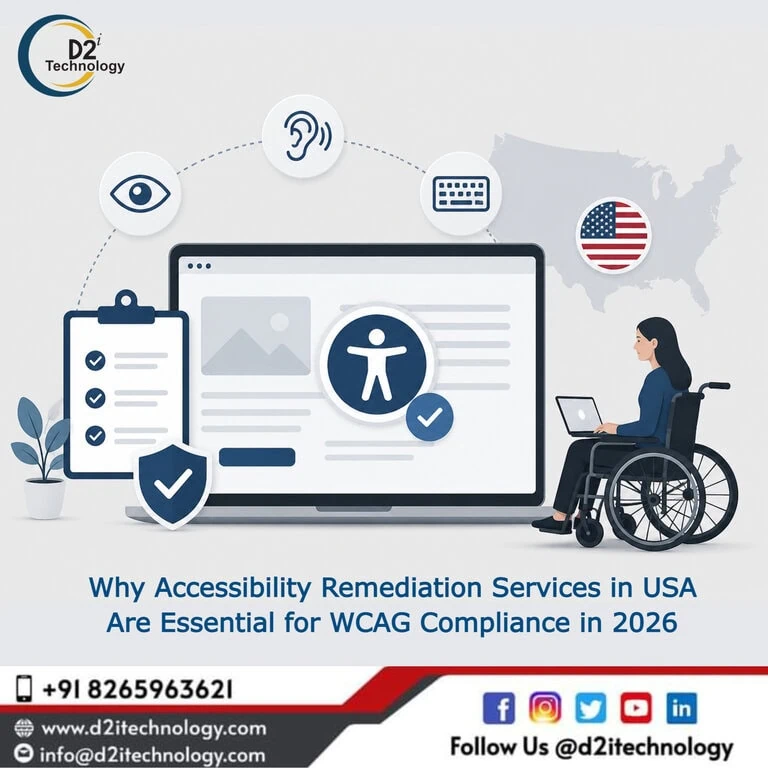
Finding accessibility issues on your website is the easier half of the work. The harder half — the part where most organizations stall — is fixing them correctly, at scale, without breaking everything else in the process. This is precisely why accessibility remediation services in USA have become an essential resource for organizations facing ADA Title II deadlines, Section 508 obligations, and growing user expectations around inclusive design. An audit tells you what’s wrong. Remediation is the work that actually closes the gap.
In 2026, the urgency is real. ADA Title II compliance deadlines are active, enforcement activity is increasing, and the volume of accessibility-related litigation in the US continues to rise. Organizations that have completed audits but haven’t yet addressed the findings are sitting on documented risk. Those who haven’t started at all are operating with compounding exposure. Either way, remediation is the next step — and doing it well requires more than assigning tickets to a development team.
What Accessibility Remediation Actually Involves
There’s a widespread assumption that accessibility remediation is primarily a front-end development task: apply some CSS fixes, add alt text to images, label a few form fields, and call it done. The reality is more layered than that.
Code-Level Fixes
The technical foundation of accessibility remediation is correcting the HTML, CSS, JavaScript, and ARIA that governs how assistive technologies interpret and interact with your website. This includes fixing semantic markup — using the right HTML elements for their intended purpose rather than styling non-semantic elements to look like buttons or headings. It means correcting ARIA implementation, where incorrectly used attributes can actively harm screen reader usability rather than help it.
Practical web accessibility remediation at the code level is where the technical depth of a remediation team shows most clearly. Teams that understand how screen readers parse the DOM, how focus management works in complex components, and how JavaScript interactions get announced — or fail to be announced — to assistive technology users produce far better outcomes than those working from a surface-level checklist.
Keyboard Navigation and Focus Management
Keyboard accessibility is one of the most impactful areas of remediation and one of the most technically involved. Users who navigate without a mouse — including those using screen readers, switch controls, or keyboard-only navigation — need to be able to reach every interactive element, understand where focus currently is, and interact with components without getting trapped.
A practical guide to keyboard navigation accessibility covers the specific requirements and common failure patterns: focus indicators that don’t meet contrast requirements, modal dialogs that don’t trap and release focus correctly, dropdown menus that lose focus when opened, and interactive components that have no keyboard equivalent at all.
Getting keyboard accessibility right in complex web applications — those with dynamic content, rich UI components, and single-page application routing — requires developers who understand focus management patterns and know when to use, and when to avoid, ARIA roles and properties.
Content Remediation: Images, Documents, and Media
Not all accessibility remediation lives in code. A significant portion involves content: images that need accurate and contextually appropriate alt text, PDFs that need to be tagged for reading order and structure, videos that need captions and audio descriptions, and data tables that need properly associated headers.
For organizations with large content libraries — and particularly for those in regulated industries with extensive document archives — content remediation can represent the largest volume of work in the entire program. The difference between fixing a broken ARIA pattern (one template change, potentially thousands of instances resolved) and remediating a poorly tagged PDF (one document at a time) is significant. A professional remediation team will help you build a triage framework that addresses both efficiently.
Component-Level Structural Fixes
Some accessibility issues can’t be patched — they require the component to be rebuilt. Custom dropdown menus that don’t support keyboard interaction, carousels with no pause controls, date pickers with no keyboard alternative, drag-and-drop interfaces with no keyboard equivalent: these are architecturally inaccessible in their current form.
The most persistent WCAG practices that require structural attention tend to involve exactly these kinds of interactive components. Patching them cosmetically — adding a focusable attribute without rethinking the interaction model — produces code that technically passes automated checks but still fails real users. The right fix is a rebuild that applies proper ARIA patterns from the ground up.
Why 2026 Makes Professional Remediation Services Specifically Valuable
ADA Title II Deadlines Are Binding
The April 2026 compliance deadline for larger US state and local government entities isn’t a guideline — it’s an enforcement date established by a final DOJ rule. Organizations in scope that haven’t achieved WCAG 2.1 Level AA conformance by that date are materially exposed to complaints, investigation, and corrective action proceedings.
The timeline of ADA Title II compliance and what meeting the deadline actually requires makes clear that the gap between running an audit and achieving documented conformance is measured in months of sustained work, not days of quick fixes. Professional remediation services compress that timeline by bringing capacity, expertise, and process to a problem that in-house teams rarely have bandwidth to tackle alone.
Enterprise Accessibility Remediation Is a Different Scale
The volume of work required for enterprise-level accessibility remediation is genuinely different from a small site cleanup. Hundreds of page templates. Multiple distinct applications. Thousands of PDFs. Legacy codebases with technical debt layered over years of development. Third-party integrations with their own accessibility debt.
Web accessibility audit and remediation services for enterprises in 2026 addresses the specific scale challenges that large organizations face — how to prioritize across a sprawling digital estate, how to coordinate remediation across multiple development teams, and how to build governance processes that prevent new accessibility debt from accumulating as fast as old issues are resolved.
Overlay Tools Are Not an Answer
It’s worth addressing directly because it comes up in every conversation about accessibility deadlines: overlay tools — JavaScript products that claim to automatically fix accessibility — are not a solution to remediation. They don’t produce WCAG conformance. They are actively criticized by accessibility professionals and disability advocacy organizations as harmful to users who rely on assistive technology. Choosing an overlay because the remediation timeline feels too long is trading real exposure for imaginary protection.
Why proactive accessibility through actual code fixes is the only reliable path is a principle that holds regardless of how compelling an overlay vendor’s pitch sounds.
The Remediation Process: What Good Looks Like
Starting From Audit Findings
Remediation doesn’t start from scratch — it starts from a findings report. A good audit produces prioritized issues with enough technical detail to drive action: which WCAG criterion is violated, which element on which page, what the failure mode is, and what a correct implementation would look like.
If your organization has an audit report but doesn’t know how to translate it into a remediation plan, that’s precisely where a professional remediation partner earns immediate value. What professional accessibility audit companies deliver — and how the audit output should be structured to support efficient remediation — is the foundation that everything else depends on.
Fixing at the Root, Not the Symptom
The most efficient remediation programs don’t treat each issue instance as a separate task. They identify root causes — a broken template, an inaccessible component library, a CSS pattern that suppresses focus indicators — and fix those. A single template fix can resolve hundreds of apparent violations simultaneously.
This approach requires developers who understand the architecture of the site well enough to trace individual issues back to their source. It’s the difference between a remediation program that’s completed in months and one that’s still running two years later with no end in sight.
Retesting After Fixes
Code changes that resolve automated checker violations don’t always resolve the underlying user experience problem. Screen reader behavior is particularly prone to this gap — a fix that looks correct in HTML doesn’t always behave correctly when a screen reader user navigates through it.
Professional accessibility remediation services include retesting as part of the workflow: running automated checks after fixes to confirm violations are resolved, and conducting targeted manual testing with screen readers on components that were behaviorally broken rather than just syntactically wrong. How professional accessibility testing transforms site usability after remediation captures why this verification step matters as much as the fix itself.
Using AI-Assisted Remediation Thoughtfully
AI tools are increasingly available to assist with some parts of the remediation process — automated alt text generation, PDF tagging at scale, and pattern detection across large codebases. Used thoughtfully alongside human review, these tools can accelerate work that would otherwise be prohibitively time-consuming.
How AI can support web accessibility improvements at scale is a practical look at where AI-assisted tools add genuine value and where they still require human oversight to produce accurate, contextually appropriate results. Auto-generated alt text, for instance, needs human review to confirm it actually describes what the image conveys in the context it appears — not just that it’s grammatically present.
Beyond Fixes: Building Accessibility Into the Development Lifecycle
The most common failure mode in accessibility programs isn’t failing to fix issues — it’s fixing them once and then watching the same issues reappear as new content and features are added. Sustainable WCAG compliance requires more than a remediation sprint. It requires integrating accessibility into how your team develops.
This means developer training so that accessibility patterns become instinct rather than afterthought. It means automated accessibility checks in your CI/CD pipeline so regressions are caught before they reach production. It means content author guidelines so that new pages don’t introduce the same issues that were just remediated. It means making your website accessible on a budget through sustainable practices, not through periodic expensive cleanup.
D2i Technology’s accessibility services are designed with this lifecycle in mind — not just closing the current gap, but building the capability to keep it closed.
Why D2i Technology
D2i Technology’s IAAP-certified team provides accessibility remediation services in USA that span the full remediation scope: code fixes across HTML, CSS, JavaScript, and ARIA; document remediation for PDFs and Office files; content review for image alt text and media; component rebuilds for architecturally inaccessible elements; and retesting to verify that fixes actually work with real assistive technologies.
Our work connects directly with accessibility testing services and is informed by audit findings — which means remediation recommendations are specific, prioritized, and grounded in how your actual users experience your site. We work with organizations ranging from enterprise-scale digital properties to focused compliance projects with tight deadlines, and we bring the same technical depth to both.
Conclusion
An accessibility audit without remediation is a document that describes a problem without solving it. For US organizations with ADA Title II deadlines, Section 508 obligations, or growing compliance pressure in 2026, accessibility remediation services are the bridge between knowing what’s wrong and achieving defensible WCAG conformance.
The organizations that invest in professional remediation now — with genuine technical depth, root-cause thinking, and proper retesting — are the ones that will be able to demonstrate real compliance rather than good intentions. D2i Technology is ready to help you build that bridge.
Frequently Asked Questions
Your Audit Found Issues — Let's Fix Them Properly
D2i Technology provides expert accessibility remediation services for organizations across the USA, covering code fixes, document remediation, component rebuilds, and verified retesting. With ADA Title II deadlines in effect, there's no better time to close your compliance gap with a team that knows how.