- Website Accessibility
- August 3, 2026
Accessible Web Compliance Audit Guide for Regulated Entities
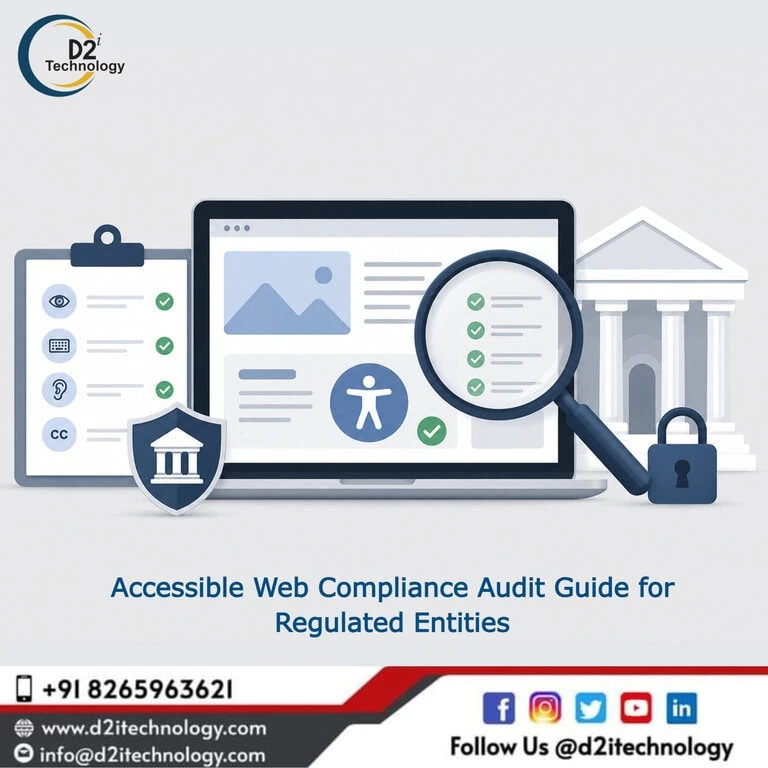
Regulated industries operate under a level of scrutiny that most businesses don’t. When an accessibility failure happens on a financial institution’s website, a healthcare portal, or a government service platform, the consequences aren’t limited to user frustration — they can include regulatory action, enforcement proceedings, and litigation exposure that’s difficult to recover from. This is exactly why conducting a thorough accessible web compliance audit for regulated entities isn’t simply a technical task. It’s a risk management exercise that connects directly to organizational governance, legal standing, and the ability to serve all users equitably.
This guide walks through what a credible accessibility audit looks like for entities operating under regulatory frameworks — what the process involves, why the regulated sector faces particular challenges, how to interpret and act on findings, and what sustaining compliance looks like over time.
Why Regulated Entities Face a Different Compliance Landscape
Multiple Overlapping Standards
A private e-commerce website that wants to improve accessibility faces one primary framework: WCAG 2.1 or 2.2 at Level AA. A regulated entity often sits at the intersection of multiple overlapping obligations. A US financial institution, for example, may need to satisfy ADA requirements, Section 508 if it receives federal contracts or funding, state-level accessibility laws, and potentially international standards if it serves customers abroad.
In India, SEBI-regulated entities — including listed companies, stock brokers, depositories, and mutual fund platforms — are now required to ensure their digital properties meet accessibility standards, with WCAG 2.1 Level AA as the expected baseline. How to conduct a WCAG compliance audit for SEBI-regulated entities outlines the specific compliance obligations and audit framework that applies to this sector.
Healthcare organizations face HIPAA considerations alongside accessibility requirements — including the critical need to ensure that patient portals, scheduling systems, and health information pages are accessible to users with disabilities. Education institutions operating in the US must satisfy both ADA Title II requirements (if public) and Section 504 obligations alongside WCAG standards.
Understanding which regulatory frameworks apply to your organization before an audit begins is essential. Auditing against the wrong standard — or missing an applicable one — produces a compliance result that doesn’t actually reflect your risk exposure.
Higher Stakes for Accessibility Failures
In most industries, an accessibility failure results in a poor user experience and potential reputation risk. In regulated industries, the stakes are higher. A visually impaired investor who cannot access their account, a patient who cannot navigate a healthcare portal to book a critical appointment, or a benefits recipient who cannot complete a required government form — these situations attract regulatory attention and legal action in ways that accessibility failures on a retail website typically don’t.
The growing importance of digital accessibility for Indian companies operating in regulated sectors reflects a broader shift globally: regulators are increasingly treating digital accessibility as a core component of equitable service delivery, not a discretionary enhancement.
What a Credible Compliance Audit Involves
Stage 1: Scope Definition
Before any testing begins, an effective audit establishes a clear scope. For regulated entities, this means identifying:
- All web properties and subdomains that serve customers, clients, or members
- Mobile applications on iOS and Android platforms
- Documents used in regulated service delivery — account opening forms, benefit disclosures, policy documents, statements
- Third-party integrations embedded in your digital environment (payment processors, authentication flows, chatbots, interactive tools)
- Employee-facing systems if Section 508 or equivalent obligations apply
Scope definition is not a paperwork exercise. Including the wrong things — or missing the right ones — changes the audit’s compliance value entirely. Professional accessibility audit companies invest significant time in scope clarification specifically because a narrowly scoped audit can leave an organization with an incomplete and therefore misleading picture of its compliance status.
Stage 2: Automated Scanning
Automated accessibility scanning tools test web content against WCAG success criteria that can be evaluated programmatically — missing alt attributes, contrast ratios, form label associations, missing document language declarations, and similar machine-detectable issues.
The tools available today — axe-core, WAVE, Lighthouse, and others — are genuinely useful and run quickly across many pages. The top WCAG accessibility compliance checkers available in 2026 covers the major options and their respective strengths and limitations.
The critical limitation to understand: automated tools catch approximately 30–40% of WCAG failures. The remaining issues require human judgment to identify. An organization that relies exclusively on automated scanning is operating with a partial view of its compliance status — one that creates false confidence at precisely the time when false confidence is most dangerous.
Stage 3: Manual Evaluation by Trained Specialists
Manual evaluation covers everything automated tools cannot assess: whether an image’s alt text actually describes what the image conveys, whether an interactive feature works correctly when operated by keyboard alone, whether screen reader announcements are meaningful to a user who cannot see the page, whether error messages are clear and specific enough to help users correct mistakes.
For regulated entities — where forms, authentication flows, account management interfaces, and document-heavy content are typically central to the digital experience — manual evaluation is where the audit earns its value. How manual and automated accessibility testing complement each other explains why both are necessary and neither is sufficient alone.
Manual evaluation should be conducted using actual assistive technologies — NVDA or JAWS for Windows screen readers, VoiceOver for macOS and iOS, TalkBack for Android — in addition to keyboard-only navigation testing. Real assistive technology behavior sometimes differs significantly from what static code analysis would predict.
Stage 4: Document and Media Accessibility Review
Regulated entities frequently rely heavily on documents: prospectuses, policy terms, account statements, annual reports, application forms, compliance disclosures. PDFs in particular are commonly produced without any accessibility tagging, making them completely inaccessible to screen reader users.
An accessible web compliance audit for regulated entities should include systematic review of documents used in regulated service delivery. This means checking for proper PDF tagging structure, reading order, heading hierarchy, alt text for charts and diagrams, form field labels in interactive PDFs, and language identification. The same applies to any video content — captions, audio descriptions, and accessible media players.
Stage 5: Findings Report and Prioritization
The output of a compliance audit should be a findings report detailed enough to actually guide remediation — not a high-level summary that leaves development teams without actionable direction. For each issue identified, the report should include: which WCAG success criterion is violated, where the issue occurs (specific pages, templates, components), what the technical failure is, and what remediation would look like.
Prioritization within the report matters as much as completeness. For regulated entities, issues that affect core regulated service flows — account access, transaction completion, document retrieval, authentication — should be categorized separately from issues in secondary content. The step-by-step guide to accessibility audit services covers how to structure findings for maximum remediation efficiency.
Sector-Specific Audit Considerations
Financial Services and Fintech
Financial websites and applications typically combine high-stakes transactional interfaces with complex data visualizations — neither of which is friendly to accessibility by default. Charts and graphs used to display investment performance need text alternatives or data table equivalents. Multi-step transaction flows need clear error handling and the ability to review before submitting. Authentication flows need to work with screen readers and cannot rely on visual CAPTCHA alone.
For US-based financial entities, a digital accessibility audit for US financial websites addresses the specific interaction patterns and regulatory obligations that apply. For India’s capital markets sector, SEBI WCAG compliance audit guidance for 2026 covers the regulatory context and what audits in this sector need to address.
OTP-based authentication — widely used in Indian financial services — creates its own accessibility gap that needs specific evaluation. The accessibility gap in OTP and two-factor authentication systems is a problem that appears consistently in audits of financial digital products.
Healthcare
Healthcare portals need to balance stringent security requirements with full accessibility across patient-facing features: appointment booking, prescription management, test results, billing, and telehealth interfaces. Accessibility testing for healthcare needs to specifically address cognitive accessibility considerations — the relationship between web accessibility and cognitive disability is particularly relevant for health information platforms where clarity and simplicity have direct implications for patient outcomes.
Education and E-Learning
Educational institutions face accessibility obligations across their websites, student portals, and increasingly across e-learning platforms and course content. E-learning accessibility has its own specific evaluation requirements, particularly for content built in platforms like Articulate Storyline where custom interactions need individual evaluation. D2i Technology’s work in e-learning accessibility audit for Articulate Storyline 360 reflects the specific challenges this content type presents.
Building Accessibility Into Procurement and Ongoing Governance
One of the most consequential accessibility decisions regulated entities make happens before any public-facing content is built: procurement. When an organization purchases a CMS platform, a customer portal, a document management system, or any third-party digital tool without evaluating its accessibility, it inherits accessibility problems it often has limited ability to fix.
An accessibility strategy for procurement that requires vendors to demonstrate WCAG conformance — through Voluntary Product Accessibility Templates (VPATs) or direct audit results — is one of the most effective long-term accessibility investments any regulated entity can make.
Beyond procurement, sustaining compliance over time requires governance: defined ownership for accessibility across the organization, developer and content author training, a scheduled audit cycle, and a process for evaluating accessibility before new features or platforms go live rather than after.
Why D2i Technology for Regulated Entity Audits
D2i Technology’s IAAP-certified accessibility team has direct experience auditing digital properties for organizations operating in regulated industries — including financial services, healthcare, education, and government entities across the US and India. Our accessibility testing services are structured to meet the specific needs of regulated entities: thorough scope definition, combined automated and manual evaluation, assistive technology testing, document review, and audit reports detailed enough to guide actual remediation.
Where findings require fixes, our accessibility remediation services provide the technical depth to address issues in code, content, and documents — not just document them. The D2i AccessScan tool is available for organizations wanting a preliminary picture of their accessibility status before committing to a full audit engagement.
Conclusion
An accessible web compliance audit for regulated entities isn’t the same exercise as a general accessibility check. It requires understanding the specific regulatory frameworks that apply, evaluating the full scope of digital properties and documents, combining automated and manual testing methodologies, and producing findings that are detailed enough to drive systematic remediation rather than surface-level fixes.
For organizations operating in sectors where accessibility failures carry regulatory, legal, and reputational consequences, the quality of the audit — and the partner conducting it — matters enormously. D2i Technology brings certified expertise, sector-specific experience, and a complete service offering from audit through remediation and ongoing compliance to every engagement.
Frequently Asked Questions
Your Sector Has Specific Accessibility Requirements — Does Your Audit Reflect That?
D2i Technology delivers professional web accessibility audits tailored to the compliance obligations of regulated industries — financial services, healthcare, education, and government. Our IAAP-certified team provides the depth, documentation, and remediation support that regulated entities need to demonstrate genuine compliance.