- Mobile App Development
- July 24, 2026
Top Reasons to Choose a Mobile App Development Company in India
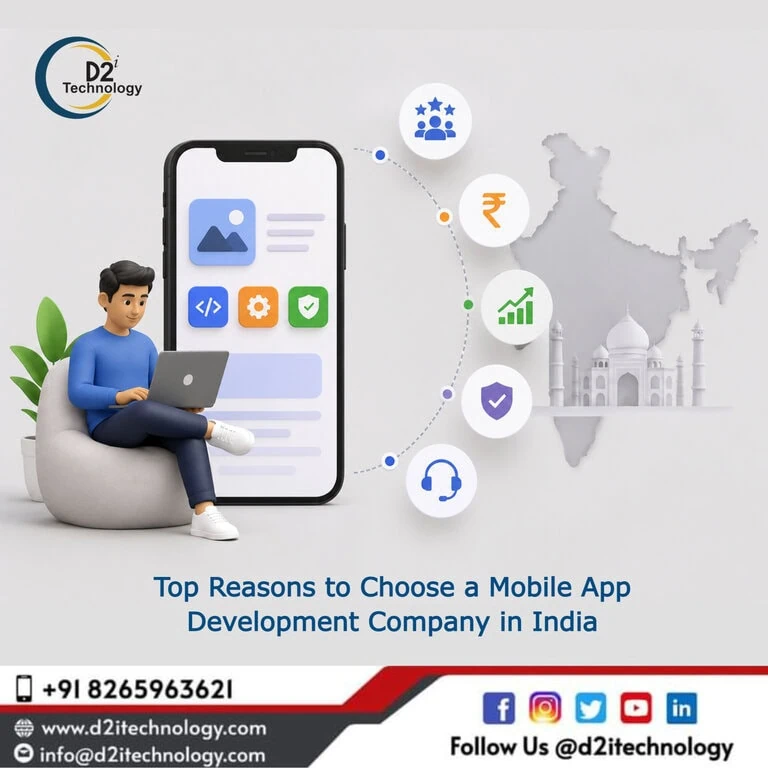
Choosing where to build your mobile app is one of the most consequential decisions in the early stages of a product. Get it right and you have a development partner that understands your goals, delivers quality code, and scales with you as the product grows. Get it wrong and you’re left managing missed deadlines, unclear ownership, and a codebase you can barely maintain. For businesses weighing their options, partnering with a mobile app development company in India has become a well-trodden path — and for good reasons that go well beyond the obvious cost advantages.
This post covers the substance of those reasons: what makes India-based mobile development companies genuinely competitive, what to look for when you’re selecting one, and how to think about the partnership over the full lifecycle of your product.
Why India Has Become a Go-To for Mobile App Development
A Developer Talent Pool That’s Both Deep and Specialized
India’s software industry isn’t large simply because of population scale. It’s large because decades of infrastructure investment in engineering education, combined with a culture that treats technical expertise as a credible career path, has produced an enormous community of skilled developers who actively compete for challenging work.
For mobile development specifically, this matters in a concrete way. You’ll find developers who have built consumer apps for millions of users, enterprise platforms that handle complex business logic, fintech applications with strict security requirements, healthcare apps with compliance constraints, and everything in between. The top software development companies in India in 2026 reflect this range — the ecosystem has diversified well beyond the generic outsourcing stereotype of years past.
Cost Efficiency That Expands What’s Possible
Development rates in India are substantially lower than in the US, UK, or Australia — not because the work is lower quality, but because the cost of living and market rates are different. What this means practically is that the same budget that might buy a basic MVP with a Western team can fund a more complete product with an Indian development company: more features, more thorough QA, better design, stronger backend architecture.
Understanding the full cost breakdown of app development helps set realistic expectations before you engage any vendor. The point isn’t that cheaper is always better — it’s that cost efficiency, applied well, gives you options that would otherwise be out of reach.
Mature Delivery Processes for International Clients
Indian mobile development companies that work with international clients — which is most of the established ones — have had to develop strong communication practices, documentation standards, and project management workflows. Working across time zones and cultures forces a level of process discipline that firms operating entirely in a single domestic market don’t always develop.
This matters when you’re evaluating a partner. A company that has delivered projects for US, UK, and Australian clients is one that has already solved the collaboration challenges that worry first-time offshore buyers. The communication friction that people fear is largely a function of choosing inexperienced vendors — experienced ones have already worked through it.
What to Look for in a Mobile App Development Company in India
Full-Cycle Development Capability
The best mobile app development companies handle the full build lifecycle — discovery and scoping, UX/UI design, frontend and backend development, QA testing, app store submission, and post-launch maintenance. Companies that hand off parts of the process to third parties create coordination risks and knowledge gaps that show up in the final product.
Ask specifically about what’s in-house and what gets subcontracted. A company that can take you from a product brief through to a tested, submitted app using its own team is a meaningfully different proposition from one that delivers code and leaves the rest to you.
D2i Technology’s custom mobile app development services are structured to cover this full cycle — from product strategy through development, testing, and launch support — so that you’re working with a single team throughout.
Technical Range Across Platforms
Mobile development in 2026 means being fluent across a wider set of platforms and frameworks than it did five years ago. Native development in Swift (iOS) and Kotlin (Android) remains important for performance-critical applications. Cross-platform frameworks like Flutter and React Native have matured to the point where they’re the right choice for a wide range of products — reducing development time and cost without the quality compromises that earlier cross-platform tools had.
The choice of programming language and framework shapes everything that comes after, including how easy the app is to maintain, how well it performs, and how much it costs to add features later. Choosing the right programming language for mobile app development is worth understanding before your first technical conversation with a potential vendor.
Quality Engineering Built Into the Process
A lot of development companies treat testing as something that happens at the end before delivery. This approach produces unreliable software. The companies worth working with integrate quality engineering throughout the development cycle — writing tests alongside code, running regression suites before each release, and using performance testing to catch bottlenecks before users do.
Look for evidence of both manual testing practices and automation testing capability in how a company works. Automated testing keeps regression coverage sustainable as the codebase grows; manual testing catches the kinds of usability issues that automation misses. A team that does both is more likely to ship something that actually works reliably.
Security Practices That Match the Application’s Risk Profile
Every mobile app handles some form of sensitive data. Login credentials at minimum; often payment information, health data, personal records, or location. The security of that data is the developer’s responsibility during the build, and it’s worth verifying that any company you’re considering takes that responsibility seriously.
This means secure storage and transmission, proper authentication flows, protection against common mobile vulnerabilities, and validation against platform security guidelines. For apps where security is a central concern, Android penetration testing and API security validation should be part of the pre-launch process, not an afterthought.
AI and Advanced Feature Integration
Mobile apps that include intelligent features — personalization, predictive recommendations, on-device machine learning, natural language interfaces — are increasingly common across all categories, not just consumer tech. A mobile app development company that can integrate AI development services directly into the build, rather than treating AI as a separate layer, gives you more flexibility in how you architect these capabilities.
This is an area where the technical range of your development partner matters. Building an AI-powered feature into a mobile app is a different kind of problem than building the mobile app itself, and teams that have done it before will make better architectural decisions than those encountering it for the first time.
Common Pitfalls When Choosing a Mobile App Development Partner
Choosing on Price Alone
Cost efficiency is one good reason to work with an Indian development company. It shouldn’t be the only one. Vendors that compete primarily on price tend to cut corners elsewhere — in QA, in documentation, in architecture quality. The lowest bid rarely produces the best long-term outcome. Evaluate on capability, track record, and process quality. Let cost be a factor, not the deciding one.
Underinvesting in the Discovery Phase
The more clearly defined your requirements are before development begins, the better the outcome tends to be. Vague product briefs lead to vague builds. Spending time on discovery — defining user flows, feature prioritization, technical requirements, and integration points — is an investment that pays back significantly during development. Good mobile app companies will facilitate this process; be cautious about any vendor that wants to start writing code before this work is done.
Ignoring Post-Launch Needs
Mobile apps require continuous attention after launch. Platform updates break things. User feedback reveals improvements. New features need to be added. A company that treats delivery as the end of the engagement isn’t a long-term partner — it’s a vendor. Make sure post-launch support is discussed and agreed upon before you sign anything.
For a broader view of how to evaluate and structure the outsourcing relationship, understanding the challenges and solutions in IT outsourcing is useful context before you go into vendor conversations.
Why D2i Technology
D2i Technology brings mobile app development together with quality engineering, security testing, and AI capabilities — a combination that matters more than it might initially seem. Mobile apps don’t exist in isolation: they depend on backend systems, need to perform under real user conditions, carry security responsibilities, and increasingly need to incorporate intelligent features.
Having all of that capability under one roof means your development partner isn’t handing off pieces of your product to third parties and hoping it all fits together. It means a single team that understands the whole product, makes integrated decisions, and is accountable for the complete result.
Explore the top web application development companies in India for 2026 for context on what the best-in-class Indian development firms look like, and see how D2i Technology’s integrated approach positions it within that landscape.
Conclusion
The decision to work with a mobile app development company in India is, at its core, a decision about where you can access the right combination of skills, process maturity, and value for your specific product. India’s mobile development ecosystem offers all three — but finding the right company within that ecosystem still requires careful evaluation.
The reasons businesses keep coming back to Indian development partners aren’t just about cost. They’re about the quality of the output, the flexibility of the engagement, the depth of the technical team, and — when you find the right company — a genuine partnership in building something that works and lasts.
Frequently Asked Questions
Looking for a Mobile App Development Company in India You Can Actually Trust?
D2i Technology builds custom mobile applications with full-cycle development, integrated QA, security validation, and AI capabilities — all under one roof. Whether you're building your first app or scaling an existing product, we're ready to talk about what your project needs.