- Web Accessibility
- August 17, 2026
Best Free Accessibility Testing Tool for Web Developers in 2026
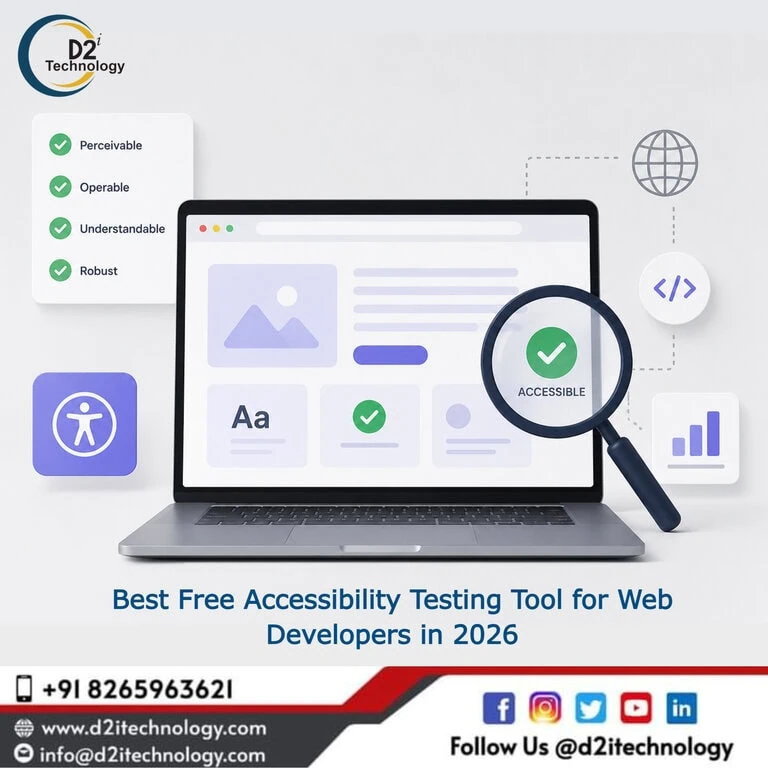
If you’re a web developer trying to build accessible UIs in 2026, the question of which is the best free accessibility testing tool for web development isn’t just academic — it’s a practical daily decision. The tools you reach for shape what you catch, when you catch it, and how much rework you end up doing later. A color contrast check run during design costs nothing to fix. The same issue discovered in a post-launch audit costs hours of back-and-forth with a design team and a redeployment cycle. Getting the tooling right isn’t about compliance paperwork — it’s about writing better code the first time.
This post is written specifically for developers, not compliance officers or business stakeholders. The tools covered here are ones that fit into the way developers actually work: in code editors, in the browser, in test suites, and in CI/CD pipelines.
What Developers Actually Need From Accessibility Testing Tools
The tooling needs of a developer are different from those of a compliance manager or an accessibility consultant. Developers need:
- Speed. A tool that runs inline or in the browser without switching contexts.
- Specificity. Element-level information with enough detail to locate and fix the issue without investigation.
- Relevance. Results that reflect the rendered page, not just the static HTML source.
- Integration. The ability to run in the same environments where development happens — IDEs, browsers, CI pipelines.
A compliance report formatted for executive review doesn’t meet any of these needs. What follows is a developer-oriented breakdown of the best free tools available in 2026.
1. Axe-Core: The Developer Foundation
Axe-core (from Deque Systems) is the open-source accessibility testing engine that powers most of the other tools on this list. Understanding axe-core directly — not just through its wrappers — is worth the investment, because it gives you the flexibility to integrate accessibility checking wherever you need it.
Why it matters for developers:
Axe-core can be installed as an npm package and run in any JavaScript testing environment. It tests the rendered DOM, which means dynamic content, JavaScript-rendered components, and React/Angular/Vue applications are tested as users actually experience them — not as they look in the source HTML.
bash
npm install axe-coreFrom there, it integrates with Jest, Playwright, Cypress, and most other testing frameworks. You can write accessibility assertions alongside your component tests — which means accessibility regressions get caught in the same test run that catches functional regressions.
Axe-core’s rule set implements WCAG 2.1 Level A and AA, with WCAG 2.2 coverage expanding. The rules are well-documented, the violation descriptions are developer-friendly, and the false positive rate is low by design — Deque has deliberately set the threshold to avoid generating noise.
How Playwright integrates with accessibility testing frameworks is worth reading alongside axe-core documentation, as Playwright’s built-in accessibility snapshot capabilities complement axe-core’s rule-based testing effectively.
2. Axe DevTools Browser Extension: In-Browser Testing
The axe DevTools browser extension (free tier) brings axe-core’s analysis directly into Chrome and Firefox DevTools. For developers who want to test a specific page state — after user authentication, after a modal opens, after a dynamic form loads — this is the most practical option because it tests exactly what’s in the browser at that moment.
What it does:
Run a scan on any open page and get a structured results panel showing violations, incomplete (needs manual review), inapplicable, and passing rules. Each violation links to the specific element in the DOM and includes a clear description of the failure and suggested remediation.
The free tier covers the core WCAG automated checks. The paid tier adds guided manual testing workflows — but for basic automated scanning in the browser, the free version is genuinely excellent.
Best use case: Testing authenticated pages, specific page states, or interactive components that can’t be reached by URL-based scanners.
3. D2i AccessScan: URL-Based Multi-Page Scanning
For scanning pages that are publicly accessible, D2i Technology’s free AccessScan tool provides structured WCAG results without requiring installation. Enter a URL, get a detailed accessibility report organized by WCAG criterion, severity, and specific element location.
For developers who need to quickly assess a client’s existing site, test a staging environment before launch, or validate a page that’s difficult to reach in a local testing environment, a URL-based scanner offers a frictionless entry point. The AccessScan report format is built for technical use — specific enough for developers to act on without needing intermediate translation.
D2i Technology also provides the D2i Accessibility Toolkit for WordPress, which gives WordPress developers in-CMS accessibility feedback integrated directly into the editing environment.
4. eslint-plugin-jsx-a11y: Catch Issues at Write Time
For React developers, eslint-plugin-jsx-a11y is the most efficient accessibility tool in the entire stack because it catches violations in the code editor before the code is even run.
Why it’s particularly effective:
Accessibility issues caught at write time require zero context-switching to fix — the developer sees the problem in the same file, in the same moment, and can address it immediately. This is categorically cheaper than catching the same issue in a browser extension scan, a CI pipeline failure, or a post-launch audit.
Common violations the plugin flags include: interactive elements without accessible names, invalid ARIA attribute usage, form inputs without labels, images without alt text, and heading elements used incorrectly.
bash
npm install eslint-plugin-jsx-a11y --save-devAdd it to your ESLint configuration with the recommended ruleset and it runs automatically whenever you lint your code. For teams using TypeScript with React, it works alongside other ESLint plugins without conflicts.
Best practices for UI automation testing that incorporate accessibility checks covers how to structure your test configuration to catch both functional and accessibility regressions in the same automated run.
5. WAVE Browser Extension: Visual Feedback for Layout and Structure
The WAVE browser extension (from WebAIM) takes a different approach from axe-core — instead of a results panel, it overlays visual annotations directly on the page, showing accessible elements, structural hierarchy, and errors in their visual context.
Why developers find it useful:
WAVE is particularly good for understanding the spatial relationship between accessibility issues and page content. When you’re trying to understand why a heading structure is confusing to a screen reader, or why focus order is counterintuitive, seeing the issues annotated on the rendered page often communicates more clearly than a list in a side panel.
It also provides structural views — showing the document outline, ARIA landmarks, and tab order — that help identify high-level structural problems that automated rule-checkers sometimes handle less intuitively.
Best combined with: Axe DevTools for rule-based violations plus WAVE for structural overview gives significantly better coverage than either alone.
6. Accessibility Insights for Web: Guided Manual Testing
Accessibility Insights for Web (from Microsoft, available free as a Chrome extension) is the most complete free tool for structured manual testing. Beyond automated scanning, it provides step-by-step guided workflows for evaluating criteria that require human judgment.
The “Assessment” mode walks evaluators through WCAG 2.2 Level AA success criteria that can’t be automated, with clear instructions and pass/fail recording. For developers who need to go beyond automated scanning before shipping a feature, this is the most rigorous free option.
Tab stops visualization is a particularly useful feature for developers building interactive components — it renders the keyboard focus order visually on the page, making focus management problems immediately obvious.
How manual and automated accessibility testing complement each other explains why Accessibility Insights fills an important gap — providing structure to the manual testing that automated tools can’t replace.
7. Color Contrast Analyzers: Built Into Every Designer-Developer Handoff
Color contrast violations are among the most commonly occurring accessibility failures — and the ones most likely to come from design decisions rather than coding errors. A dedicated contrast tool belongs in the developer’s workflow for verifying what designs specify before implementing them.
D2i Technology’s free Color Contrast Analyzer provides real-time ratio calculation with clear WCAG 2.1 pass/fail results for both AA and AAA thresholds. For any color combination coming in from a design file, running it through the analyzer before writing the CSS costs less than 30 seconds and catches failures before they’re coded in.
Color contrast requirements beyond the basic WCAG thresholds covers the nuances of WCAG 1.4.11 (Non-Text Contrast) that many developers miss — the requirement extends beyond body text to UI component borders, focus indicators, and meaningful icons.
Building These Tools Into Your Development Workflow
A developer accessibility toolkit isn’t just about having the tools — it’s about when and how they get used. Here’s a practical sequence:
During development: eslint-plugin-jsx-a11y runs on every file save. Color contrast checked for every new color value. Zero context-switch, zero delay.
During component review: Axe DevTools browser extension run on the component in isolation in a local development environment. Five-minute check before marking a component as done.
Before merging: Axe-core integration in your test suite runs as part of the CI pipeline. Any accessibility violation in the changed components fails the build.
Before release: D2i AccessScan and Accessibility Insights for Web run on the staging environment. Structural review with WAVE. Manual keyboard navigation walkthrough of new flows.
Post-launch monitoring: Scheduled scans of production pages at intervals matched to your deployment cadence.
How automated code review and testing are evolving for accessibility looks at where developer tooling is headed — including AI-assisted accessibility checking that will become part of standard code review workflows.
Understanding the full landscape of web accessibility issues that developers encounter gives useful context for why this layered testing approach exists — different categories of accessibility failure require different tools to surface.
What Free Tools Don’t Cover
Every tool covered in this post is genuinely useful. None of them, combined, produces full WCAG 2.2 compliance verification. The remaining issues require:
- Real screen reader testing (NVDA, JAWS, VoiceOver) — actual assistive technology behavior differs from what code analysis predicts.
- Cognitive accessibility evaluation — whether instructions are clear, whether error recovery is intuitive, whether timing is manageable.
- Screen magnification testing — whether layout holds up at 400% zoom reflow.
- Voice control testing — whether UI can be controlled entirely by voice.
For developers working on products with formal compliance requirements, top accessibility testing services in the USA outlines what professional evaluation adds beyond what free tools provide. D2i Technology’s accessibility testing services cover this full evaluation scope, complementing what your developer toolkit catches automatically.
When free tools surface issues that need remediation, accessibility remediation services provide the expert support to address them — particularly for complex components or legacy codebases where fixes require architectural judgment.
Conclusion
The best free accessibility testing tool for web development in 2026 isn’t a single tool — it’s a combination that covers different contexts and different failure types. Axe-core for automated testing in code. Axe DevTools for browser-level scanning. ESLint plugin for real-time editor feedback. WAVE for structural visualization. Accessibility Insights for guided manual evaluation. D2i AccessScan for URL-based multi-page assessment. A color contrast analyzer for every design-to-code handoff.
Used together at the right points in the development lifecycle, these tools make accessibility a natural part of how you write code — not an external audit you brace for.
Frequently Asked Questions
Good Tools Are a Start — D2i Technology Takes You the Rest of the Way
Free accessibility testing tools cover the detectable layer. D2i Technology's certified accessibility team covers everything else: full manual audits, screen reader testing, remediation support, and compliance documentation for organizations that need more than automated scanning can provide.