- Web Accessibility
- August 10, 2026
Best Free Website Accessibility Checker Tool for Faster WCAG Audits
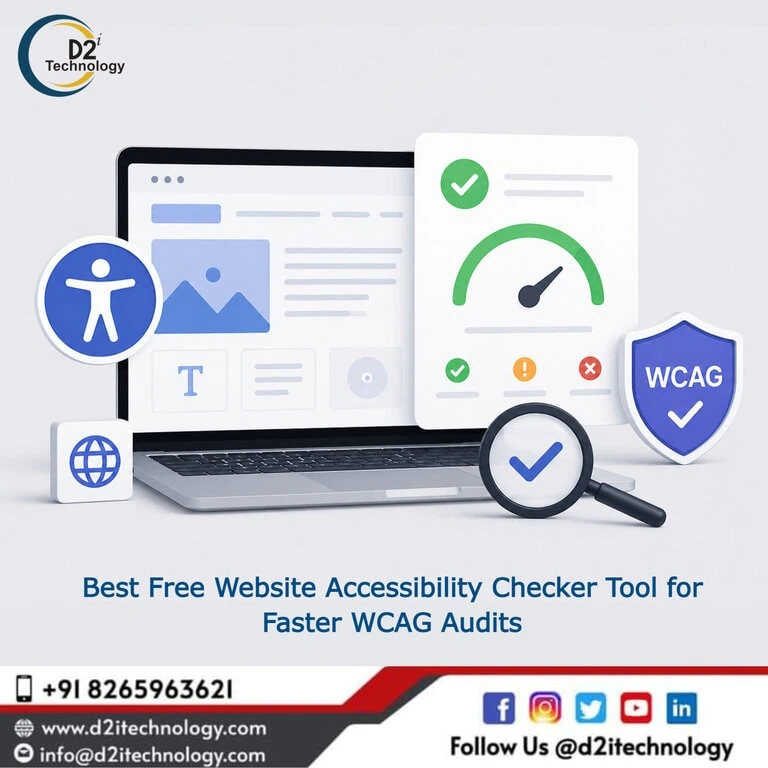
Accessibility audits have a reputation for being slow, expensive, and opaque. Some of that reputation is earned — a thorough WCAG audit covering the full range of success criteria, conducted manually by trained evaluators, genuinely does take time. But the slow part of an audit shouldn’t be the discovery phase. A reliable free website accessibility checker tool can compress what used to take hours of initial triage into minutes of structured output, letting audit teams, developers, and compliance officers focus their energy on the issues that actually require human judgment rather than ones a machine can flag automatically.
This post is about getting the most out of free accessibility checker tools — choosing the right one, using it strategically within a WCAG audit workflow, understanding where it accelerates your work and where it hands off to human evaluation, and how tools offered by D2i Technology fit into that picture.
What Makes One Accessibility Checker Better Than Another
Not all free website accessibility checker tools are created equal, and the differences matter enough to be deliberate about which ones you use. A few factors separate the tools that genuinely accelerate audits from those that generate noise:
Rule Coverage and WCAG Version
The fundamental question is which WCAG criteria the tool actually tests against. WCAG 2.1 Level AA — the standard required by most current US accessibility regulations including ADA Title II and Section 508 — added criteria beyond WCAG 2.0, including non-text contrast (1.4.11), reflow (1.4.10), and status messages (4.1.3). A tool that only implements WCAG 2.0 rules will miss these.
The best accessibility testing toolkit in 2026 benchmarks the major available tools against rule coverage, accuracy, and output quality — useful reading before committing to a checking workflow.
Output Specificity
A checker that returns “possible contrast issue detected on this page” is minimally useful. A checker that returns “element #header-nav a has a foreground color of #767676 and background color of #FFFFFF, producing a contrast ratio of 4.54:1, failing WCAG 1.4.3 for normal text which requires 4.5:1″ is actionable. The difference between vague and specific output can mean hours of developer time saved in tracking down exactly what needs to be fixed and where.
Rendering Approach
Some checkers test the raw HTML source. Others test the rendered DOM — the page after JavaScript has executed, dynamic content has loaded, and CSS has been applied. For modern web applications built with React, Angular, or Vue, testing raw HTML is largely useless because most of the content doesn’t exist in the source. Look for tools that test the rendered DOM to get results that reflect what real users — and real assistive technologies — actually encounter.
Multi-Page Capability
Single-page checks have value for spot-checking specific pages, but most websites have dozens or hundreds of pages with shared templates. A checker that can crawl multiple URLs and aggregate findings across a site gives you a representative compliance picture, identifies which issues are systemic (appearing across templates) versus isolated (on individual pages), and prioritizes more effectively.
D2i Technology’s D2i AccessScan tool is built for exactly this — running structured accessibility checks across your site rather than one URL at a time, and organizing results in a way that supports both technical review and compliance documentation.
Integrating a Free Checker Into a WCAG Audit Workflow
A free website accessibility checker tool isn’t a standalone audit — it’s a phase within an audit. Understanding how it fits changes how much value you extract from it.
Phase 1: Broad Discovery Across Your Site
Start by running the checker across your highest-traffic pages, your core service delivery pages, and a representative sample of page templates. The goal here isn’t comprehensive coverage — it’s identifying which WCAG criteria are failing broadly and which templates are generating the most violations.
For example, if your checker returns color contrast failures on every page, that’s a signal that contrast isn’t a page-specific problem — it’s a design system or CSS variable problem. If heading sequence failures appear only on blog posts, that’s template-specific. This kind of pattern recognition is what turns a list of violations into a prioritized remediation roadmap.
What the best practices for web accessibility audits actually involve covers how to structure this discovery phase within a broader audit framework, including how to document findings in a way that supports both development work and compliance reporting.
Phase 2: Triage by Impact and Frequency
Once you have checker results across multiple pages, sort findings by two dimensions: how severe the barrier is (does it completely block access, significantly impair it, or cause minor friction?) and how frequently it appears (isolated to one page, or present across dozens of templates?).
High-severity and high-frequency issues — like missing form labels that appear on every form across the site, or color contrast failures that affect all body text — should head the remediation queue. These address the most users and the most compliance risk simultaneously.
The most common accessibility issues found across websites maps well to what free checkers typically surface: missing alt attributes, contrast failures, empty link text, form labeling gaps, and heading structure violations. If your checker results cluster around these, you’re seeing a typical pattern — and one that’s well-understood in terms of remediation approach.
Phase 3: Flag What Needs Manual Review
Good accessibility checker tools flag not just confirmed violations but also potential issues that require human judgment. These warnings are where manual review picks up after automated scanning finishes.
Specifically, manual review needs to cover: whether alt text is meaningfully descriptive (not just present), whether keyboard navigation works correctly through complex interactions, whether error messages are contextually helpful, and whether dynamic content announcements work with screen readers. How manual and automated accessibility testing divide the work between them makes the handoff point clear — automated tools handle what’s machine-detectable, human evaluators handle the rest.
Phase 4: Re-scan After Fixes
This is a step many teams skip, to their detriment. After developers address the issues surfaced in the initial scan, run the checker again. Accessibility fixes can introduce new violations — a ARIA role added to fix one issue might conflict with existing attributes on the same element. Re-scanning before closing out remediation work catches these secondary issues before they reach production.
The D2i Technology Accessibility Toolkit
Beyond the AccessScan tool, D2i Technology has developed the D2i Accessibility Toolkit for WordPress — a plugin that brings accessibility checking and improvement capabilities directly into the WordPress environment. For teams managing content in WordPress, having checker functionality integrated into the CMS workflow means accessibility can be evaluated at the point of content creation rather than after the fact.
This is a meaningful workflow improvement. The earlier in the content lifecycle an accessibility issue is caught, the cheaper it is to fix — a heading structure error caught while a page is being drafted takes seconds to correct; the same error found six months post-launch requires tracking down the page, editing it, and re-publishing.
What Faster Audits Actually Enable
Speed in the discovery phase of an audit isn’t valuable for its own sake. What it enables is the reallocation of limited time and expertise toward the parts of accessibility evaluation that can’t be automated.
A WCAG audit that uses a strong free checker to handle the detectable violations quickly — covering the 30–40% of failures that automated tools reliably find — frees evaluators to spend more time on the remaining 60–70%: interactive behavior, screen reader compatibility, cognitive accessibility, and the nuanced judgment calls that determine whether a technically passing element is actually usable.
The impact that manual accessibility audit companies have on overall compliance is clearest when you understand what manual evaluators focus on when they’re not spending half their time doing work a scanner could have done for them.
For teams and organizations building this capability in-house, the best accessibility tools being used by accessibility professionals provides a practical reference for what a well-equipped accessibility testing workflow looks like across its automated and manual components.
Accessibility Checking and SEO: A Bonus Worth Understanding
There’s a practical byproduct to running accessibility checks that often surprises teams: many of the issues that accessibility checkers surface also improve search engine performance when fixed. Image alt text provides context that search crawlers use for image indexing. Semantic heading structure improves content hierarchy interpretation. Descriptive link text replaces “click here” with meaningful anchor text. Fast-loading, well-structured pages — which tend to be more accessible — perform better in rankings.
How website accessibility directly affects search engine ranking factors explores this intersection in practical terms. Running an accessibility checker and acting on its output is rarely a purely compliance exercise — it almost always produces SEO improvements alongside accessibility improvements.
Beyond Checking: When a Tool Needs Professional Backup
A free website accessibility checker tool is genuinely useful. It’s also not the endpoint of an accessibility program. For organizations with compliance obligations — ADA, Section 508, WCAG for regulated sectors — a free checker provides the automated layer but doesn’t replace the manual evaluation layer needed to establish defensible conformance.
How D2i Technology’s accessibility testing services support the full audit process covers what professional engagement looks like beyond automated scanning — and when organizations with compliance deadlines need to move from self-service tools to certified evaluation.
For organizations that want to understand what accessibility testing does for the user experience beyond compliance, the relationship between web accessibility testing and user experience quality makes the case that accessible sites aren’t just legally safer — they’re functionally better for everyone who uses them.
D2i Technology’s accessibility testing services and accessibility remediation services work alongside the free tools, picking up where automated scanning leaves off and carrying organizations through to genuine, documented WCAG conformance.
Conclusion
The best free website accessibility checker tool is the one you actually use — consistently, at the right points in your development and content workflows, and with a clear understanding of what it’s telling you and what it isn’t. Used well, free checkers dramatically accelerate the triage and discovery phases of WCAG audits, surface systemic patterns across site templates, and give development teams specific, actionable information to work from.
Used in isolation — without the manual evaluation layer that catches the other 60–70% of accessibility failures — they create an incomplete picture. The goal is to use them for exactly what they’re good at, and to know when to call in professional support for the rest.
Frequently Asked Questions
Start With a Free Check — Then Get Serious About Compliance
D2i Technology's free AccessScan tool gives you an immediate automated accessibility assessment. When you're ready to go deeper — with full manual audits, certified WCAG evaluation, and remediation support — our accessibility team is ready to help you close the compliance gap properly.