- Accessibility Testing
- June 19, 2026
10 Essential Tools for Accessibility Testing in 2026
Digital inclusion is no longer a “nice-to-have” feature; it is a fundamental requirement for every modern business operating in the digital space. As we navigate through 2026, the legal and ethical landscape surrounding web standards has become more stringent than ever. For businesses looking to reach every potential user, partnering with a professional Accessibility Testing Company in USA like D2i Technology is the most effective way to ensure that your platforms are usable by everyone, including people with disabilities. Building an inclusive website requires a combination of expert knowledge and the right technological stack.
While manual testing remains the gold standard for catching nuanced usability issues, automated tools play a critical role in maintaining high standards at scale. If you are searching for a reliable Accessibility Testing Service In USA, understanding the tools that experts use can help you appreciate the depth of a comprehensive audit.
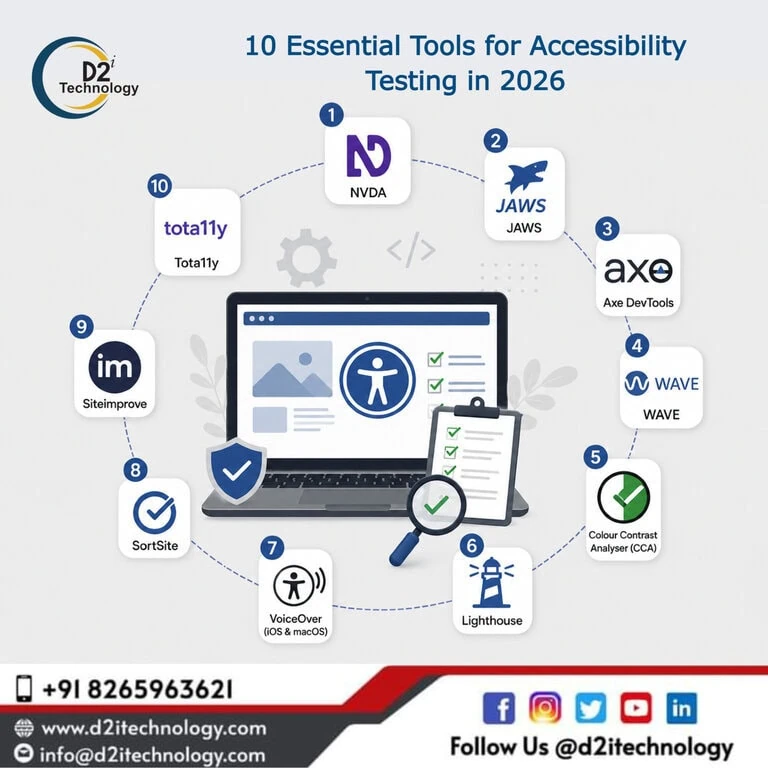
Here are the 10 essential tools for accessibility testing that are shaping the industry in 2026.
1. NVDA (NonVisual Desktop Access)
Screen readers are the primary way users with visual impairments interact with the web. NVDA remains a powerhouse in this category because it is open-source and highly compatible with Windows environments. As a Top Accessibility Testing Service In USA, we use NVDA to verify that “behind-the-scenes” code—like ARIA labels and alt text—is actually translated into a meaningful experience for the user. It helps identify focus order issues and hidden elements that might confuse a visitor.
2. JAWS (Job Access With Speech)
JAWS is perhaps the most widely used commercial screen reader in professional environments. In 2026, its integration with web browsers has become even more sophisticated. When performing a digital accessibility audit, testing with JAWS is non-negotiable. It provides a highly accurate representation of how power users navigate complex data tables and forms.
3. Axe DevTools (by Deque)
For developers who want to catch errors during the coding phase, Axe DevTools is the industry standard. This browser extension allows for quick, automated scans that identify roughly 30-40% of accessibility issues instantly. It’s a staple for any accessibility development and remediation company in USA because it integrates directly into Chrome and Firefox, providing immediate feedback on WCAG violations.
4. Wave (Web Accessibility Evaluation Tool)
Wave, developed by WebAIM, is a favorite for its visual representation of errors. Instead of just giving you a list of code snippets, Wave overlays icons directly onto your webpage. This makes it incredibly easy to see exactly where a contrast error or a missing header is located. For companies providing a website accessibility remediation services guide, Wave is often the first tool used to give clients a “big picture” view of their site’s health.
5. Colour Contrast Analyser (CCA)
WCAG 2.1 and 2.2 standards have very specific requirements for color contrast ratios. The CCA tool allows testers to pick colors from any part of the screen (not just the browser) to ensure that text is readable against its background. This is a vital part of accessibility testing because poor contrast is the most common accessibility failure on the web today.
6. Lighthouse (Chrome DevTools)
Lighthouse is built directly into the Google Chrome browser and provides a holistic view of a website’s performance, SEO, and accessibility. While it is an automated tool and cannot replace a human auditor, it is an excellent starting point for baseline testing. A top accessibility testing service in USA will use Lighthouse scores as a benchmark to track progress during the remediation process.
7. VoiceOver (iOS and macOS)
With mobile traffic dominating the web, testing on mobile screen readers is mandatory. VoiceOver is the native screen reader for Apple devices. Ensuring that your mobile app or responsive website works seamlessly with VoiceOver gestures is a key component of mobile development and accessibility compliance. It helps identify issues like “trap” elements where a user might get stuck in a loop.
8. SortSite
SortSite is a comprehensive one-click tool that checks entire websites for accessibility, broken links, and SEO issues. It is particularly useful for large enterprises with thousands of pages. By using SortSite, an Accessibility Testing Company in USA can quickly map out a site-wide accessibility strategy for procurement and remediation, ensuring no page is left behind.
9. Siteimprove
Siteimprove offers a robust platform that goes beyond simple testing. It provides a dashboard for continuous monitoring, which is essential for businesses that update their content frequently. It helps teams maintain compliance over time, which is why it’s often recommended by IAAP certified accessibility audit services.
10. Tota11y
Tota11y is an accessibility visualization toolkit that helps developers see how their site performs with assistive technologies. It’s an excellent educational tool because it explains why certain elements are failing and how they impact the user. When we provide accessibility services, we often use Tota11y to demonstrate issues to stakeholders who may not be technical.
Why Tools Alone Aren’t Enough
While these tools are powerful, they are only as good as the experts using them. Automated tools can tell you that an image is missing “alt text,” but they cannot tell you if the alt text you wrote actually makes sense in the context of the page. This is where manual testing becomes vital. A human tester can judge the logical flow of a page, the clarity of instructions, and the overall user experience with web accessibility testing.
In 2026, the complexity of web applications—including AI-driven interfaces and dynamic content—requires a hybrid approach. At D2i Technology, we combine the efficiency of the tools listed above with the deep insight of our certified auditors to provide the best accessibility testing toolkit for our clients.
The Role of SEBI and International Standards
For businesses operating in India or with Indian branches, the landscape has shifted significantly with recent mandates. SEBI has made digital accessibility mandatory for financial institutions. Whether you are navigating SEBI compliance in India or ADA/Section 508 requirements in the United States, the goal remains the same: creating a web that works for everyone.
Choosing the right Accessibility Testing Company in USA means choosing a partner who understands both the global standards and the local regulations that affect your specific industry. From remediating complex accessibility issues to ensuring your eKYC process is accessible, our team is equipped with the latest tools and methodologies to keep you compliant and inclusive.
Frequently Asked Questions
Ready to make your digital platforms inclusive?
Don't let compliance gaps hold your business back. Our team of certified experts is ready to help you navigate the complexities of WCAG and ADA standards using the most advanced testing methodologies.