- Accessibility Services
- May 4, 2026
Accessibility in Financial Applications: The Hidden Challenge in KYC and Digital Onboarding
Over the past few months, while working extensively on accessibility audits and remediation across multiple financial applications aligned with modern web accessibility standards, one pattern has become impossible to ignore: smaller organizations are adapting faster, while large financial institutions—banks, AMC managers, and loan providers—are struggling to make meaningful progress.
This is not due to a lack of intent. In fact, most large institutions have already acknowledged the importance of accessibility. The real issue lies deeper—in complexity, legacy systems, risk aversion, and one of the most critical bottlenecks in the ecosystem: the KYC (Know Your Customer) process.
As a team deeply involved in accessibility implementation and remediation, we at D2i Technology have seen firsthand how digital accessibility, WCAG compliance, inclusive design, screen reader compatibility, and accessible forms—guided by evolving web accessibility standards—intersect and often clash within financial workflows.
This blog explores those challenges, especially around KYC, and why solving them is not just a compliance requirement, but a business and ethical necessity.
The Reality of Accessibility in Financial Systems
Financial platforms are among the most complex digital systems. They handle:
- Sensitive user data
- Multi-step workflows
- Regulatory compliance
- Real-time validation
- Security layers
Now add accessibility into this mix.
What should ideally be a straightforward implementation of WCAG compliance becomes a layered challenge involving:
- Legacy UI frameworks
- Fragmented APIs
- Multiple stakeholders
- Strict compliance requirements
Interestingly, smaller fintech players—with fewer dependencies and modern tech stacks—are often able to fix accessibility issues faster. They:
- Move quickly
- Have simpler workflows
- Can redesign flows without heavy approvals
In contrast, large institutions operate in tightly controlled environments where even a small UI change requires:
- Risk assessments
- Legal approvals
- Compliance validation
- Multiple stakeholder sign-offs
And nowhere is this more evident than in KYC flows.
KYC: The Biggest Accessibility Roadblock
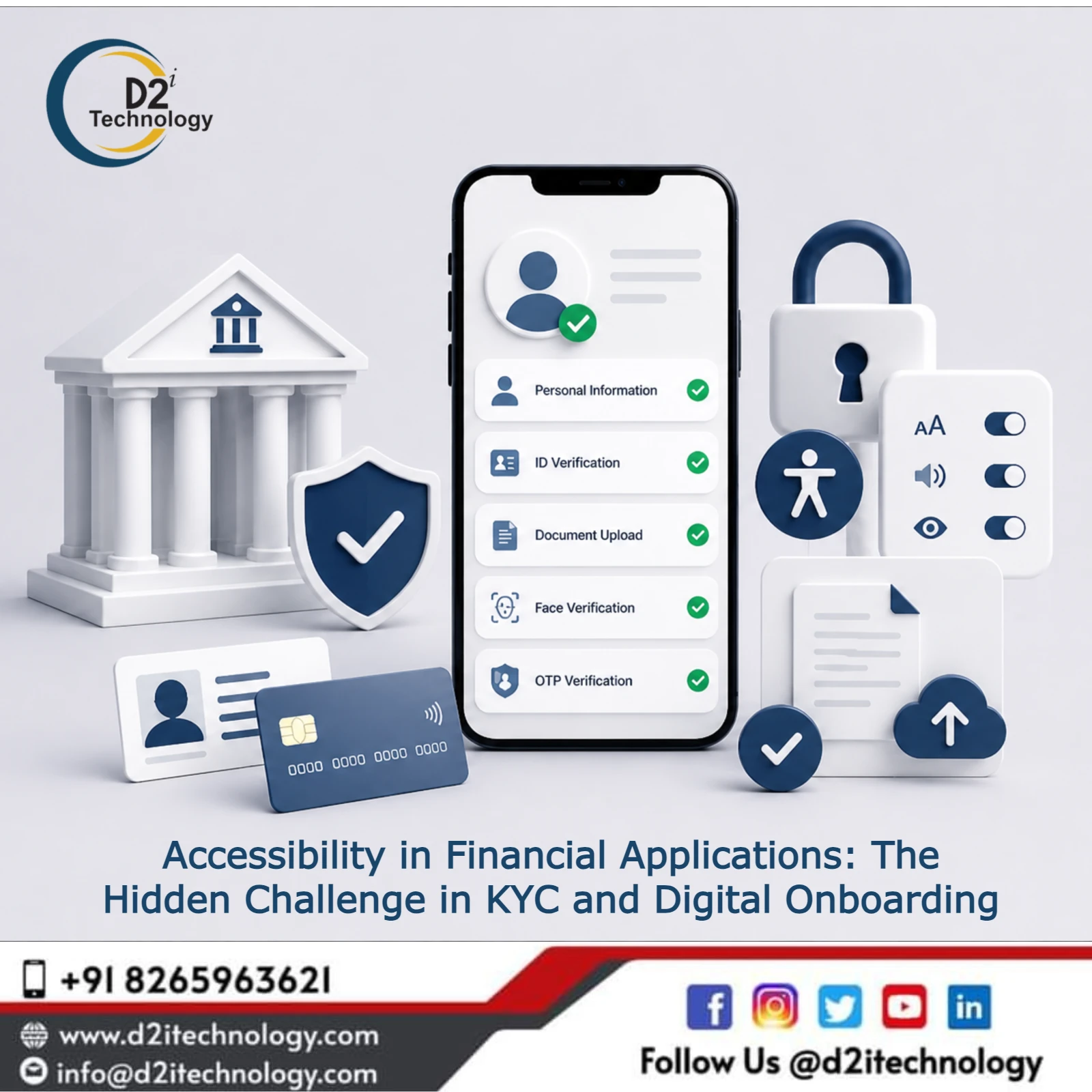
KYC is the backbone of digital onboarding in financial systems. It involves:
- Identity verification
- Document uploads
- OTP validations
- Face recognition or video KYC
- Data validation
From an accessibility standpoint, this is one of the hardest flows to get right.
Why KYC Fails Accessibility
1. Complex Multi-Step Forms
Most KYC journeys involve long, multi-step forms. These often lack:
- Proper labels
- Logical tab order
- Clear instructions
This directly impacts screen reader compatibility, making it difficult for visually impaired users to navigate.
2. Poor Error Handling
One of the most common issues we’ve observed during audits: Banks intentionally avoid showing clear error messages.
Why?
Because they fear:
- Increased drop-offs
- User frustration
- Abandonment during onboarding
But this creates a bigger problem.
For users with disabilities:
- Errors are not announced properly
- Users don’t know what went wrong
- They get stuck in loops
This violates core principles of accessible forms and inclusive design.
3. CAPTCHA and OTP Challenges
Security measures like CAPTCHA and OTP are essential—but often inaccessible:
- CAPTCHA images without alternatives
- OTP timers not announced to screen readers
- No option for voice-based verification
This becomes a major barrier in achieving digital accessibility.
4. Document Upload Barriers
Uploading documents is a critical KYC step, but:
- Buttons are not labeled correctly
- File formats are not explained
- Errors are silent or unclear
Users relying on assistive technologies struggle to complete this step independently.
5. Video KYC Limitations
Video KYC is increasingly common, but:
- No captions or instructions for hearing-impaired users
- No alternative for users with speech disabilities
- Lack of clear guidance
This completely excludes a segment of users.
The Bigger Problem: Lack of Clear Strategy
When we engage with financial institutions, one recurring challenge emerges:
They don’t have a clear answer to this question:
“How will we onboard users with disabilities?”
This is not just a technical issue—it’s a strategic gap.
Many organizations:
- Focus on compliance checklists
- Fix surface-level UI issues
- Miss end-to-end user journeys
Accessibility is not about fixing buttons—it’s about ensuring complete task success.
And in financial systems, the most critical task is onboarding.
The Business Impact of Ignoring Accessibility
Let’s address a misconception:
Accessibility is often seen as a “compliance requirement.”
In reality, it directly impacts:
- Customer acquisition
- Conversion rates
- Brand trust
- Legal risk
1. Lost Customers
If a user cannot complete KYC:
- They abandon the application
- They switch to competitors
This is not a small segment. Millions of users require accessible experiences.
2. Increased Support Costs
When users cannot complete flows independently:
- They call support
- They visit branches
- They escalate issues
This increases operational costs significantly.
3. Legal & Compliance Risks
Global regulations are tightening:
- WCAG guidelines are becoming mandatory
- Accessibility lawsuits are increasing
Ignoring WCAG compliance is no longer an option.
Why Smaller Players Are Winning
From our experience, smaller fintech companies succeed because they:
- Build accessibility into design
- Use modern frameworks
- Test with real users
- Iterate quickly
They treat inclusive design as a core principle, not an afterthought.
What Large Financial Institutions Need to Do
The solution is not simple—but it is achievable.
1. Rethink KYC from an Accessibility Lens
Instead of patching existing flows:
- Redesign KYC journeys with accessibility in mind
- Simplify steps
- Provide alternatives
2. Prioritize Clear Communication
Every action must be:
- Announced
- Explained
- Confirmed
Especially:
- Errors
- Success states
- Instructions
Remember:
Hiding errors reduces drop-offs temporarily, but increases failure for accessibility users.
3. Build Truly Accessible Forms
To meet accessible forms standards:
- Use proper labels
- Provide instructions before inputs
- Announce errors dynamically
- Ensure logical navigation
4. Improve Screen Reader Compatibility
Test with:
- NVDA
- JAWS
- VoiceOver
Ensure:
- All elements are readable
- Focus order is correct
- Dynamic content is announced
5. Provide Alternatives for Critical Steps
For KYC:
- Alternative to CAPTCHA
- Voice-based OTP options
- Assisted onboarding
- Manual verification options
Accessibility is about choice and flexibility.
6. Align Business and Accessibility Goals
This is crucial.
Instead of thinking:
“Will this increase drop-offs?”
Think:
“Will this allow more users to complete the journey?”
Accessible experiences increase completion rates in the long run.
The Role We Play at D2i Technology
At D2i Technology, we work closely with financial institutions to:
- Conduct detailed accessibility audits
- Identify real user challenges
- Remediate complex workflows
- Improve KYC journeys
- Align platforms with WCAG compliance
But more importantly, we help organizations shift mindset:
From compliance-driven to user-centric accessibility
Because accessibility is not about ticking boxes—it’s about enabling access.
The Future of Accessibility in Finance
The financial industry is at a turning point.
With increasing digital adoption:
- Physical branches are reducing
- Self-onboarding is becoming the norm
This makes digital accessibility even more critical.
If KYC remains inaccessible:
- A large segment of users will be excluded
- Financial inclusion goals will fail
Accessibility is not optional—it is foundational.
Final Thoughts
The challenges in making financial applications accessible—especially KYC—are real. Large institutions are not failing due to lack of effort, but due to complexity and legacy constraints.
However, the path forward is clear:
- Embrace inclusive design from the start
- Ensure strong screen reader compatibility
- Build truly accessible forms
- Align with WCAG compliance
- Focus on end-to-end digital accessibility
Most importantly:
Stop designing for drop-offs, and start designing for completion.
Because when accessibility is done right, it doesn’t just help users with disabilities—it improves the experience for everyone.
If you’re working on financial platforms and struggling with accessibility or KYC challenges, this is the right time to rethink your approach.
At D2i Technology, we’re actively helping organizations bridge this gap—one accessible experience at a time.
Frequently Asked Questions
Make Your Financial Platform Truly Accessible
Ready to improve accessibility across your KYC and digital onboarding flows? D2i Technology helps financial institutions identify critical gaps, enhance user journeys, and achieve WCAG compliance—ensuring more users can complete onboarding without barriers.