- AI Development
- September 2, 2026
What Is Agentic Software Development Lifecycle (ASDLC)?
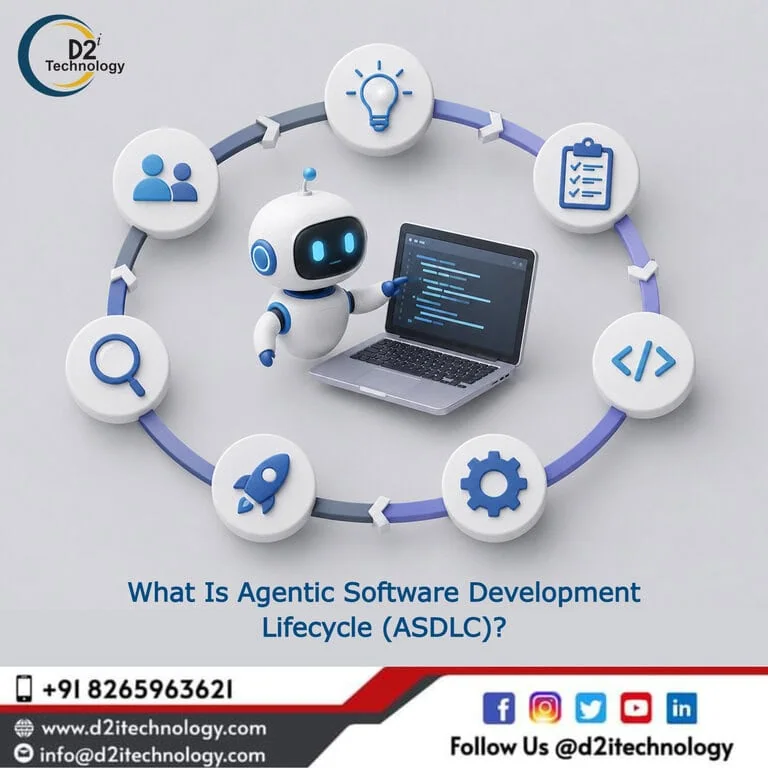
Software development has a new entry in its vocabulary. The Agentic Software Development Lifecycle — ASDLC — describes a model of software development where AI agents participate as active contributors across the full development process: analyzing requirements, drafting code, writing and executing tests, reviewing contributions, coordinating deployments, and monitoring production systems. It’s not a replacement for the traditional software development lifecycle. It’s a restructuring of who — or what — performs the work within each phase, and how much of that work proceeds autonomously versus under direct human direction.
Understanding what ASDLC is, what it’s built on, and where it actually changes software development is genuinely useful for engineering leaders, developers, and organizations evaluating how AI fits into their development processes.
The Origin of ASDLC
The term synthesizes two concepts that have been developing in parallel. “Agentic AI” refers to AI systems that pursue goals through sequences of autonomous actions — taking steps, using tools, making decisions, and adapting based on intermediate results — rather than simply generating a response to a single prompt. Applied to software development, this produces systems that don’t just suggest code in an editor window, but autonomously navigate the research, implementation, testing, and review work that a developer would otherwise perform step by step.
The “software development lifecycle” framing is familiar to any engineer — the structured sequence of phases (planning, design, implementation, testing, deployment, maintenance) through which software moves from idea to production. ASDLC applies agentic AI within that established phase structure rather than replacing it, which makes it more practical to adopt in existing engineering organizations than a complete process reinvention would be.
The practical preconditions for ASDLC became real around 2023-2024 with the maturation of large language models capable enough to produce reliable code across multiple files, combined with tool-use capabilities that allow agents to call APIs, read and write to filesystems, execute commands, and interpret the results of those actions. Those capabilities are the technical foundation that makes AI agents meaningful participants in software development rather than sophisticated autocomplete tools.
The Core Components of ASDLC
AI Agents (The Participants)
The defining element of ASDLC is the AI agent — a system that operates goal-directedly across multiple steps to accomplish a development task. Agents in software development typically combine:
- A capable language model as the core reasoning engine
- Tool access: the ability to read and write files, execute terminal commands, invoke APIs, query databases, and interact with version control systems
- Context management: the ability to maintain relevant information about the codebase, the task, and prior actions across a multi-step workflow
- Output targeting: producing specific artifacts (code files, pull requests, test reports, documentation) rather than conversational responses
Different agents are specialized for different tasks. A requirements agent parses stakeholder input and produces structured specifications. A coding agent implements those specifications across codebase files. A testing agent generates and executes test suites against the implementation. A review agent evaluates pull requests for quality, security, and style compliance. A deployment agent orchestrates pipeline progression based on quality gate results.
How AI agent governance and monitoring need to be structured to keep agents operating within safe, defined boundaries is foundational reading alongside any ASDLC implementation — the agents themselves are only one component; the governance infrastructure that defines and enforces what they can do is equally important.
Governance and Access Controls
In ASDLC, governance isn’t optional infrastructure — it’s a core architectural component. Every agent needs explicitly defined authority boundaries: what it can do without human approval, and what requires human sign-off before proceeding. These boundaries need to be technically enforced — through access control configurations, branch protection rules, API scope restrictions — rather than stated as policy and relied on as convention.
This is a meaningful difference from traditional development governance, which manages human-to-human workflows. Agent governance manages human-to-system workflows where the system can act faster than human monitoring can catch and where mistakes can propagate at machine speed.
Audit and Monitoring Infrastructure
Every agent action — every file read, file write, API call, command execution, and external resource access — needs to be logged in a way that allows complete reconstruction of what happened and why. This isn’t primarily a compliance exercise; it’s practical engineering infrastructure. When an agent does something unexpected (and agents occasionally do), the audit trail is what allows debugging, correction, and prevention of recurrence.
Security risks specific to agentic AI operating in web application environments illustrates why this logging infrastructure matters: agents with access to codebases, credentials, and APIs introduce security considerations that traditional development environments didn’t have to account for.
CI/CD Pipelines as Quality Gates
The CI/CD pipeline is the enforcement layer for quality standards on agent-generated contributions. In ASDLC, the pipeline needs to gate agent-generated code through the same automated test suites, static analysis, security scanning, and accessibility checks applied to human-generated code — with the same passing requirements for merging. The pipeline is what makes agent autonomy safe: agents can generate and submit code freely, but the pipeline determines what actually progresses.
Why well-designed CI/CD pipelines are the foundation that makes agentic deployment reliable captures this dependency. D2i Technology’s DevOps services cover the pipeline design that makes agent output trustworthy in practice.
Human Review at Strategic Checkpoints
ASDLC doesn’t remove humans from software development — it restructures where human attention is most needed. At the core of well-implemented ASDLC is a set of human review checkpoints at the decisions that most benefit from human judgment: architectural choices, security-critical code paths, complex business logic implementations, and production deployment authorization.
Outside those checkpoints, agents operate with defined autonomy. Within them, human engineers provide the judgment, context, and accountability that AI systems can’t supply. How code review in AI-assisted development needs to be substantive, not cursory covers what effective human review looks like in an agentic context.
How ASDLC Changes the Development Process Phase by Phase
Planning and Requirements
Traditional: business analysts manually synthesize stakeholder input into specifications, with conflicts and gaps surfacing during implementation when they’re expensive to address. Agentic: research and synthesis agents process stakeholder input at scale, cross-reference for conflicts, and generate structured specification drafts for human review and refinement. The judgment calls — what to build, how to prioritize, what trade-offs to make — remain human.
Implementation
Traditional: developers write all code, with implementation speed and quality bounded by developer availability and skill. Agentic: coding agents draft implementations for well-specified tasks across multiple files, generating tests alongside code and opening pull requests for human review. Engineering time shifts toward direction and review rather than routine implementation.
Testing
Traditional: test coverage competes with implementation time, often losing under deadline pressure. Agentic: test generation agents produce test suites alongside implementation code as a standard output, raising coverage baselines without dedicated testing sprints. Why testing in agentic AI environments also needs to cover the agents themselves is an important addition to conventional quality practices.
D2i Technology’s automation testing services and manual testing services complement agent-generated coverage with the human evaluation layer that automated generation doesn’t replace.
Security
Traditional: security review is uneven, most thorough when experienced reviewers are available. Agentic: security analysis agents run continuously against the codebase, scanning for known vulnerability patterns with every code change. D2i Technology’s security testing and penetration testing services provide the expert evaluation that catches what pattern-based scanning misses.
Deployment
Traditional: deployment involves human coordination at multiple pipeline stages, creating calendar delays. Agentic: deployment orchestration agents manage mechanical pipeline coordination automatically, with human authorization required only for high-stakes deployments.
Monitoring and Maintenance
Traditional: production telemetry often produces more noise than signal; on-call engineers work from raw alerts. Agentic: monitoring agents continuously analyze telemetry, surface anomalous patterns, and generate contextual incident summaries. How agent governance extends into production monitoring of AI systems covers the monitoring infrastructure needed both for the application and for the agents themselves.
What ASDLC Doesn’t Change
Understanding what stays the same is as important as understanding what changes.
Engineering judgment. Architectural decisions, complex trade-offs, security depth, and accountability for production outcomes remain human responsibilities. Agents are capable contributors to defined tasks; they aren’t substitutes for engineering judgment in complex, context-dependent situations.
Specification quality. Agents produce better outputs from better specifications. ASDLC doesn’t lower the bar for clear requirements — it raises the stakes for having them, because ambiguous specifications produce ambiguous implementations at agent speed.
Code ownership. Human engineers need to understand the code that agents produce through substantive review, not just automated gate-passing. Code that nobody on the team genuinely understands is a long-term liability regardless of how efficiently it was produced.
D2i Technology’s approach to building AI that solves real engineering problems sustainably reflects the philosophy underlying good ASDLC implementation: grounding AI capability in concrete outcomes that human engineers can evaluate, own, and stand behind.
Where ASDLC Makes the Most Difference
The organizations that see the clearest benefit from ASDLC implementation share a few common characteristics: they work with large development volumes where the ratio of routine implementation to judgment-intensive work is high; they have existing quality infrastructure (test suites, CI/CD pipelines, security scanning) that agent output can be gated through; and they have engineering teams prepared to invest in the governance and review practices that make agent contributions trustworthy.
ASDLC adds the most value where requirements can be specified with precision, where the technology stack uses well-documented and widely-understood patterns, and where engineering teams have the maturity to maintain genuine understanding of what agents produce. What enterprise-scale application development actually involves and why it benefits from agentic approaches covers the enterprise context where these conditions frequently apply.
D2i Technology and ASDLC
D2i Technology supports organizations implementing ASDLC through two connected capabilities: AI development services that design and build the agent systems themselves, and the security, quality, and DevOps infrastructure that makes those systems trustworthy in production. Getting both right — agent capability and governance infrastructure — is what distinguishes ASDLC implementations that deliver lasting value.
Conclusion
The Agentic Software Development Lifecycle is a structurally meaningful evolution of how software gets built — not a replacement for engineering practice, but a redistribution of the work within it. AI agents take on the high-volume, well-defined portions of each development phase; human engineers focus their judgment on the decisions that determine whether software actually works, remains secure, and serves its intended purpose over time. Understanding what ASDLC is, what it requires, and where its limits sit is the starting point for any organization evaluating how to use it responsibly.
Frequently Asked Questions
Ready to Understand and Implement ASDLC for Your Team?
D2i Technology helps engineering organizations design and implement Agentic Software Development Lifecycle workflows — combining AI agent development with the governance, security, and quality infrastructure that makes autonomous development safe and productive.