- eLearning Accessibility
- June 2, 2026
How eLearning Accessibility Remediation Ensures Section 508 Compliance and Inclusive Learning
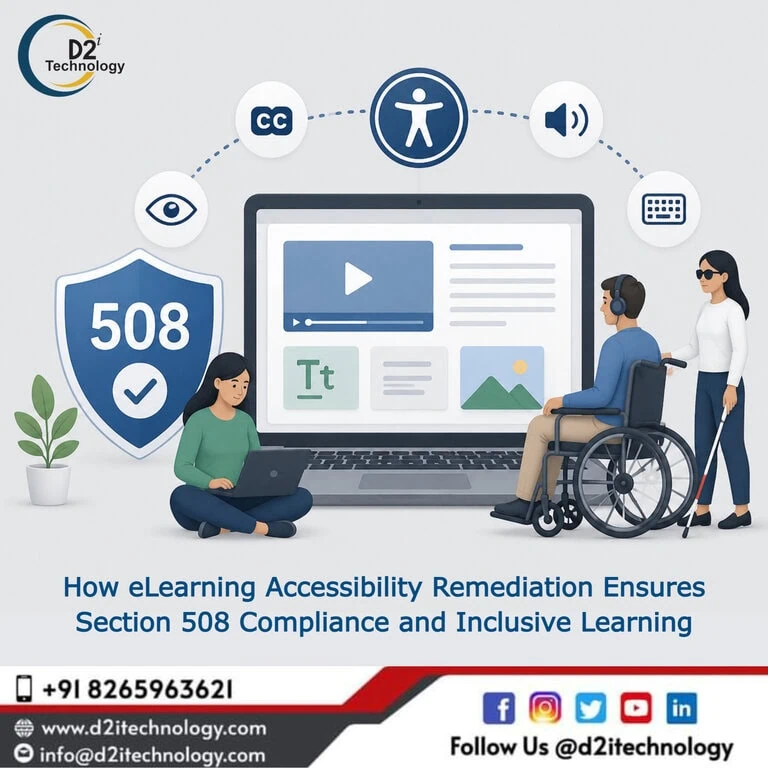
Compliance and inclusion aren’t two separate outcomes that happen to align — they’re the same outcome described from different angles. When eLearning accessibility remediation fixes a broken drag-and-drop interaction or corrects a course’s heading structure, it simultaneously closes a Section 508 compliance gap and removes a real barrier a learner was facing. Understanding remediation through this dual lens — as both the mechanism that produces legal compliance and the work that makes training genuinely usable — changes how organizations should think about prioritizing and investing in it.
This post traces the direct relationship between specific remediation actions and the Section 508 requirements they satisfy, why that relationship matters for how organizations justify and structure remediation work, and how to verify that remediation has actually achieved what it set out to do.
The Connection Between Remediation Actions and Section 508 Requirements
Section 508 doesn’t function as an abstract legal standard divorced from technical reality — it maps onto specific, identifiable fixes that remediation work performs. Understanding this mapping helps organizations see remediation not as generic “accessibility work” but as a direct response to defined legal requirements.
Keyboard Accessibility Fixes Satisfy Operable Criteria
Section 508’s alignment with WCAG 2.1 Level AA includes a clear requirement that all functionality be operable by keyboard. When remediation rebuilds an inaccessible drag-and-drop exercise with a keyboard-accessible alternative, that specific action directly satisfies this specific requirement. The technical approach to rebuilding drag-and-drop interactions with keyboard-accessible alternatives in Articulate Storyline 360 isn’t generic accessibility polish — it’s the precise fix that closes one of the most consistently cited Section 508 gaps in e-learning content.
Heading Structure Fixes Satisfy Robust and Perceivable Criteria
Correcting heading structure — ensuring headings are properly tagged rather than just visually styled, and that they follow a logical hierarchy — satisfies the WCAG requirements underlying Section 508’s expectation that content be programmatically interpretable by assistive technology. This single category of fix often resolves a large share of a course’s navigation-related accessibility gaps.
Focus Management Fixes Satisfy Navigation and Orientation Requirements
Properly configuring focus triggers and tab order addresses Section 508’s requirement that users be able to determine their current location within content and navigate predictably. Correctly configuring Storyline’s Set Focus trigger to support coherent screen reader navigation is the specific technical action that closes this particular compliance gap — and it’s one of the patterns most likely to be implemented incorrectly even by teams attempting remediation without specialized Storyline experience.
Alt Text and Caption Fixes Satisfy Perceivable Criteria
Adding meaningful alt text to instructional images and accurate captions to video content directly satisfies the Perceivable principle’s requirement that content be available through multiple sensory channels. This is often the highest-volume category of remediation work in a course library, simply because most courses contain large amounts of visual and video content accumulated over time.
Color Contrast Adjustments Satisfy Perceivable Criteria
Adjusting color combinations that fall below WCAG’s required contrast ratios closes a specific, measurable compliance gap. Going beyond the baseline WCAG contrast requirements to address non-text and focus indicator contrast is particularly relevant in e-learning, where branded course templates frequently use color combinations that weren’t checked against accessibility thresholds during initial design.
Why This Direct Mapping Matters for Remediation Strategy
It Makes Remediation Defensible, Not Just Technical
When an organization can point to specific remediation actions and the specific Section 508 requirements those actions satisfy, the remediation program becomes defensible documentation — not just a technical cleanup project. This matters significantly if compliance is ever questioned by an auditor, a complaint, or internal legal review. Why remediation needs to be approached as a documented, verifiable process rather than informal fixes reflects exactly this principle.
It Clarifies What “Done” Actually Means
Without a clear mapping between fixes and requirements, remediation can drift into an open-ended, never-quite-finished project. With the mapping made explicit, an organization can verify systematically: has this course’s drag-and-drop interaction been rebuilt with a keyboard alternative? Has heading structure been corrected? Has contrast been verified across all slide variations? Each yes or no maps to a specific compliance requirement, which makes “complete” a meaningful, checkable state rather than a vague aspiration.
It Helps Prioritize Remediation Investment Efficiently
Some fixes resolve multiple compliance gaps simultaneously — correcting a shared slide template’s heading structure, for instance, might resolve the same WCAG violation across dozens of courses built from that template. Understanding which remediation actions have this kind of multiplying effect helps organizations sequence their work for maximum compliance impact per hour invested, rather than working through issues in whatever order they happen to be discovered.
The Remediation Process in Practice
Audit First, Remediate Second
Remediation without a preceding audit is guesswork. Structured frameworks for auditing e-learning content against accessibility criteria establish the specific, documented list of issues that remediation work then addresses — without this step, remediation risks missing issues entirely or spending disproportionate effort on lower-priority problems.
Fix Within the Authoring Tool, Not Around It
E-learning remediation happens within the source files in the authoring tool — Articulate Storyline 360 in most of the engagements D2i Technology handles — rather than through external patches or overlays applied after the fact. Comprehensive accessibility services specifically for Articulate Storyline content reflect this approach: fixes implemented at the source so they hold up correctly through republishing and redistribution.
Verify With Real Assistive Technology, Not Just Automated Re-Checks
The distinction between manual and automated accessibility testing matters enormously at the verification stage. A remediation fix that resolves an automated checker’s flag doesn’t automatically mean the underlying user-facing barrier is gone. Confirming with actual screen reader testing — NVDA and JAWS in particular for most US and Indian enterprise and government contexts — verifies that the fix produces a genuinely usable experience, not just a clean automated report.
Test in the Actual Delivery Environment
A course that behaves correctly within the authoring tool’s preview mode needs to be retested once republished as a SCORM package and loaded into the actual LMS where learners will encounter it. This final verification step catches discrepancies between authoring-tool behavior and real-world delivery — a gap that’s easy to overlook but consequential if missed.
The Business Case for Investing in Remediation
Reduced Legal and Regulatory Exposure
For organizations subject to Section 508 — federal agencies, contractors, and federally funded entities — documented, systematic remediation directly reduces legal exposure. Understanding the broader testing landscape that organizations need to navigate in 2026 reflects an enforcement environment that continues to tighten, making proactive remediation investment increasingly cost-effective relative to the risk of inaction.
Reduced Long-Term Maintenance Burden
Courses remediated at the template level — fixing shared structural issues once rather than course by course — produce a course library that’s easier and cheaper to maintain going forward. New courses built from remediated, accessible templates inherit that accessibility automatically, reducing the need for repeated remediation cycles.
Improved Learner Outcomes Across the Board
As covered in the broader discussion of why eLearning accessibility matters for compliance and learner experience, remediation doesn’t only benefit learners using assistive technology. Clearer navigation, better-structured content, and properly functioning interactions improve completion rates and reduce friction for the entire learner population.
How D2i Technology Approaches eLearning Remediation for Section 508 Compliance
D2i Technology’s accessibility team approaches remediation with the requirement-to-fix mapping described throughout this post built directly into how we scope and document engagements. Every remediation action we take is tied to the specific WCAG/Section 508 criterion it addresses, which gives clients a clear, auditable record of what’s been fixed and why it matters for their compliance posture.
Our accessibility testing services establish the audit baseline, and our accessibility remediation services carry out the technical fixes — within Articulate Storyline 360 source files, verified through republishing, and confirmed with real screen reader testing before we consider an engagement complete.
Conclusion
eLearning accessibility remediation isn’t a generic improvement applied loosely to course content — when done properly, every fix maps to a specific Section 508 requirement and, simultaneously, to a specific barrier a real learner was facing. Understanding that dual relationship changes how remediation should be planned, prioritized, documented, and verified. Organizations that treat remediation as a precise, mapped, and verifiable process — rather than an open-ended cleanup effort — end up with both stronger compliance documentation and genuinely more usable training content.
D2i Technology brings exactly this structured, requirement-mapped approach to e-learning remediation, helping organizations achieve Section 508 compliance that holds up to scrutiny while building training content that actually works for every learner.
Frequently Asked Questions
Turn Remediation Into Verified Section 508 Compliance
D2i Technology's accessibility team maps every remediation action to the specific Section 508 and WCAG requirements it satisfies — giving you both genuine compliance documentation and training content that works for every learner. Let's assess your course library.