
- Web Accessibility
- April 6, 2026
Australia’s 2026 Accessibility Updates: What Developers and Organizations Need to Know
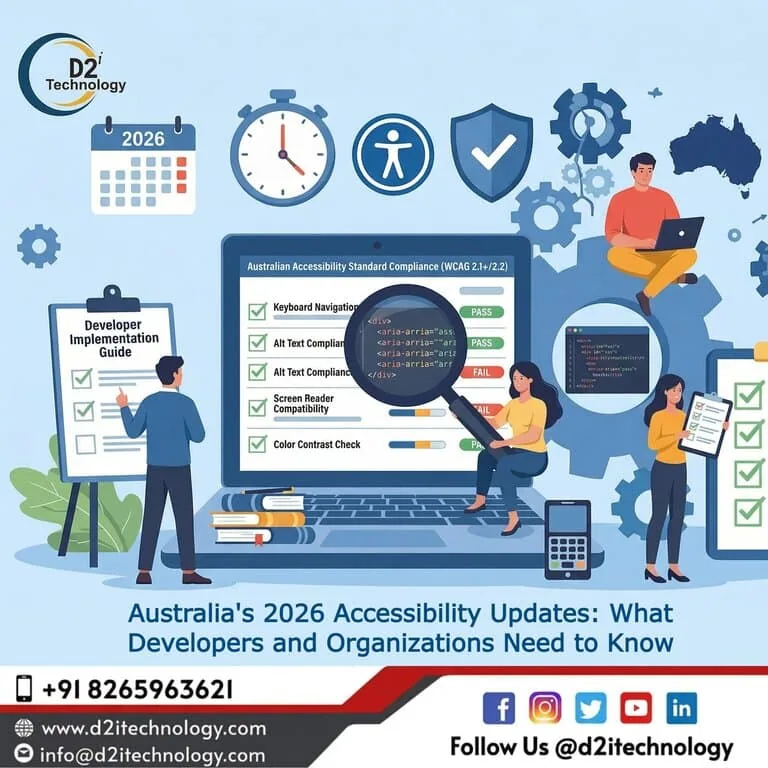
Australia web accessibility 2026 standards are undergoing a significant shift — and if your organization has not yet started preparing, the window to act is narrowing. Across Australia, governments, enterprises, universities, and digital service providers are being held to higher accessibility benchmarks than ever before, making accessibility testing service in Australia more essential than ever. The combination of updated international guidelines, evolving domestic legislation, and growing awareness among users with disabilities means that compliance is no longer optional — it is a legal, ethical, and business imperative.
This blog walks you through what is changing in 2026, what it means for your web presence, and how developers and organizations can take practical steps to stay ahead.
Understanding the Landscape: Australia’s Accessibility Framework
Australia’s approach to digital accessibility sits at the intersection of domestic law and international guidelines. The two pillars every organization needs to understand are:
- The Disability Discrimination Act 1992 (DDA): Australia’s primary anti-discrimination legislation applies to websites and digital services. Under the DDA, failing to make your digital content accessible to people with disabilities can constitute unlawful discrimination.
- WCAG (Web Content Accessibility Guidelines): The Web Content Accessibility Guidelines, published by the W3C, serve as the technical standard referenced by Australian Government agencies, courts, and regulators. WCAG 2.2 is now the active standard globally, and Australian compliance expectations are aligning with it.
For a deeper look at how these same principles are being applied globally, read our guide on ADA Website Accessibility Compliance 2026.
What Is Changing in 2026?
Several converging factors are reshaping Australia’s digital accessibility expectations in 2026:
1. WCAG 2.2 Becomes the Baseline Expectation
WCAG 2.2 was officially published in October 2023. By 2026, it has moved from being a recommendation to being the expected minimum standard across Australian Government digital frameworks. Key additions in WCAG 2.2 that directly affect developers include:
- Focus Appearance (2.4.11 & 2.4.12): Keyboard focus indicators must now meet minimum size and contrast requirements — a significant change for developers who rely on default browser styles.
- Dragging Movements (2.5.7): Any action that requires dragging must have a pointer-based alternative — a rule directly relevant to drag-and-drop interactions in web apps and eLearning content.
- Target Size (2.5.8): Interactive elements must meet minimum target size requirements, improving usability for motor-impaired users on touchscreens.
- Accessible Authentication (3.3.7 & 3.3.8): CAPTCHAs and memory-reliant login flows must be made accessible or provide alternatives.
These changes build on the foundation of WCAG 2.1. If your team is still addressing common WCAG 2.1 issues, our resource on common accessibility issues provides a practical starting point.
2. Australian Government Digital Service Standard Updates
The Australian Government’s Digital Service Standard requires all federal government digital services to meet WCAG 2.1 AA at minimum. In practice, 2026 is seeing increased enforcement expectations, with many agencies voluntarily adopting WCAG 2.2 as part of broader digital transformation programs.
State and territory governments are following suit. New South Wales, Victoria, and Queensland have each published updated accessibility guidance for public sector websites, with measurable compliance requirements and audit frameworks becoming standard practice.
3. Legal Risks Are Growing
Disability discrimination complaints related to inaccessible websites have increased steadily in Australia. With greater awareness among advocacy groups and the growing use of assistive technologies, organizations that do not proactively address accessibility are increasingly exposed to formal complaints under the DDA — and potential conciliation or litigation through the Australian Human Rights Commission.
Our blog on why businesses need accessibility testing services in 2026 outlines the business and legal case in detail.
Who Needs to Pay Attention?
Australia’s 2026 accessibility updates are not limited to government agencies. Any organization with a digital presence that serves the Australian public should treat this as a priority:
- Federal and state government agencies
- Universities and registered training organizations (RTOs)
- Financial services companies and banks
- Healthcare providers and telehealth platforms
- Retailers and eCommerce businesses
- eLearning content developers and LMS providers
- Nonprofits and community organizations
If your website, app, or digital product can be accessed by an Australian user, you are within scope of the DDA — and the technical expectations now point firmly toward WCAG 2.2 AA compliance.
Key Areas Developers Must Address Right Now
Keyboard Navigation
Every function available via a mouse must be achievable with a keyboard alone. This includes focus visibility, logical tab order, and the ability to operate all interactive components. Many websites still fail here in ways that block screen reader and keyboard-only users entirely. See our detailed keyboard navigation accessibility guide for implementation guidance.
Colour Contrast and Visual Design
WCAG 2.2 maintains the requirement for a 4.5:1 contrast ratio for normal text and 3:1 for large text. In practice, many brand-led designs still fall short. Design and development teams need to validate contrast across all colour combinations — including interactive states like hover and focus.
Alternative Text for Images
Images that convey information require descriptive alt text. Decorative images should have empty alt attributes. This remains one of the most frequently failed WCAG criteria across Australian websites, despite being one of the most straightforward to address.
Form Accessibility
Every form field needs an associated label — not just a placeholder. Error messages must be clear, descriptive, and programmatically associated with the relevant field. With Accessible Authentication now part of WCAG 2.2, login and verification flows deserve particular attention.
Video and Audio Content
All prerecorded video must have captions. Audio descriptions are required where visual information is not conveyed through audio alone. For organizations delivering training, compliance, or marketing content through video, this is an area where gaps are commonly found.
How to Achieve Compliance: A Practical Roadmap
Achieving WCAG 2.2 AA compliance does not happen in a single sprint. Here is a realistic phased approach for developers and organizations:
- Phase 1 — Audit: Conduct a comprehensive accessibility audit combining automated scanning and expert manual testing with real assistive technologies.
- Phase 2 — Prioritise: Triage issues by severity and impact. Address critical blockers that prevent users from completing core journeys first.
- Phase 3 — Remediate: Fix issues at the code level — not through overlays or automated quick-fix plugins, which create a false sense of compliance.
- Phase 4 — Test with Users: Where possible, involve people with disabilities in usability testing. Real-world feedback reveals issues that automated tools miss.
- Phase 5 — Document and Maintain: Publish an Accessibility Statement, maintain an audit trail, and integrate accessibility into your ongoing development workflow.
D2i Technology offers end-to-end accessibility testing services and accessibility remediation services tailored to Australian compliance requirements.
The Role of IAAP-Certified Professionals
As accessibility standards grow more complex, the value of working with qualified professionals increases significantly. IAAP (International Association of Accessibility Professionals) certifications — such as the Web Accessibility Specialist (WAS) — validate that practitioners have the technical depth to identify and resolve issues correctly. Learn more about why an IAAP-certified auditor matters for your accessibility audit.
At D2i Technology, our accessibility specialists hold IAAP WAS certification and bring hands-on experience across web, mobile, and eLearning platforms — ensuring your compliance work is thorough, accurate, and defensible.
The Business Case Beyond Compliance
Accessibility is sometimes framed purely as a compliance obligation. In reality, the business benefits extend well beyond avoiding legal risk:
- Wider audience reach — 1 in 6 Australians lives with some form of disability
- Improved SEO — accessible sites align closely with search engine quality signals
- Better UX for all users — captions benefit users in noisy environments; keyboard navigation benefits power users
- Stronger brand reputation — demonstrating inclusion builds trust with customers and partners
- Reduced technical debt — building accessibly from the start costs far less than retroactive remediation
Explore our comprehensive web accessibility audit and remediation services for enterprises in 2026 to understand how other organizations are approaching this.
Frequently Asked Questions
Ready to Meet Australia's 2026 Accessibility Standards?
D2i Technology's IAAP-certified accessibility specialists help Australian and global organizations audit, remediate, and maintain WCAG 2.2 compliant digital products — so you can focus on building, not firefighting.