- Accessibility Compliance
- December 8, 2025
How SEBI Regulated Entities in India Can Achieve WCAG Compliance Through Effective Audits
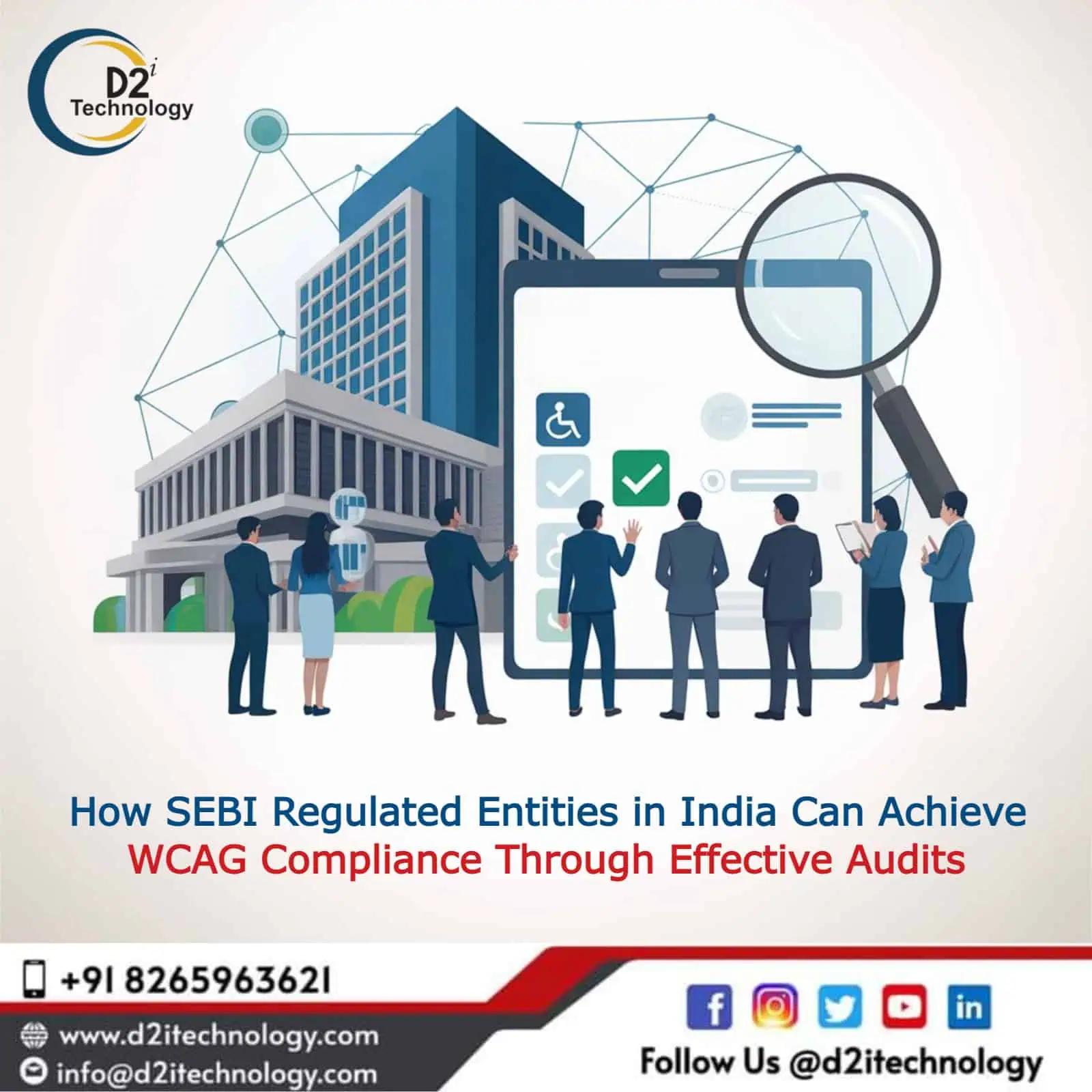
Digital accessibility is no longer optional—especially for financial institutions operating under regulatory bodies like SEBI. As more investors, analysts, and customers access financial information online, it becomes critical for companies to ensure that all users, including those with disabilities, can interact with their digital platforms without barriers.
For SEBI-regulated organizations—such as stockbrokers, mutual fund houses, investment platforms, portfolio managers, AMCs, R&T agents, and trading apps—failing to meet accessibility standards can lead to compliance risks, reputational damage, potential lawsuits, and customer churn.
The best way to ensure digital accessibility is through a WCAG Compliance Audit For SEBI Regulated Entities India, which evaluates whether web and mobile platforms meet globally accepted accessibility standards.
In this comprehensive guide, we explore why accessibility is essential for SEBI entities, what WCAG compliance involves, and how an effective accessibility audit can help organizations achieve full compliance.
Why Accessibility Matters for SEBI-Regulated Entities
1. Accessibility aligns with SEBI’s investor-first philosophy
SEBI’s mission is to protect investors and ensure fairness, transparency, and equal access to information. Accessibility directly supports this mission by ensuring that:
- People with visual, auditory, cognitive, or motor impairments can access market information
- Everyone can use trading applications without assistance
- All investors receive the same quality of experience
Financial services deal with sensitive, high-risk decision-making. Any barrier in accessing statements, charts, fund performance data, or trading features can severely impact users with disabilities.
2. Legal and policy pressures are increasing
While India’s legal framework—such as the Rights of Persons with Disabilities (RPwD) Act—already mandates accessibility, global regulatory bodies are also tightening scrutiny.
Although SEBI has not yet issued a formal accessibility mandate, the direction is clear: Digital inclusion is becoming a regulatory expectation, not a suggestion.
A proactive WCAG Compliance Audit For SEBI Regulated Entities India helps organizations future-proof themselves against emerging regulations and avoid last-minute mandatory transitions.
3. Reduces litigation risks
Globally, financial companies are among the top targets for accessibility lawsuits.
Banks, insurance companies, and investment platforms frequently face legal actions because inaccessible interfaces directly impact financial independence.
While Indian courts have seen limited accessibility lawsuits so far, they are increasing steadily. Being prepared with a WCAG Compliance Audit For SEBI Regulated Entities India minimizes legal exposure and protects the brand’s reputation.
4. Business growth through expanded investor base
Over 26.8 million people in India live with a disability (Census 2011), and the real number is significantly higher.
Accessible platforms attract:
- Users with disabilities
- Senior citizens
- People with temporary impairments (injury, low vision, etc.)
- Investors who prefer clean, user-friendly interfaces
Accessibility is good business—not just compliance.
Understanding WCAG – The Global Accessibility Standard
WCAG (Web Content Accessibility Guidelines), developed by the W3C, is the global benchmark for digital accessibility.
For SEBI entities building trading apps, financial dashboards, investment portals, and research tools, WCAG ensures that platforms are:
1. Perceivable
Information should be visible and usable for everyone, including users with screen readers, color blindness, or low vision.
2. Operable
Navigation must be smooth for keyboard-only users or people with motor disabilities.
3. Understandable
Financial data, forms, and instructions must be easy to follow.
4. Robust
Content must work with assistive technologies like screen readers, magnifiers, and voice navigation.
A WCAG Compliance Audit For SEBI Regulated Entities India evaluates all these aspects and identifies gaps that could block users.
Why SEBI Entities Often Fail Accessibility Standards
Through accessibility audits across the finance sector, the most common issues include:
1. Charts and graphs missing alternative descriptions
Financial dashboards heavily rely on:
- Stock charts
- NAV graphs
- Trend lines
- Heatmaps
Without proper accessibility support, screen reader users cannot read financial data.
2. Complex forms with poor labeling
KYC forms, login forms, investment application forms, and transaction pages often miss:
- Proper labels
- Error identification
- Field instructions
This makes financial processes inaccessible to many users.
3. Poor color contrast and unreadable UI
Many trading apps use:
- Low contrast colors
- Red/green indicators
- Tiny fonts
These are extremely challenging for people with low vision or color blindness.
4. Keyboard traps and broken navigation
Trading interfaces are often heavy with modals, tables, and shortcuts—failing to support keyboard navigation properly.
5. Inaccessible PDFs and reports
Annual reports, statements, account summaries, and research reports often aren’t accessible to screen readers.
A professional WCAG Compliance Audit For SEBI Regulated Entities India helps uncover these accessibility failures early and sets the foundation for remediation.
What Is a WCAG Compliance Audit and Why It Matters for SEBI Entities?
A WCAG compliance audit is a systematic evaluation of your digital platforms (websites, apps, dashboards, portals) to determine if they meet accessibility standards.
A complete audit includes:
- Automated scans using tools like Axe, Lighthouse, WAVE
- Manual testing by IAAP-certified accessibility testers
- Assistive technology testing using screen readers like NVDA, JAWS, VoiceOver
- Keyboard-only navigation testing
- Color contrast and visual design assessment
- Code-level inspection by accessibility developers
- Documentation of issues with severity levels
- Remediation guidance and consultation
- Verification (retesting) after fixes
- Accessibility certification report
For SEBI-regulated organizations, this process is essential for:
- Maintaining investor trust
- Meeting evolving regulatory expectations
- Ensuring equal access to financial information
- Reducing the risk of legal action
- Improving overall user experience
A structured WCAG Compliance Audit For SEBI Regulated Entities India ensures your digital assets comply with international accessibility standards.
Step-by-Step Guide: How SEBI Entities Can Achieve WCAG Compliance
Below is a clear, actionable process SEBI organizations can follow:
Step 1: Identify all digital assets requiring audit
This includes:
- Corporate website
- Trading platform (web/mobile)
- Customer dashboard
- Investor onboarding/KYC systems
- Research and reporting portals
- Mobile apps (iOS/Android)
- Any PDFs, reports, or downloadable documents
The scope must be fully documented before beginning the WCAG Compliance Audit For SEBI Regulated Entities India.
Step 2: Conduct baseline automated testing
Tools include:
- Google Lighthouse
- Axe DevTools
- WAVE
- Tenon
Automated tests detect around 40–50% of accessibility issues. This provides an initial overview but is not enough for compliance.
Step 3: Perform a full manual audit
This is the critical layer. IAAP-certified auditors test:
- Navigation and focus order
- Form labeling and error alerts
- Reading order
- Dynamic market data updates
- Accessibility of charts and graphs
- Screen reader behavior
- Keyboard traps
- Visual contrast issues
- Accessible alternatives for complex financial content
A professional WCAG Compliance Audit For SEBI Regulated Entities India heavily relies on manual testing because it uncovers the real barriers users face.
Step 4: Review code and architecture
Accessibility issues often originate in code:
- Incorrect ARIA usage
- Missing alt text
- Improper semantic HTML
- Dynamic elements not accessible
- Custom widgets not screen-reader friendly
Developers receive detailed remediation instructions.
Step 5: Fix issues with support from accessibility engineers
Most SEBI entities require support not only to find issues but also to fix them.
Accessibility developers should work closely with internal teams to ensure corrections follow WCAG guidelines.
Step 6: Retesting for confirmation
After fixes, auditors recheck all components to ensure issues are resolved.
Step 7: Receive a final WCAG compliance certification
A detailed report helps:
- Stakeholders
- Investors
- Regulatory bodies
- Internal teams
It proves your organization has completed a WCAG Compliance Audit For SEBI Regulated Entities India and meets accessibility guidelines.
Benefits of Accessibility Compliance for SEBI Regulated Entities
1. Improved Investor Experience
Accessible platforms build trust and loyalty.
2. Higher adoption of digital financial products
Users with disabilities and senior citizens often drop off inaccessible platforms.
3. Better brand reputation
Accessibility shows responsibility, inclusivity, and innovation.
4. Lower long-term development costs
Fixing accessibility early saves up to 60% of future remediation effort.
5. Reduced litigation and compliance risk
Accessibility significantly lowers legal exposure.
6. Stronger global credibility
WCAG-compliant financial platforms align with worldwide accessibility expectations.
Choosing the Right Partner for WCAG Compliance
SEBI entities should partner with teams who are:
- IAAP-certified
- Experienced in accessibility audits
- Skilled in making complex financial interfaces accessible
- Strong in both testing and remediation
- Familiar with SEBI-regulated ecosystem and data sensitivity
A good accessibility partner helps with:
- Full WCAG audits
- Developer support
- Design accessibility
- Remediation
- Certification
- Continuous monitoring
This ensures lasting success—not just a temporary compliance exercise.
Conclusion: Accessibility Is Not an Obligation—It’s an Opportunity
SEBI-regulated companies must understand that accessibility:
- Is not just about meeting regulations
- Is not just for people with disabilities
- Is not only for avoiding risks
It is about delivering a better digital experience for everyone.
A complete WCAG Compliance Audit For SEBI Regulated Entities India ensures your digital ecosystem is future-ready, inclusive, and aligned with global best practices.
Organizations that adopt accessibility early position themselves as leaders in trust, innovation, and investor-first thinking.
Need Help Achieving WCAG Compliance?
If your organization is looking for an expert team to handle accessibility audits, testing, remediation, and certification, D2i Technology can help.
With IAAP-certified accessibility testers and developers, and deep experience across finance, healthcare, eLearning, and enterprise applications, we provide end-to-end accessibility solutions—including complete WCAG Compliance Audit For SEBI Regulated Entities India.
Feel free to reach out anytime for support or collaboration.