- AI Development
- April 20, 2026
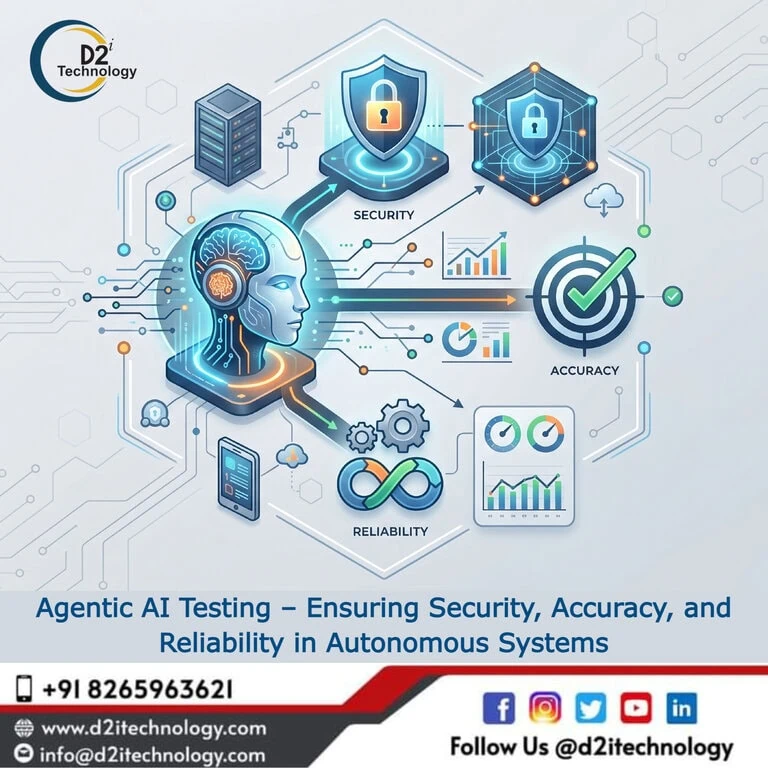
Agentic AI Testing – Ensuring Security, Accuracy, and Reliability in Autonomous Systems
Introduction
The rise of Agentic AI is transforming how applications operate. Unlike traditional systems that follow predefined rules, AI agents can reason, act, and make decisions autonomously. They interact with APIs, process dynamic inputs, and execute tasks without constant human supervision.
While this evolution unlocks immense potential, it also introduces a new layer of complexity in testing. Traditional QA practices are no longer sufficient. Testing an AI agent is not just about validating outputs—it is about ensuring behavior, safety, compliance, and reliability in unpredictable environments.
Agentic AI testing is emerging as a critical discipline, especially for organizations building production-grade AI-powered systems.
This blog explores how to approach testing AI agents comprehensively, covering key areas such as accuracy, hallucination detection, security, guardrails, and compliance.
Understanding Agentic AI Testing
Agentic AI systems are fundamentally different from traditional applications. They are dynamic, context-aware, and capable of taking actions based on goals rather than instructions.
This means:
- Outputs are not always deterministic
- Behavior changes based on context
- Interactions span multiple systems
Because of this, testing must go beyond simple input-output validation.
Agentic AI testing focuses on:
- Behavioral correctness
- Safety and compliance
- Robustness under varied scenarios
- System-level interactions
Read Also This Blog: Best Software Development Company in USA for Web, Mobile & AI Applications
1. Responsible AI and Regulatory Compliance
One of the most critical aspects of testing AI agents is ensuring they comply with ethical and regulatory standards.
AI systems must:
- Avoid biased or discriminatory responses
- Respect privacy and data protection laws
- Follow domain-specific regulations
For example:
- Healthcare AI must comply with patient data regulations
- Financial AI must adhere to transaction and audit requirements
Testing should include:
- Bias detection scenarios
- Sensitive data handling validation
- Compliance rule enforcement
Responsible AI is not optional—it is a foundational requirement for production systems.
2. Hallucination Checks
Hallucination is one of the most widely discussed challenges in AI systems.
It refers to situations where the AI generates:
- Incorrect information
- Fabricated facts
- Misleading responses
In an enterprise setting, hallucinations can lead to:
- Wrong business decisions
- Loss of trust
- Compliance risks
Testing for hallucinations involves:
- Validating responses against trusted data sources
- Creating adversarial prompts
- Checking consistency across similar queries
A robust testing framework should identify:
- When the AI is uncertain
- When it should decline to answer
- When it needs to fetch verified data
3. Accuracy of Responses
Accuracy remains a fundamental metric in AI testing.
However, measuring accuracy in AI systems is more complex than in traditional systems.
Key considerations include:
- Contextual correctness
- Relevance to user intent
- Domain-specific precision
Testing strategies:
- Benchmark datasets
- Ground truth comparison
- Scenario-based validation
For example:
If an AI agent provides financial advice, even a small inaccuracy can have serious consequences.
Accuracy testing must be continuous and iterative, especially as models evolve.
4. Quality of Responses
Beyond accuracy, response quality plays a crucial role in user experience.
A response may be technically correct but still fail if it is:
- Hard to understand
- Poorly structured
- Lacking context
Quality testing includes:
- Clarity and readability
- Tone and professionalism
- Completeness of information
For conversational agents, quality also involves:
- Natural flow of dialogue
- Context retention across interactions
High-quality responses build trust and improve adoption.
5. Testing Utterances vs Conversations
Traditional testing often focuses on single inputs (utterances). However, AI agents operate in conversational contexts.
This introduces new challenges:
- Context management
- Multi-turn reasoning
- Memory handling
Testing must cover:
- Individual queries
- Multi-step conversations
- Long interaction flows
Example scenarios:
- Follow-up questions
- Context switching
- Interruptions
A well-tested AI agent should:
- Maintain context accurately
- Avoid contradictions
- Handle incomplete inputs gracefully
6. Toxicity and Safety Checks
AI systems must be safe for users.
Toxicity testing ensures that the agent:
- Does not generate harmful or offensive content
- Handles abusive inputs responsibly
- Maintains a neutral and respectful tone
Testing should include:
- Edge-case prompts
- Adversarial inputs
- Stress testing with harmful language
The goal is not just to block harmful content but to:
- Respond appropriately
- De-escalate situations
- Maintain brand reputation
7. Functional Testing of AI Agents
Even though AI systems are dynamic, they still perform functional tasks.
Examples:
- Triggering workflows
- Calling APIs
- Updating databases
Functional testing ensures:
- Correct execution of actions
- Proper integration with backend systems
- Error handling
Key areas:
- API response validation
- Workflow completion
- System integration
This layer bridges traditional QA with AI-specific testing.
8. Guardrails and Safety Mechanisms
Guardrails are essential for controlling AI behavior.
They define boundaries within which the AI can operate safely.
Examples include:
- Restricting sensitive actions
- Blocking unsafe queries
- Enforcing compliance rules
Testing guardrails involves:
- Verifying restrictions
- Testing bypass attempts
- Ensuring consistent enforcement
A strong guardrail system should:
- Prevent misuse
- Detect anomalies
- Adapt to new threats
Challenges in Agentic AI Testing
Testing AI agents is not straightforward.
Some of the key challenges include:
1. Non-Deterministic Behavior
The same input may produce different outputs.
2. Lack of Clear Test Cases
Traditional test cases may not apply.
3. Rapid Model Evolution
Models change frequently, requiring continuous testing.
4. Complex System Interactions
AI agents interact with multiple systems simultaneously.
5. Security Risks
Agents can perform unintended actions if compromised.
Best Practices for Effective AI Agent Testing
To address these challenges, organizations should adopt structured practices.
- Combine Manual and Automated Testing: Use human judgment alongside automated tools.
- Build Scenario-Based Test Suites: Focus on real-world use cases.
- Implement Continuous Monitoring: Track behavior in production.
- Use Feedback Loops: Improve models based on user feedback.
- Integrate Security Testing Early: Shift security left in the development process.
For a deeper perspective on how manual and automated approaches compare, see our guide on manual vs automation testing.
Role of QA Teams in the AI Era
QA teams are evolving from testers to quality enablers.
In AI-driven systems, they must:
- Understand AI behavior
- Design intelligent test scenarios
- Collaborate with data scientists
This requires new skills:
- Prompt engineering
- Data validation
- AI risk assessment
Understanding the future of software quality and automation testing is essential for QA professionals who want to stay relevant in an AI-first world.
Future of Agentic AI Testing
As AI systems become more advanced, testing will also evolve.
Key trends include:
- AI-driven testing tools
- Automated anomaly detection
- Self-healing systems
Testing will move from:
Reactive → Proactive → Predictive
Organizations that invest in AI testing today will gain a competitive advantage.
Conclusion
Agentic AI Testing is redefining how applications operate. It brings intelligence, automation, and efficiency—but also introduces new risks.
Testing is no longer just about verifying functionality. It is about ensuring trust, safety, and reliability in systems that think and act autonomously.
A comprehensive testing strategy must include:
- Accuracy validation
- Hallucination detection
- Security and guardrails
- Functional and conversational testing
As AI adoption grows, the importance of robust testing frameworks will only increase.
Organizations that prioritize AI testing today will be better prepared to build secure, scalable, and trustworthy systems for the future.
Call to Action
If you are building or deploying AI agents in your applications, now is the time to evaluate your testing strategy.
At D2i Technology, we help businesses:
- Test AI agents end-to-end
- Validate security and compliance
- Improve quality and reliability
Reach out for a discussion or audit to ensure your AI systems are ready for real-world challenges.
Frequently Asked Questions
Ready to Secure Your AI Systems?
At D2i Technology, we help businesses test AI agents end-to-end — validating security, compliance, accuracy, and reliability so your autonomous systems are production-ready.