- AI Governance & Security
- April 15, 2026
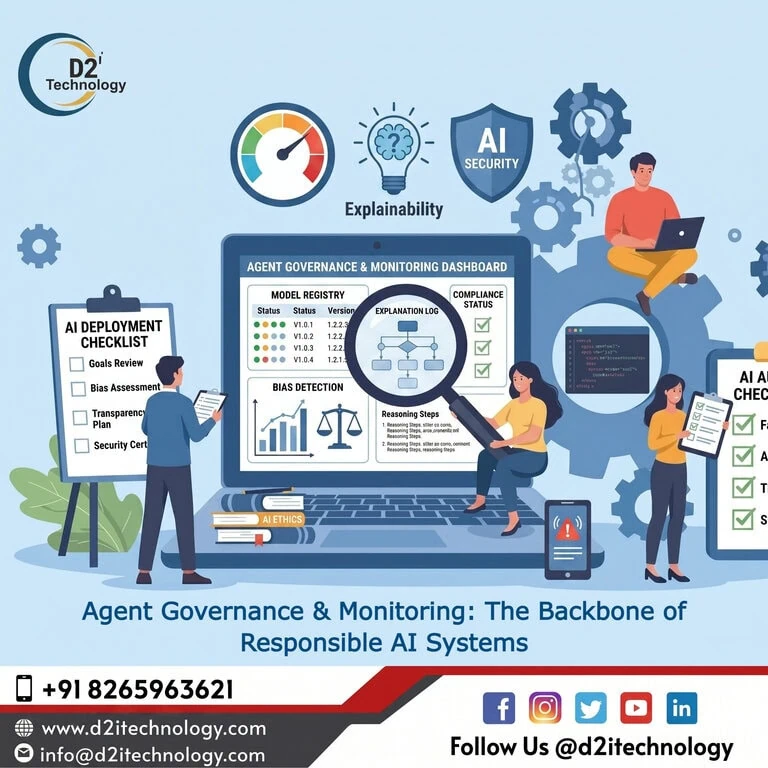
Agent Governance & Monitoring: The Backbone of Responsible AI Systems
The Shift from Automation to Autonomy
AI agents are rapidly transforming how modern digital systems operate. What started as simple automation has now evolved into autonomous systems capable of making decisions, interacting with APIs, and executing workflows independently.
This shift introduces significant opportunity—but also substantial risk. Unlike traditional systems that follow predefined rules, AI agents operate in a dynamic and non-deterministic manner. They interpret context, adapt behavior, and make decisions in real time.
Without structured control, this flexibility can lead to unpredictable outcomes. This is why agent governance and AI monitoring are no longer optional—they are foundational requirements for any organization deploying AI systems at scale.
Why Agent Governance is Critical
Agent governance establishes the boundaries within which AI systems operate. It ensures that agents act in alignment with business objectives, security standards, and regulatory requirements.
In the absence of governance, organizations face multiple risks. Agents may execute unauthorized actions, access or expose sensitive data, and create systems that are difficult to audit or trust. Over time, this erodes both operational stability and stakeholder confidence.
Effective governance provides structure, accountability, and control. It enables organizations to leverage AI capabilities while maintaining compliance, security, and reliability.
Key Risks in Uncontrolled AI Systems
One of the most immediate risks is unauthorized action. AI agents interacting with APIs can trigger workflows or perform operations beyond their intended scope. Even minor misinterpretations can result in significant system impact.
Data exposure is another critical concern. AI agents frequently process sensitive information, including user data and internal business logic. Without proper safeguards, this information can be inadvertently exposed or mishandled.
Lack of accountability further complicates the problem. When agents act autonomously, organizations must be able to trace decisions and actions. Without proper monitoring and logging, identifying root causes becomes extremely difficult.
Performance and cost inefficiencies also emerge in poorly governed systems. Agents can over-utilize resources, create redundant processes, and significantly increase operational costs.
Finally, compliance risks are particularly relevant in regulated industries. Without proper controls, AI systems can violate data protection and governance standards, leading to legal and financial consequences.
Core Components of Agent Governance
A robust governance framework begins with identity and access control. Every AI agent must operate with clearly defined permissions, following the principle of least privilege. This limits the scope of potential damage in case of failure or misuse.
Guardrails and constraints are equally important. Organizations must explicitly define what agents are allowed to do, which systems they can access, and what data they can process. These constraints prevent unintended behavior and reduce overall risk.
Approval workflows introduce an additional layer of control. Not all actions should be fully autonomous, especially those involving financial transactions, sensitive data, or critical system changes. Human oversight remains essential in high-risk scenarios.
Auditability is a fundamental requirement. Every action taken by an agent should be logged and traceable. This includes input context, decision paths, actions executed, and outputs generated. Such transparency is essential for debugging, compliance, and trust.
Policy enforcement ensures consistency. Governance policies must be clearly defined, systematically enforced, and continuously updated to reflect evolving risks and requirements.
The Role of Monitoring in AI Systems
While governance defines the rules, monitoring ensures that those rules are consistently followed. Without effective monitoring, governance frameworks cannot be enforced in practice.
Monitoring provides visibility into agent behavior, system performance, and potential risks. It enables organizations to detect anomalies, respond to incidents, and continuously improve system reliability.
Key Areas of Monitoring
Monitoring agent behavior is essential to understand how systems operate in real-world conditions. Tracking actions, decision patterns, and execution frequency helps identify anomalies and inefficiencies.
Input and output monitoring plays a critical role in maintaining system integrity. By analyzing prompts and responses, organizations can detect misuse, prevent prompt injection attacks, and ensure outputs remain aligned with expectations.
System performance monitoring ensures that agents do not degrade application performance or introduce latency. It also helps maintain scalability and user experience.
Security monitoring focuses on identifying unauthorized access attempts, suspicious activities, and policy violations. This is particularly important in environments where agents interact with multiple systems and data sources.
Cost monitoring is often overlooked but increasingly important. AI systems can quickly increase infrastructure usage and associated costs. Continuous tracking helps maintain operational efficiency.
Building an Effective Governance and Monitoring Framework
Organizations should begin by clearly defining use cases. Understanding what agents are expected to do and what systems they will interact with provides a foundation for risk assessment.
Risk classification is the next step. Not all use cases carry the same level of risk, and governance controls should be applied accordingly. High-risk scenarios require stricter policies and oversight.
Guardrails must then be implemented to define boundaries and restrict actions. This includes limiting API access, controlling data flow, and enforcing execution constraints.
Comprehensive logging and monitoring should be enabled to provide full visibility into system behavior. Real-time alerts should be configured to detect anomalies and enable rapid response.
Finally, governance frameworks must be continuously reviewed and refined. AI systems evolve over time, and governance strategies must adapt accordingly.
Best Practices for Enterprise Adoption
Organizations should adopt a phased approach when implementing AI agents. Starting with controlled use cases allows teams to understand system behavior and refine governance mechanisms.
Combining AI capabilities with human oversight is critical. Fully autonomous systems may offer efficiency but introduce significant risk. A hybrid approach ensures better control and accountability.
Securing API integrations is another essential practice. Access should be authenticated, limited, and continuously monitored.
Testing for edge cases is equally important. Scenarios such as prompt injection, unexpected inputs, and failure conditions must be evaluated thoroughly.
Documentation should not be overlooked. Clear documentation of policies, workflows, and system behavior ensures consistency and supports long-term scalability.
The Future of Agent Governance
As AI adoption increases, governance and monitoring frameworks will become more sophisticated. Organizations will move toward automated policy enforcement, adaptive governance models, and AI-driven monitoring systems.
We can expect the emergence of self-monitoring agents, dynamic risk assessment models, and tighter integration with DevOps and security ecosystems.
However, the fundamental principle will remain unchanged. The success of AI systems will depend not on their capabilities, but on the level of control organizations maintain over them.
Conclusion
AI agents represent a significant advancement in how systems operate, offering the potential to improve efficiency, automate complex workflows, and enhance decision-making.
However, without structured governance and continuous monitoring, these same systems can introduce significant operational, security, and compliance risks.
Organizations that succeed in this space will not be those that adopt AI the fastest, but those that implement it with discipline, control, and accountability.
Agent governance and monitoring are not supporting functions—they are the foundation of responsible AI systems.
Need Support
If you are exploring or implementing AI agents, establishing a strong governance and monitoring framework from the outset is essential.
D2i Technology works with organizations to design secure, scalable, and compliant AI systems, ensuring that innovation does not come at the cost of control.
A structured approach early in the lifecycle can prevent significant challenges later.
Frequently Asked Questions
Ready to Secure Your AI Future?
Establishing a strong governance and monitoring framework early in the AI lifecycle is essential to prevent significant challenges later. D2i Technology works with organizations to design secure, scalable, and compliant AI systems, ensuring innovation never comes at the cost of control.