- AI Development
- April 22, 2026
Agentic AI in Web Applications: The Next Big Security Risk?
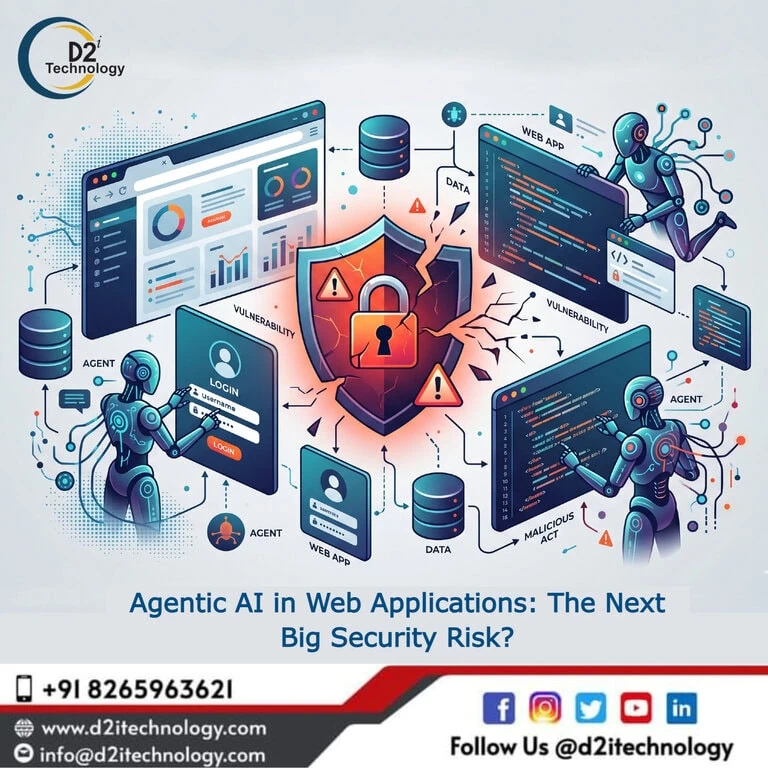
The rapid advancement of artificial intelligence is fundamentally changing how modern web applications are designed and operated. What was once limited to automation and assistance is now evolving into systems capable of independent reasoning and decision-making.
This new class of systems, often referred to as Agentic AI, introduces a powerful shift. These AI agents are not just responding to inputs; they are planning actions, interacting with APIs, and executing tasks with minimal human intervention.
While this brings significant efficiency and innovation, it also introduces a new category of security risks that many organizations are not fully prepared to handle. As AI agents become deeply integrated into web applications, they create unpredictable attack surfaces that traditional security models were never designed to address.
What is Agentic AI in Web Applications?
Agentic AI refers to autonomous systems that can make decisions and perform actions based on goals rather than predefined instructions. These systems are capable of interpreting context, interacting with external systems, and continuously adapting their behavior.
In web applications, this typically includes AI agents that:
- Interact with APIs and backend systems
- Execute workflows automatically
- Retrieve and process data from multiple sources
- Perform actions such as sending emails, updating databases, or triggering transactions
Examples include intelligent customer support systems, automated DevOps assistants, and AI-driven financial tools. For a broader perspective on how AI is reshaping development, see our overview ofagent governance and AI monitoring.
Unlike traditional applications, these systems do not operate within rigid, predictable boundaries. Their dynamic nature is what makes them powerful—and also what makes them risky.
Why Agentic AI Expands the Attack Surface
Traditional web applications operate within defined workflows. Inputs are validated, outputs are predictable, and system behavior can be tested against known scenarios.
Agentic AI disrupts this model in several important ways.
First, decision-making becomes dynamic. AI agents respond to context rather than fixed rules, making their behavior harder to predict and test. This introduces uncertainty into system operations.
Second, these systems rely heavily on APIs. Every interaction with an internal or external API becomes a potential point of vulnerability. The more integrations an application has, the larger its exposure.
Third, AI agents often require access to multiple systems and datasets. In many cases, they are granted broad permissions to perform their tasks effectively. This increases the impact of any compromise.
Finally, traditional security boundaries become less effective. Firewalls, access controls, and rule-based protections assume predictable behavior. Agentic AI operates across these boundaries, often in ways that are difficult to monitor using conventional tools.
Major Security Risks in Agentic AI Systems
Prompt Injection Attacks
One of the most significant risks in AI-driven applications is prompt injection. This occurs when an attacker manipulates the input provided to an AI system in order to influence its behavior.
For example, an attacker might attempt to override system instructions or trick the AI into revealing sensitive information. Because AI models are designed to interpret and respond to natural language, they can be susceptible to cleverly crafted inputs.
The challenge with prompt injection is that it bypasses traditional input validation techniques. Instead of exploiting code, it exploits reasoning.
API Misuse by AI Agents
APIs are central to the functioning of Agentic AI systems. They allow agents to retrieve data, perform actions, and interact with other services.
However, without strict controls, AI agents can misuse APIs in unintended ways. This may include calling unauthorized endpoints, performing actions outside their intended scope, or exposing sensitive data.
Common issues include excessive permissions, weak authentication mechanisms, and lack of monitoring. When combined, these vulnerabilities can lead to serious security incidents.
Read Also This Blog: Top Web Development Companies Using AI, Cloud & Modern Tech
Unauthorized Actions by Autonomous Agents
Agentic AI systems are designed to take action. They can update records, trigger workflows, and execute transactions.
If an agent is compromised or behaves unexpectedly, it can perform actions that were never intended. This could include deleting data, modifying configurations, or initiating financial transactions.
The key concern is scale. Unlike human errors, AI-driven actions can occur rapidly and repeatedly, amplifying the impact.
Data Leakage Risks
AI agents often process large volumes of sensitive information, including user data and internal business data.
If not properly secured, this data can be exposed through responses, logs, or API interactions. In some cases, the AI system itself may inadvertently reveal information that should remain confidential.
This risk is particularly concerning in regulated industries such as healthcare and finance, where data protection is critical.
Dependency and Supply Chain Risks
Modern applications rely on a complex ecosystem of third-party libraries, APIs, and services. Agentic AI systems are no exception.
Each dependency introduces a potential point of failure. A vulnerability in a widely used library or service can have cascading effects across multiple systems.
This makes supply chain security an essential component of any AI security strategy.
How to Secure Agentic AI in Web Applications
Securing Agentic AI systems requires a shift in approach. Traditional security testing measures must be supplemented with strategies designed specifically for dynamic, autonomous systems.
Strengthen API Security
Ensure that all API interactions are secured using strong authentication mechanisms such as OAuth or JWT. Access should be restricted based on roles, and rate limiting should be implemented to prevent abuse.
Apply the Principle of Least Privilege
AI agents should only have access to the systems and data they need to perform their tasks. Over-permissioning increases the potential impact of any compromise.
Protect Against Prompt Injection
Input validation must go beyond traditional techniques. It is important to implement safeguards that prevent AI systems from being manipulated through malicious prompts. This may include using predefined system instructions and restricting how inputs are interpreted.
Monitor AI Behavior Continuously
Visibility is critical. Organizations should monitor how AI agents interact with systems, track API usage, and identify unusual patterns of behavior. Logging and alerting systems should be in place to detect anomalies early. See how agent governance and AI monitoring frameworks can support this effort.
Secure Secrets and Rotate Keys
Sensitive credentials such as API keys and tokens must be stored securely. Regular key rotation reduces the risk of long-term exposure, and short-lived tokens should be used wherever possible.
Conduct Regular Security Audits
Security should be treated as an ongoing process. Regular audits, including both manual testing and automated testing, can help identify vulnerabilities before they are exploited.
Adopt a Zero Trust Approach
In a system driven by AI, trust must be continuously validated. Every interaction, whether internal or external, should be verified. No component should be assumed to be inherently secure.
The Future of Cybersecurity in AI-Driven Applications
As Agentic AI becomes more prevalent, cybersecurity will need to evolve alongside it.
We are already seeing the emergence of AI-driven security tools capable of detecting and responding to threats in real time. In the future, it is likely that AI will play a central role in both offensive and defensive cybersecurity strategies.
Organizations that adopt a proactive approach will be better positioned to manage these risks. This includes investing in secure development practices, building robust monitoring systems, and staying informed about emerging threats.
Key Takeaways
Agentic AI represents a significant advancement in how applications operate, but it also introduces new and complex security challenges.
The dynamic nature of AI agents makes them difficult to predict and control. Their reliance on APIs and access to multiple systems increases the potential impact of any vulnerability.
Traditional security models are no longer sufficient on their own. Organizations must adopt new strategies that account for the unique characteristics of AI-driven systems.
Let’s Secure Your AI-Powered Applications
As businesses continue to integrate AI into their web applications, ensuring security must be a top priority.
D2i Technology helps organizations strengthen their systems through application security audits, AI integration reviews, and comprehensive QA and testing services.
If you are looking to assess the security of your web applications or AI systems, it is worth starting with a structured audit and expert review.
Final Thought
Agentic AI is not just another technological upgrade. It represents a shift in how systems think, act, and interact.
With this shift comes responsibility. The organizations that succeed will be those that not only adopt AI but also understand how to secure it effectively.
The real challenge is not building intelligent systems. It is building systems that remain secure, reliable, and trustworthy in an increasingly autonomous world.
Frequently Asked Questions
Let's Secure Your AI-Powered Applications
D2i Technology helps businesses strengthen their AI-driven web applications through application security audits, AI integration reviews, penetration testing, and comprehensive QA services. Don't let agentic AI become your biggest vulnerability.